The trades have a reputation for adopting tech slowly. That reputation is now out of date. Recent industry research shows AI use among home service operators is climbing from roughly 17% to about 38%, with measurable business impact in a single year, with active use near 40%. Among contractors already using AI, about 57% say automation helped their business grow, and shops running two or more AI tools report growth more often than those using just one.
The macro picture matches. McKinsey reports that 88% of organizations now use AI in at least one function and that mature adopters see customer satisfaction rise by 15% to 20% and revenue by 5% to 8%. The conversational AI market alone is projected to grow from about $3.7 billion in 2022 to north of $100 billion by 2032, at roughly a 40% annual rate.
The throughline is consistent: the winning use of AI in the trades is not replacing skilled people; it is removing the repetitive office work that keeps trained people away from customers, jobs, and decisions.
Most electricians meet AI through general-purpose tools like ChatGPT, Gemini, Copilot, or Claude. They are genuinely useful for drafting job descriptions, writing marketing copy, summarizing documents, or replying to a review. But three limits show up fast once you try to run a business on them.
They do not know your business. A general chatbot has no built-in access to your customers, job history, pricing, certifications, or schedule. You can paste data in, but that means switching systems and double-checking accuracy every time.
They cannot take action. They can help you think through a task or write text, but on their own, they cannot book a job, update a schedule, apply a pricing rule, or move work forward in your field service system. They assist with individual tasks rather than run end-to-end workflows.
Integration is where it gets real. Once you care about efficiency across scheduling, estimating, and service delivery, AI has to connect to the systems that run your jobs. Tools that sit outside your core software still require additional steps and manual oversight to turn an insight into action.
The practical question is how to move from AI that assists with one-off tasks to AI that actually does the work. That takes AI built for the trade and wired into your operation, not a browser tab.
Here is the part most guides skip: an actual map of the tools you can turn on this year, organized by the three buckets above. Not every shop needs every tool. The goal is to know what exists so you can match a tool to your biggest time drain.
AI in the systems you install (a growing revenue line)
This bucket is different from the others: it is not software you buy to run your shop, it is AI-enabled equipment your customers want installed, and knowing it turns you into the contractor who can spec and sell it.
Smart panels and load management (SPAN, Lumin, Leviton Load Center). AI-driven panels monitor and shift circuit-level load automatically, which matters more every year as homes add EV chargers and heat pumps to limited service. Installing and configuring these is billable work most shops are not yet fluent in.
Home energy management and smart thermostats (ecobee, Google Nest, ENERGY STAR devices). These learn usage patterns to cut bills and, on some utilities, feed power back during peak demand. Pairing them with panel and metering work is a natural upsell.
Building management systems and IoT sensors (commercial). On commercial jobs, AI-backed BMS platforms and sensors optimize lighting, HVAC-electrical loads, and occupancy. Contractors who can wire and commission them win the higher-margin work.
Solar, storage, and EV charging with smart controls. AI orchestrates when batteries charge, discharge, or sell back to the grid. As these installs grow, the electricians who understand the control layer, not just the wiring, command better rates.
You will not "adopt" these the way you adopt software, but they are the fastest-growing part of the trade's AI story, and being the shop that confidently installs them is its own competitive edge.
AI that assists you on the job
These tools ride along with the technician, on a phone, tablet, or laptop.
General-purpose assistants (ChatGPT, Claude, Gemini, Copilot). The cheapest on-ramp, free to about $20 per month. They shine at writing: scopes of work, estimate follow-up emails, service agreements, safety checklists, turning rough field notes into clean customer updates, and explaining NEC sections in plain English. There is even a dedicated "Electrician" GPT for trade questions. They will not book a job or answer your phone, but they save hours of paperwork a week.
Voice note capture (Wispr Flow and similar). Speak your job notes instead of typing them, useful when your hands are in a panel. The clean text drops into your other tools.
Code and calculation lookup (CodeGenie, ElectriCalc Pro). Searchable NEC databases, some with offline mode for basements and crawl spaces, plus voice search and inspection-prep checklists for hands-free reference.
Field knowledge bases (Drawer AI). Your SOPs, wiring diagrams, and troubleshooting steps become an AI-searchable system, so a junior tech can look up breaker diagnostics or an EV charger install without calling a senior electrician.
Exam and training prep (Dakota Prep). Adaptive, AI-driven NEC study for apprentices and journeymen working toward a license.
AI for design, takeoff, and estimating
Estimating is where AI is moving fastest for contractors who bid.
Service-work estimating (QuoteIQ). Turns a plain job description like "200-amp panel replacement, permit included" into a priced quote in seconds. Its AI Estimator is bundled into a full field service platform starting around $29.99 per month, which makes it a fit for solo and residential service shops.
Commercial blueprint takeoff (STACK, Togal.AI, Trimble AccuBid Anywhere, McCormick Systems). For contractors bidding from plans, these use AI symbol and plan recognition to speed takeoff. STACK runs around $2,999 per year, Togal.AI roughly $199 to $299 per user per month, and McCormick brings 55,000-plus items and NECA labor units at about $300 per month. BuildOps research has cited AI estimating cutting material-calculation errors by about 35%.
AI that runs the business
This is the bucket with the fastest payback, and it splits into three groups.
Field service platforms with AI built in. These run your whole operation and are layering AI on top:
ServiceTitan (Titan Intelligence). Built for established and enterprise shops. Price Insights shows how your rates compare to your region, and the Job Value Predictor optimizes the dispatch board for profit. Expect roughly $245 to $500 per technician per month plus a real implementation project.
Jobber. The most widely used platform for small home-service shops, with AI woven in rather than bolted on: CSR AI handles inbound chat, Coach AI acts as a business advisor, Analyst AI answers plain-English reporting questions, and Marketing AI writes campaigns. A 24/7 AI Receptionist is available as an add-on. Base plans start around $39 per month.
Workiz. Includes a Genius AI toolset, with Genius Answering (AI call handling) sold separately at roughly $200 per month.
BuildOps. Commercial and multi-property focus, with agentic dispatch that matches a licensed tech to a job by certification and proximity, predictive alerts that flag failing equipment, and AI notetaking in the mobile app.
Housecall Pro, FieldPulse, Fieldproxy, Knowify. Other capable platforms adding AI scheduling, documentation, and dispatch; several offer 14-day trials.
A quick cost warning: on most mid-market platforms, the AI features are add-ons, not included. Jobber's AI Receptionist and Workiz Genius Answering both cost extra on top of the base plan, a difference that can run $1,200 or more a year. Always confirm whether the AI you want is on your plan or billed separately before you sign.
AI customer messaging and reviews. Tools like Podium (from about $399 per month) use AI to speed lead response, request reviews, and handle customer messaging, and integrate with platforms like ServiceTitan. Powerful for a growing shop, though pricey for a solo operator.
The AI front desk. The highest-return category, because it plugs the leak that costs the most: missed calls and dropped follow-up. It comes in two flavors. Some platforms build it in (Jobber's AI Receptionist, Workiz Genius Answering, Podium's AI answering), which is great if you already live in that platform. The other flavor is a platform-agnostic front desk that sits atop whatever CRM or field service system you already use, capturing every call, text, and web chat without forcing you to switch tools. That is where CloseCrew fits, covered below.
Tool | Category | Starting price | Best for |
|---|
ChatGPT / Claude / Gemini | General-purpose | Free to ~$20/mo | Writing, code explanations, proposals |
Wispr Flow | Voice notes | ~$12/mo | Hands-free field notes |
CodeGenie / ElectriCalc Pro | Code lookup | Low-cost apps | NEC reference on site |
Drawer AI | Field knowledge base | Quote-based | SOPs and diagrams for techs |
QuoteIQ | FSM + AI estimating | ~$29.99/mo | Solo and residential service estimating |
Jobber (AI suite) | FSM platform | ~$39/mo + AI add-ons | All-in-one small shop |
ServiceTitan (Titan Intelligence) | FSM platform | ~$245 to $500/tech/mo | Established and enterprise shops |
BuildOps | FSM platform | Quote-based | Commercial and multi-property |
STACK / Togal.AI / Trimble AccuBid | AI takeoff and estimating | ~$199/mo to ~$3K/yr | Commercial blueprint bidding |
Podium | Messaging and reviews | ~$399/mo | Reviews and customer messaging |
CloseCrew (Larry) | AI front desk | Add-on to your stack | Capturing calls and leads on any platform |
Prices are 2026 figures from each vendor and recent reviews, and change often. Confirm current pricing and whether AI is included or an add-on before you buy.
The best trade AI shares two traits. First, it is trained on trade-specific data and workflows, so it understands that "panel upgrade," "service call," and "emergency" mean different things and route differently. A generic prompt does not know that a dead panel is urgent. Second, it takes action within your systems rather than just suggesting one, booking the job, logging the details, and sending the confirmation without any human re-keying.
That combination is what turns AI from a clever helper into a digital teammate. And for most electrical shops, the highest-value place to start is the front desk.
Here is the uncomfortable math behind why. Industry research from Invoca and others finds that home service businesses miss anywhere from a quarter to more than 60% of inbound calls, that 85% of callers who reach voicemail never call back, and that around 78% of customers simply hire the first contractor who answers. Each missed call is worth roughly $1,200, so a shop missing five to ten calls a week is quietly losing $45,000 to $120,000 a year. No amount of dispatch optimization helps a call that never got answered.
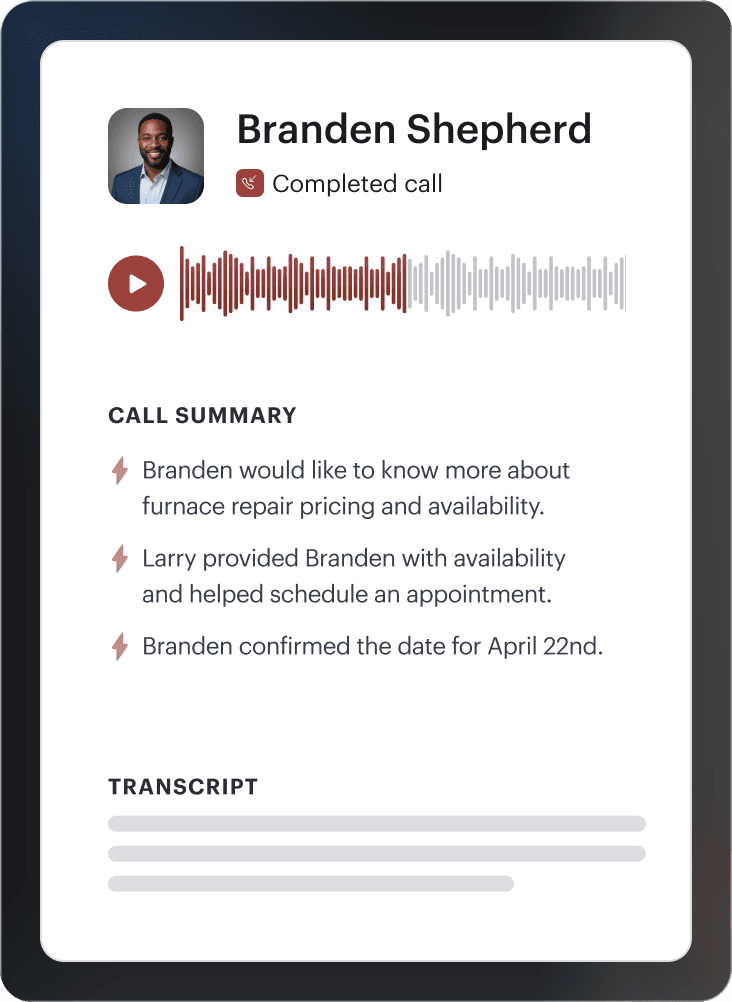
CloseCrew closes that gap. Larry, CloseCrew's AI employee, is a trade-specific AI focused on the part of the business that leaks the most revenue: the phone and the follow-up. It is not a CRM or a dispatch board; it is the AI front desk that sits on top of whatever you already run. Here is what it does.
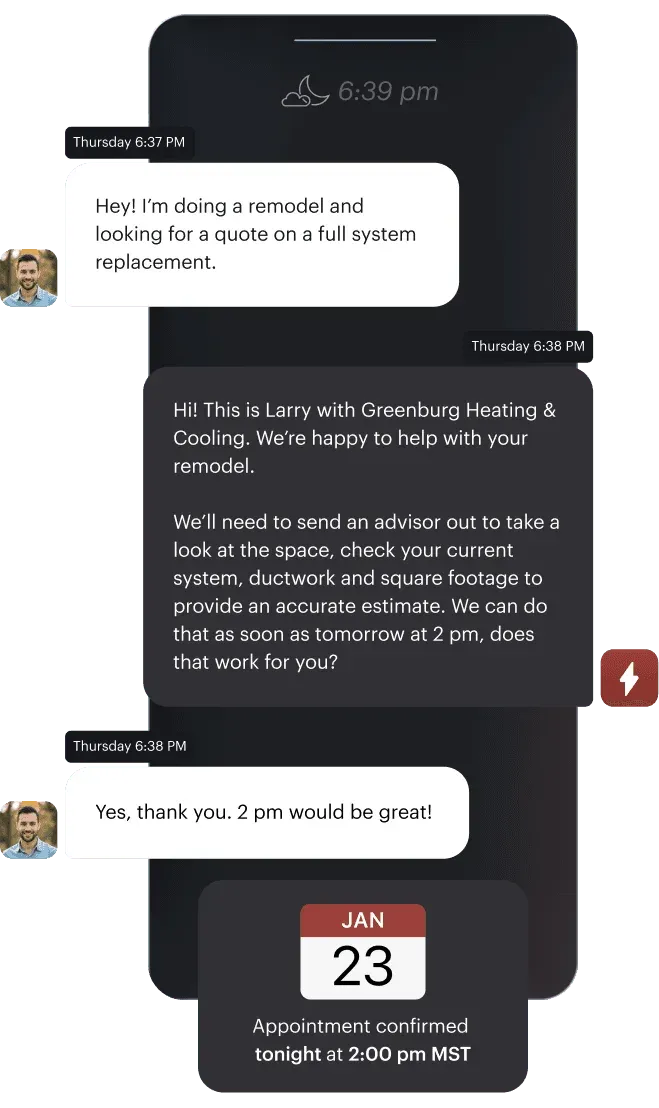
1. Answers every call, text, and web chat, 24/7. No voicemail, no busy signal, no after-hours gap. Larry handles routine intake in natural conversation, in English and Spanish, and modern voice AI is convincing enough that most callers in blind tests cannot tell it is not a human.
2. Qualifies and books straight into your schedule. Larry asks the right intake questions, qualifies the lead against your service rules, books the job directly into your calendar, and then sends a confirmation to reduce no-shows. Electrical contractors adopting voice AI have reported booking rates climbing from the typical 20 to 25 percent range into the 35 to 50 percent range.
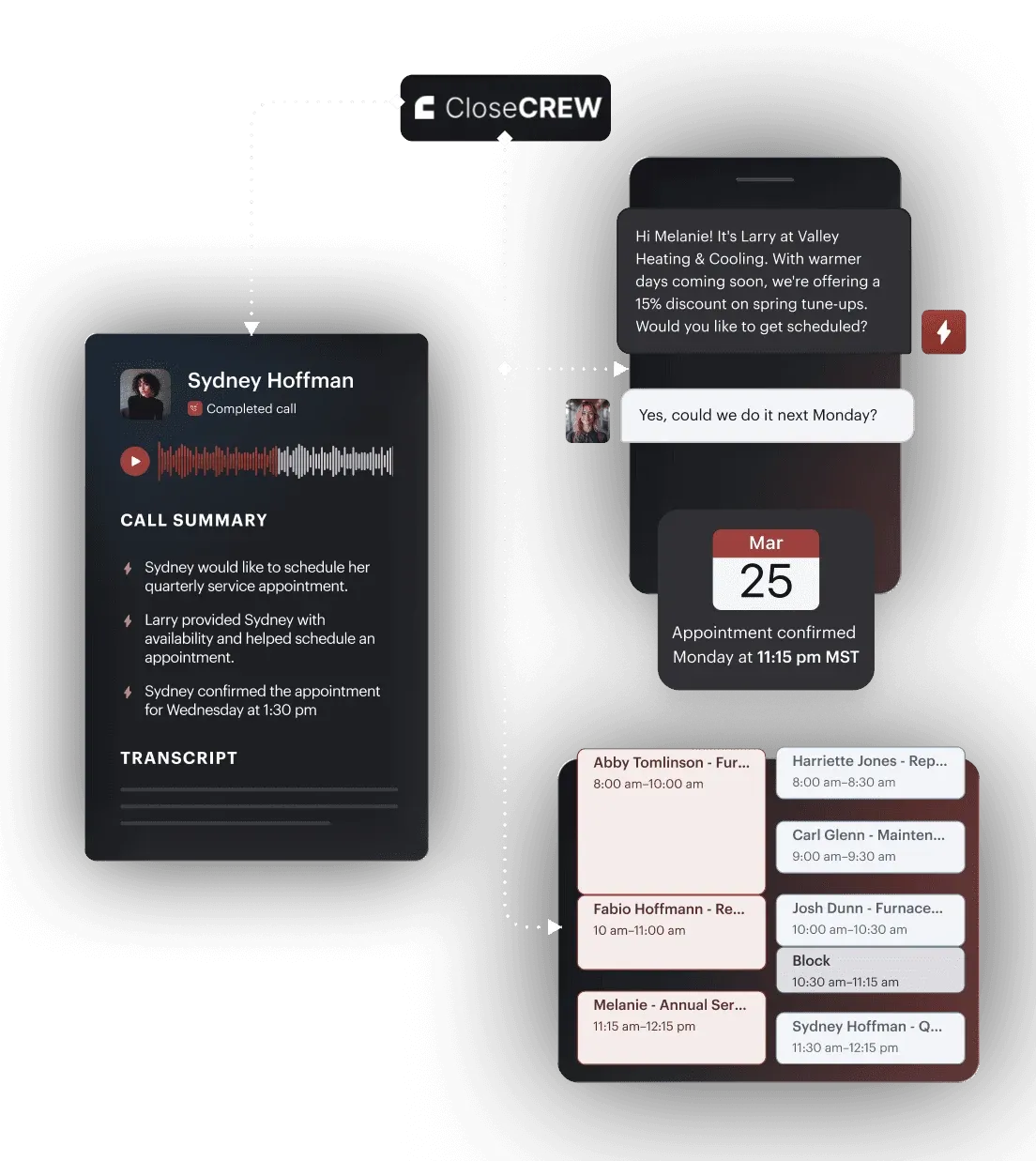
3. Works every channel from one inbox. Calls, texts, web chats, and third-party leads all land in a single place, so nothing slips through, no matter how a customer reaches out.
4. Never lets a lead go cold. Larry follows up on unsold estimates, re-engages quiet and dormant customers, and runs seasonal re-engagement, the patient follow-up work your team rarely has time for.
5. Builds your reputation automatically. After a job, Larry requests reviews, which is exactly how a growing shop earns the five-star credibility that wins the next customer.
6. Works with what you already use. Larry plugs into your existing CRM or field service platform through 200-plus integrations, so it adds a front desk without forcing you to rip anything out.