10 Best Electrical Estimating Software Options for 2026
Discover the best electrical estimating software for contractors in 2026. Compare top tools to create accurate estimates, streamline workflows, and win more projects.
14 min readPublished July 10, 2026Updated July 14, 2026
A homeowner whose panel is sparking calls three electricians. The first one to put a clear, itemized estimate in front of them usually wins. And "first" is measured in hours, not days. Yet most electrical contractors still build estimates by hand: a tech jots notes on a clipboard, someone at the office looks up part prices, builds a spreadsheet, and emails a PDF two days later. By then the job is gone.
The U.S. electrical contracting industry is a $347.5 billion market across roughly 262,000 businesses. The BLS projects 9% electrician employment growth through 2034, driven by data centers, EV charging, and aging residential service entrances. That demand makes accurate, faster estimating a direct constraint on how many jobs your shop can bid and win.
Dedicated estimating software cuts bid-preparation time by 50-70% compared to spreadsheets. A 5% estimating error on a $50,000 job erases $2,500 of margin quietly. The right tool prevents that.
This guide ranks the 10 best electrical estimating software options for 2026, starting with free tools you can use from the field today, then covering the full platforms for service quoting and commercial takeoff.
Before we get into the full estimating platforms, here are two free tools built for electricians. No signup, no software to install, works from your phone on the job site.
CloseCrew Wire Size Calculator
Wire sizing is a dual-constraint problem every electrician solves daily. The conductor must carry the load current without exceeding its ampacity after temperature and bundling derating. It must also deliver acceptable voltage at the load end over the run length. Get it wrong and motors fail to start, lights dim, and you're pulling wire a second time.
The CloseCrew Wire Size Calculator implements the full NEC screening procedure: 125% multiplier for continuous and motor loads, Table 310.16 ampacity lookup at your insulation and termination ratings, ambient and bundling correction factors, voltage drop using NEC Chapter 9 Table 8 resistance values, NEC 240.4(D) small-conductor OCPD limits, and equipment grounding conductor sizing from Table 250.122.
How it works:
Enter load and circuit details. Set amperage or motor HP, voltage, phase, run length, and maximum voltage drop. Or use a quick-start preset for common circuits like EV chargers (32A, 48A), ranges (50A), or subpanel feeders (100A, 200A).
Set installation conditions. Choose insulation and termination temperature ratings, ambient temperature, and number of current-carrying conductors for NEC derating.
Review copper and aluminum sizes. Get the governing AWG/kcmil size for both copper and aluminum, adjusted ampacity after derating, recommended OCPD, and copper EGC per Table 250.122.
Use it to quote jobs accurately, verify plans before you pull permits, and confirm wire sizing before you open the conduit. It's the fastest way to go from "what size wire do I need?" to a code-compliant answer in the field.
You sized the wire correctly. You built the estimate. The homeowner said they'd think about it. Then they called back while your crew was in a panel. The call went to voicemail. They called the next electrician in Google results.
Industry research shows electrical contractors miss 27-62% of inbound calls. Roughly 85% of callers who hit voicemail never call back. The CloseCrew Missed Call Cost Calculator puts a dollar amount on this problem.
The default electrical inputs show 45 calls/month, 32% miss rate, 28% booking conversion, and $650 average job value. The result: $31,450 in annual revenue lost. Every unanswered call is worth $182 in booked work on average.
The math behind it: missed calls x booking conversion rate x average job value. Defaults are sourced from industry benchmarks (WhatConverts, Dexcomm). Trade-specific presets available for HVAC, plumbing, and electrical.
This is where estimating and operations collide. You can price every job perfectly and still lose $31,000 a year because nobody answered the phone. We'll show you how to fix that later in this guide.
Estimating apps vs full electrical contractor software
Before choosing a tool, understand the two categories:
Standalone estimating and takeoff software (Trimble Accubid, McCormick, ConEst, STACK, TurboBid, Esticom) handles one job exceptionally well: calculating material, labor, and overhead costs from blueprints and plans. These tools are disconnected from the rest of your operations. You'll need separate apps for scheduling, dispatching, invoicing, and accounting.
All-in-one field service platforms (BuildOps, Housecall Pro, Jobber, FieldEdge) include estimating as one module alongside scheduling, CRM, dispatching, and invoicing. The estimate data flows into the rest of your workflow without rekeying.
The tradeoff is clear. Standalone estimating tools go deeper on takeoff accuracy. All-in-one platforms go wider on workflow integration. Most electrical shops under $2M revenue get more value from an all-in-one platform. Shops doing high-volume commercial plan-and-spec bidding need a dedicated takeoff engine.
Here's the full landscape at a glance. Find your shop size on the left, then read across.
#
Tool
Best For
Type
Starting Price
Mobile
Key Strength
1
BuildOps
Commercial contractors
All-in-one FSM
Custom
Yes
Real-time job costing tied to estimates
2
Housecall Pro
Small residential (3-15 trucks)
All-in-one FSM
~$79/mo
Yes
Fast mobile quoting with good-better-best
3
Trimble Accubid
Large commercial/industrial
Dedicated takeoff
~$300/user/mo+
Limited
120,000+ assemblies, AutoCAD/BIM
4
McCormick
Mid-size commercial
Dedicated takeoff
~$200-$300/user/mo
Limited
Unified takeoff + estimating since 1979
5
ConEst IntelliBid
Deep database control
Dedicated takeoff
~$115-$150/user/mo
No
140,000+ items, 500,000+ assemblies
6
STACK
Multi-trade cloud takeoff
Cloud takeoff
~$5,000/yr
Yes
AI-assisted symbol counting, real-time collab
7
TurboBid
Budget-conscious shops
Desktop
$99/mo or $1,295
No
NEC labor units at the lowest price
8
Esticom (Procore)
Procore ecosystem
Cloud takeoff
~$139/user/mo
Yes
Cloud MEP takeoff with auto-count
9
Jobber
Small service shops
All-in-one FSM
~$69/mo
Yes
Most affordable all-in-one option
10
FieldEdge
QuickBooks-first shops
All-in-one FSM
~$100-$125/user/mo
Yes
Deep pricebook + QuickBooks sync
1
BuildOps
BuildOps is built specifically for commercial electrical contractors. It connects estimating directly to scheduling, dispatching, invoicing, and job costing in one platform. Every estimate flows into the rest of the project lifecycle without rekeying data.
The real-time job cost tracking compares estimated vs actual costs as work progresses. You see margin erosion as it happens, not two weeks later when the books get reconciled.
Pros: Full commercial workflow in one system. Automated labor and material calculations. Real-time profitability tracking per job.
Cons: Commercial-focused. Less suited for small residential service shops. Custom pricing means you need a demo to get numbers.
2
Housecall Pro
Housecall Pro is the most accessible platform on this list. Easy to learn, fast to deploy, and priced for smaller teams. Techs can build itemized estimates on-site with flat-rate pricing, present good-better-best packages, and capture signatures and deposits before leaving the house.
Built-in financing options help homeowners afford larger jobs like panel upgrades and service entrance work. Automated follow-ups chase open estimates so opportunities don't fall through the cracks.
Pros: Easy to learn. Fast deployment (1-2 weeks). Built-in financing. Good-better-best estimate presentation.
Cons: Limited customization for complex commercial jobs. Fewer advanced reporting features as you scale.
Trimble Accubid is the enterprise standard for commercial electrical estimating. It carries 120,000+ pre-built assemblies, NEC-compliant labor databases, and the deepest AutoCAD and BIM integration in the category. If you're bidding multi-million-dollar tenant fit-outs, data centers, or hospital electrical systems, this is the tool dedicated estimating departments standardize on.
Pros: Deepest assembly database in the category. Direct 3D model import. Advanced change management and submittal tools.
Cons: Steepest learning curve (2-6 weeks onboarding). Enterprise pricing. Massive overkill for residential service work. No free trial.
4
McCormick Systems
McCormick has built electrical estimating software since 1979. It unifies takeoff and pricing in one platform through its built-in Design Estimating Pro. The system ships with 55,000+ items and 25,000+ assemblies. The patented Auto Home Run feature handles repetitive wiring logic automatically.
Pros: 45+ years in electrical. Unified takeoff and estimating (no import/export between tools). Three NECA labor levels. Strong review sentiment (92% positive on Capterra).
Cons: Per-user pricing adds up for larger teams. Steeper learning curve than service-side tools. Not designed for quick field quoting.
5
ConEst IntelliBid
ConEst IntelliBid has the most granular database in the category. 140,000+ items and 500,000+ assemblies covering electrical, low-voltage, datacom, and solar work. SureCount's auto-count pattern recognition flows directly into priced estimates.
Pros: Deepest customizable database. Purpose-built for electrical, low-voltage, datacom, and solar. Lower entry price than Accubid.
Cons: Estimating and takeoff are two linked applications rather than one unified engine. Demo required for pricing.
6
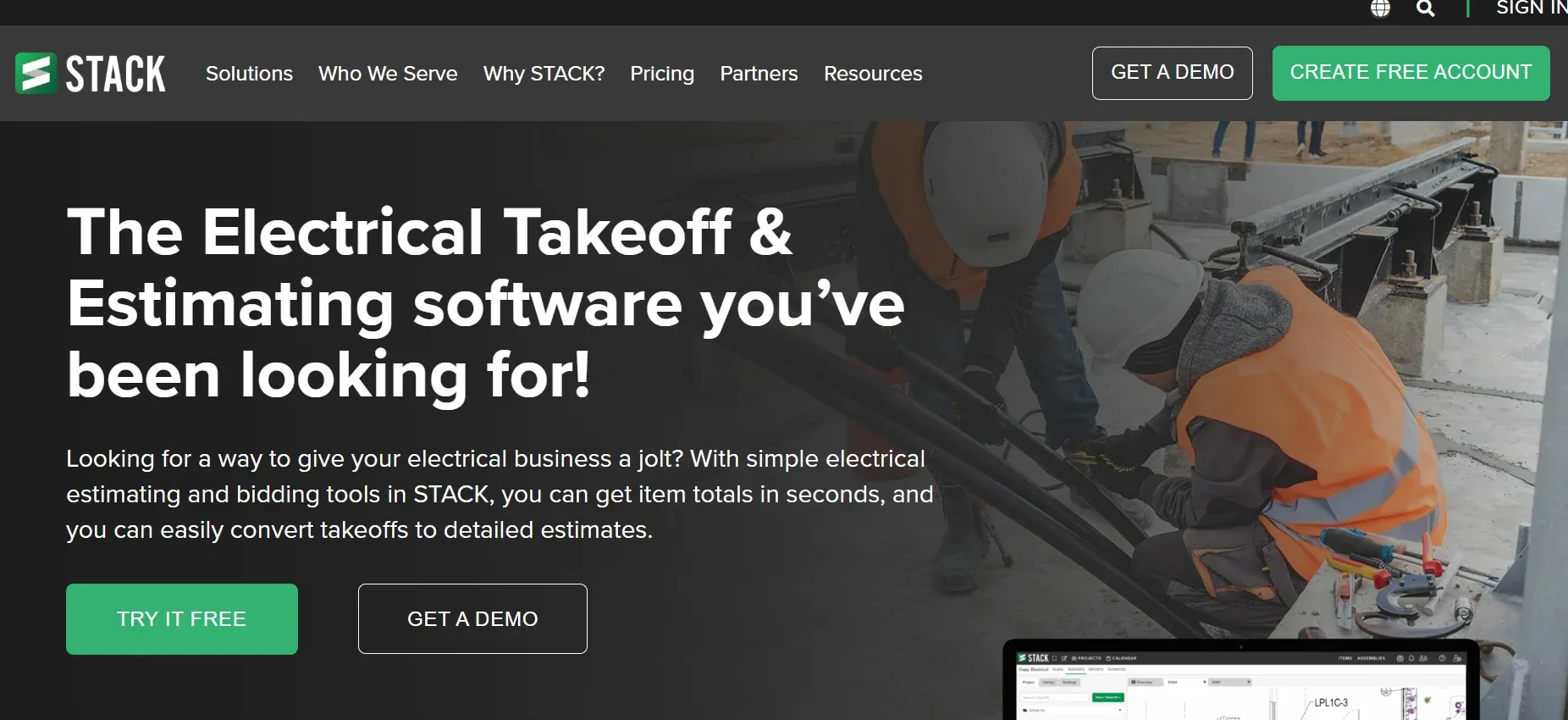
STACK
STACK is the best cloud-native takeoff option. Teams collaborate on the same project in real time rather than passing desktop files around. AI-assisted symbol detection speeds up plan takeoff. Fast onboarding (1-3 days to basic proficiency) versus weeks for desktop enterprise platforms.
Pros: Cloud-native collaboration. AI-assisted takeoff. Fast onboarding. Free account available to start.
Cons: Not electrical-specific (requires assembly setup). Per-seat pricing climbs for larger teams.
7
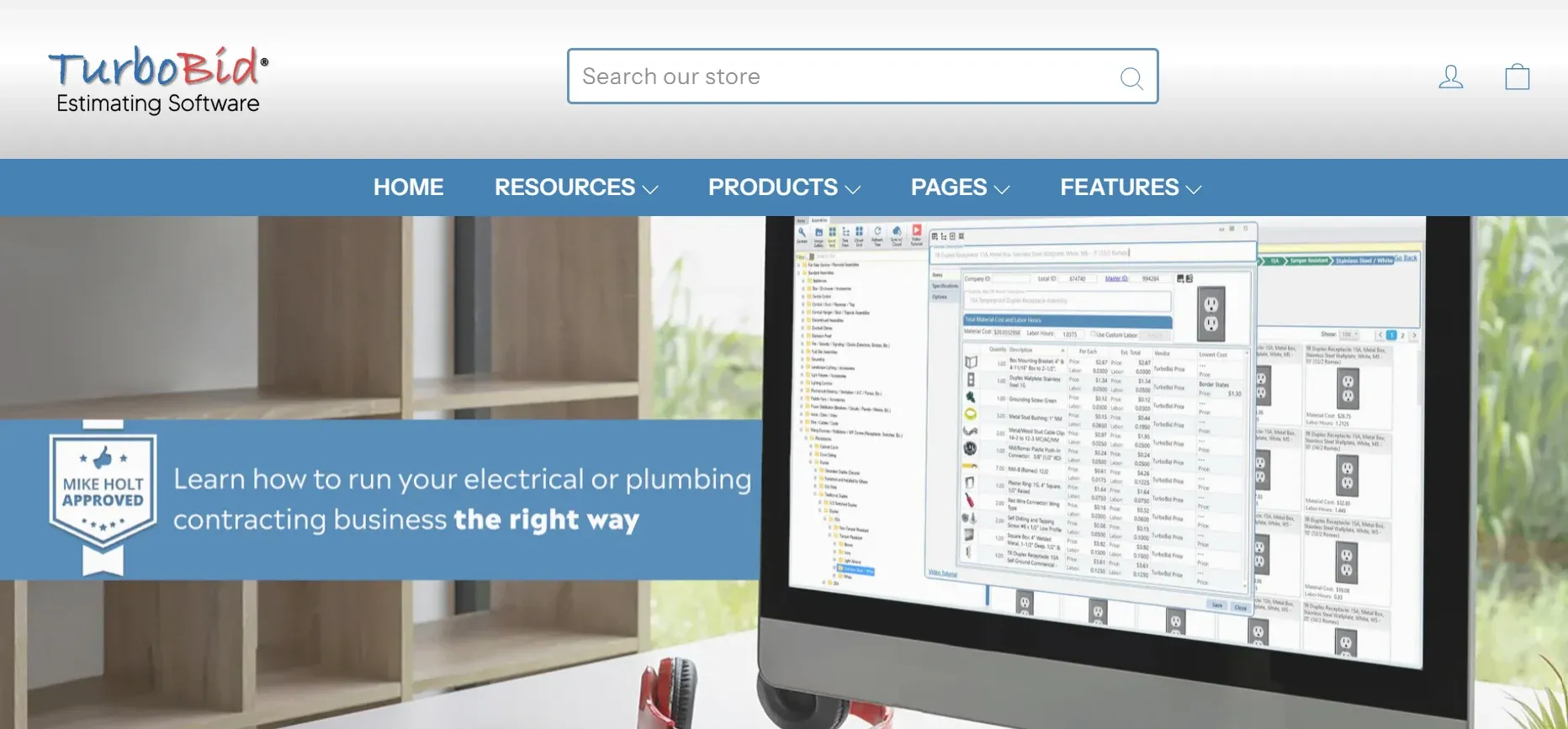
TurboBid
TurboBid is the budget pick. Desktop estimating with built-in NEC labor units covering residential, commercial, and service work at the lowest entry price. The one-time license option avoids recurring subscription costs entirely.
Pros: Lowest price. Built-in NEC labor units. Handles flat-rate service and project estimating. One-time license available.
Cons: Desktop-only. No cloud collaboration. Smaller assembly libraries than McCormick or ConEst. Dated interface.
For electricians exploring how AI tools are changing the trade, TurboBid represents the traditional approach while newer platforms integrate AI into the estimating workflow itself.
8
Esticom (Procore Estimating)
Esticom combines quantity takeoff, auto-count, and an MEP symbol database in one browser-based workflow. It's now part of Procore, so contractors already on that platform get a tighter estimate-to-project handoff.
Pros: Cloud-based. Clean interface with strong ease-of-use ratings. QuickBooks and Procore integration. Free trial.
Cons: Shallower NEC labor-unit depth than McCormick or ConEst. Per-user pricing climbs for larger teams.
9
Jobber
Jobber is the most affordable all-in-one option. Solid quoting tools, clean mobile experience, and good automation for follow-ups. Custom estimate templates, automated follow-ups on open bids, and mobile accessibility for field techs.
Pros: Budget-friendly. Simple workflow. QuickBooks and Xero integration. Client hub for customer self-service approvals.
Cons: Lacks electrical-specific calculations. Limited features for scaling operations. Light catalog depth.
10
FieldEdge
FieldEdge connects estimating directly to accounting. Every estimate syncs with QuickBooks, eliminating manual data entry. Real-time inventory pricing, customer service history, and dispatch tools round out the platform.
Pros: Direct QuickBooks integration. Real-time parts pricing. Service history tied to each customer. Good for flat-rate electrical work.
Cons: Larger commercial contractors may find estimating features too basic. Advanced features locked behind higher-tier plans.
How to choose the right tool
If your shop...
Start with...
Runs 1-5 trucks, residential service
Housecall Pro or Jobber (affordable, fast to deploy)
For service-side quoting (residential and light commercial): speed-to-quote, mobile use, good-better-best options, customer-facing proposals, integrated financing, and seamless invoicing after approval.
For commercial takeoff (plan-and-spec bidding): deep NEC/NECA assembly databases, on-screen digital takeoff, labor-unit accuracy, AutoCAD/BIM integration, and change order management.
Most shops under $2M revenue need service-side features. Most shops over $5M with dedicated estimators need commercial takeoff. Many shops in between need both, and the honest answer is using one tool for each job rather than forcing a takeoff engine to do field quoting or vice versa.
The step most electricians skip: answer the leads your estimates generate
Here is where estimating software and business operations collide.
You invested in the right estimating tool. You're quoting faster. You're winning more bids. But what happens when a homeowner who received your estimate calls back at 7 PM to accept? If that call goes to voicemail, the job goes to the competitor who answered. Home service contractors miss:
You can't answer the phone when you're pulling wire through a wall. A full-time receptionist costs $35,000-$45,000/year plus benefits.
That's exactly the gap CloseCrew is built to close.
Larry doesn't just answer. He books.
Larry, CloseCrew's AI Employee, answers every call 24/7 with Voice AI that sounds like your best employee. He qualifies the lead, books jobs directly into your FSM calendar, sends text confirmations to reduce no-shows, and follows up on open estimates automatically.
Most AI stops at the answer. Larry goes further because he works inside the same system that runs your business. He has a complete view of every customer, job history, and past conversation. So Larry always knows who he's talking to and what to do next.
What the wrong tools cost you: Most contractors run on five disconnected tools. Leads that come in after hours go cold. Your team chases callbacks instead of running jobs. Revenue slips through the cracks between the estimate, the follow-up, and the booking. CloseCrew replaces all of that with one system.
What contractors are saying
Arctic Air: 30% more revenue in one year. Hired Larry, added a truck to their fleet.
Air Texas: Booked a $20,000 job after hours. Larry answered when no one else could.
Premier Heating and Air: Response time dropped from 12 minutes to under 1 minute. Converted 3x more leads.
Air Design: 13 extra appointments in the first 30 days. Estimate conversion went from 5-10% to near 100%.
Run the numbers for your own shop with the Missed Call Cost Calculator. Most electrical contractors discover they're losing $31,000+ per year in revenue from unanswered calls alone.
Your best employee doesn't take days off. Ready to hire Larry?
Common estimating mistakes to avoid
Using mental math or spreadsheets past 3 active bids. Once you're juggling multiple quotes, manual tracking causes inconsistencies and missed details.
Bidding without current material prices. Copper, conduit, and panel prices fluctuate. Stale pricing erodes margin on every job.
One-price estimates without options. Shops presenting good-better-best options close at 55-65% versus 30-40% for single-price quotes. The middle tier becomes the default instead of the negotiation.
Building estimates at the office instead of in the field. Every trip back to the office adds a day to your quote turnaround. On-site quoting wins more jobs.
Not following up on open estimates. Without automated follow-ups, opportunities fall through the cracks. The homeowner who "needs to think about it" calls a competitor if you don't check back.
To stay sharp on the tools and techniques that make estimating faster, check out the best electrician tools for 2026. And for industry insights from other contractors, our list of the best electrician podcasts covers shows worth subscribing to.
Get estimates out faster. Get every callback answered.
The right estimating software gets your quotes in front of customers faster. CloseCrew makes sure every callback, every follow-up question, and every "yes, let's do it" gets captured and booked, 24 hours a day, 7 days a week.
Getting started takes days, not months. White-glove onboarding within 48 hours. Data migration from your existing software. Staff training for your entire crew. We test and refine Larry until he reflects your business.
Frequently asked questions
What is the best electrical estimating software for a small shop?
For residential and light commercial service shops running 1-10 trucks, Housecall Pro or Jobber offers the best balance of simplicity, speed, and cost. Both let techs build estimates on-site, present options, and capture signatures before leaving. For shops that need NEC labor units on a tight budget, TurboBid at $99/month or a $1,295 one-time license is the most affordable dedicated option.
How much does electrical estimating software cost?
Ranges widely. Entry-level all-in-one platforms (Jobber, Housecall Pro) start at $69-$79/month. Mid-tier platforms (FieldEdge) run $100-$125/user/month. Dedicated takeoff software (ConEst, McCormick) costs $115-$300/user/month. Enterprise platforms (Trimble Accubid) can reach $15,000+/user/year with implementation. Always calculate the all-in annual cost including per-user fees and setup charges.
Do I need separate estimating software if I already use field service software?
Usually not. If your all-in-one platform (Housecall Pro, Jobber, FieldEdge, BuildOps) includes estimating, adding a standalone tool creates duplicate data entry. You only need a separate takeoff tool if you regularly bid complex commercial plan-and-spec work off blueprints, which requires the assembly depth of McCormick, ConEst, or Accubid.
Can I build estimates on my phone in the field?
Yes, if you choose a cloud or mobile-first tool. Housecall Pro, Jobber, BuildOps, and STACK all support mobile estimating. Traditional desktop tools (TurboBid, ConEst) require an office computer. For field quoting, mobile capability is non-negotiable because the estimate delivered on-site wins more jobs than the one emailed two days later.
How does estimate speed affect close rate?
Dramatically. Quotes delivered same-hour close at 38-42%. Quotes delivered three days later close at 18-22%. That's roughly half the win rate for a 3-day delay. Speed-to-quote is the single biggest lever on close rate for residential electrical work.
Related tools
Run the numbers before you update your price book or field software.
Free Electrical Templates
Invoices, estimates, and flat-rate pricing sheets for electrical contractors.
This guide outlines ten practical tips to recruit and keep great electricians, grounded in current 2026 numbers, from treating hiring like marketing to building a culture people refuse to leave.
Most electrical shops start out running on a patchwork: spreadsheets, paper estimates, a filing cabinet, and a few apps that do not talk to each other. It works until it doesn't. As you grow, details get lost, jobs slip through the cracks, and your team burns hours hunting for information that should take seconds to find.
Never miss a Electrical service call again. Let Larry, your AI receptionist, book jobs while your crew is in the field.
We will run your numbers on the call and tell you if the maths does not work for a shop your size. That happens, and it is a cheaper conversation than finding out three months in.