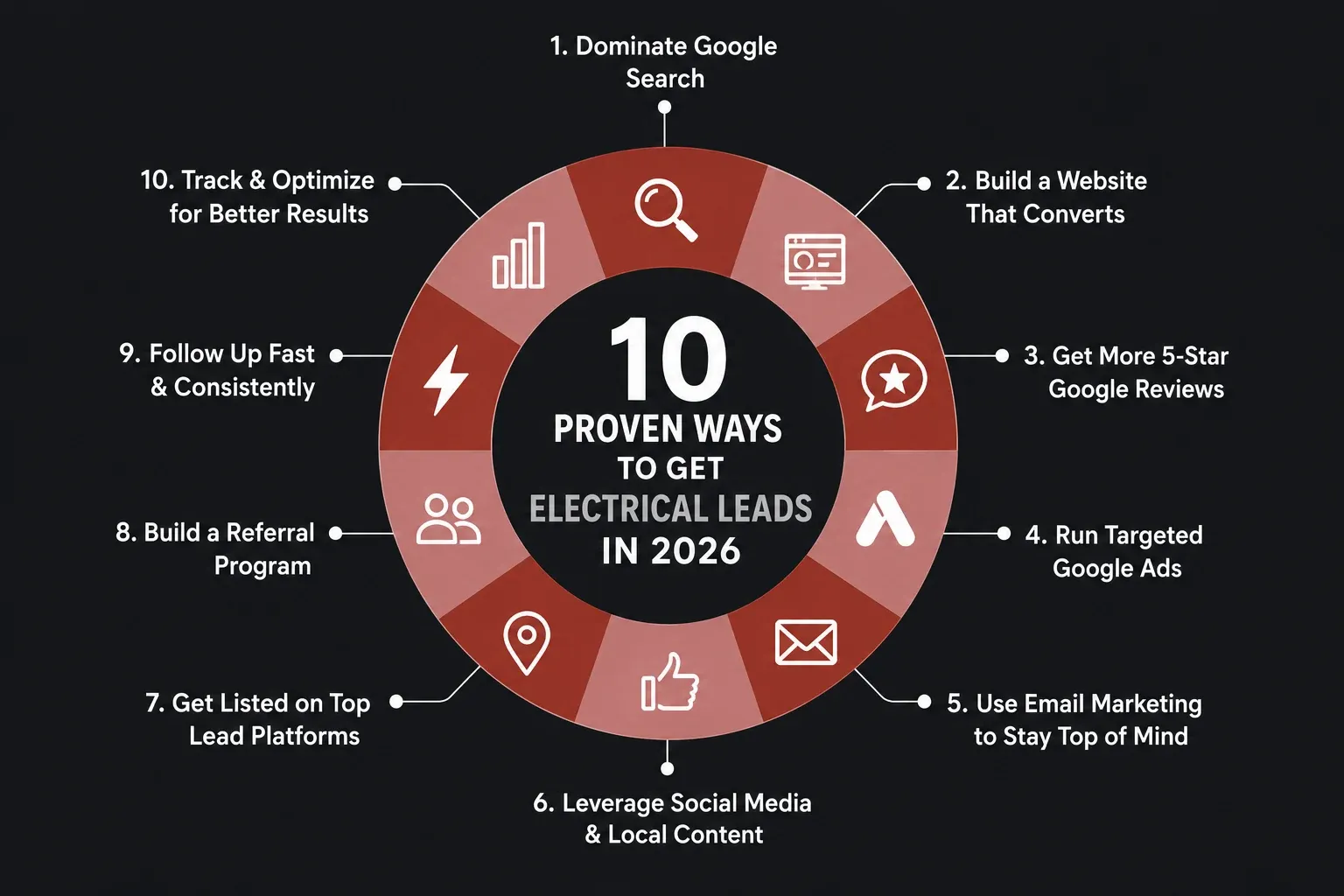
10 Proven Ways to Get Electrical Leads in 2026: Marketing Tips for Electricians
Most electricians rebuild their pipeline from scratch every month. This guide breaks down 10 proven ways to get electrical leads in 2026, from Google, reviews, and email to PPC, referrals, and automation, so you can build a lead system that runs on its own.
18 min readPublished July 2, 2026Updated July 16, 2026
Electrical contractors face a challenge most other home service businesses don't: the work is largely reactive and non-recurring. Unlike HVAC companies that sell annual maintenance plans or plumbers who handle seasonal tune-ups, most homeowners only call an electrician when something breaks or they are renovating. That means your pipeline of electrical leads has to be actively rebuilt, month after month.
The fix isn't complicated, but it does demand consistency. This guide walks through 10 tips to generate electrical leads in 2026, from dominating Google to building a review machine that sells for you while your crew is on the job. Whether you are a solo electrician trying to stay booked or running a team of 20 looking to scale, these strategies will help. Each one covers what to do, why it works, and how to implement it without wasting money.
Quick stat: 90% of consumers used the internet to find a local business in the past year, and 33% search for one every day. (BrightLocal Local Consumer Review Survey)
Before you spend a dollar on ads, build the foundation that makes every other channel work harder. Two moves come first, and both are free:
Optimize your Google Business Profile. It directly affects your local ranking and takes under two hours.
Build a review request process. Reviews compound, and they lift the performance of every paid channel you add later.
Get those two right, then layer on the rest.
And keep one thing in mind as you read on: none of these strategies is magic on its own. The revenue comes from stacking them into a system that keeps working whether you are up a ladder or asleep. The shops that grow fastest aren't the ones spending the most, they are the ones that turned lead generation into a machine and then got out of its way. That is the whole game, turning scattered marketing into predictable, growing revenue.
Now, the full playbook for generating electrical leads.
1. Dominate Google Search for Electrical Services
When a homeowner's breaker trips or they need a panel upgrade, the first thing they do is open Google. If your company isn't on the first page, you don't exist to that customer. Getting onto page one is the single highest-leverage action you can take to consistently generate electrical contractor leads.
There are two ways onto Google's first page: paid advertising and organic search (SEO). A complete strategy uses both.
Paid: Google Local Services Ads (LSAs)
Google Local Services Ads appear at the very top of results, above regular paid ads and organic listings, showing your business name, rating, and a booking button. For electricians, they are the most valuable ads available because you pay per qualified lead, not per click.
To qualify, your business must pass Google's background check and carry the required licenses and insurance. That verification earns the Google Guaranteed badge, a green checkmark that signals trust to homeowners comparing several electricians.
Pro tip: Keep your profile up to date with accurate service areas, hours, and photos. Incomplete profiles rank lower in the LSA feed.
Organic: Local SEO for Electricians
Search engine optimization is how you appear in the non-paid results. Google ranks pages on relevance, geographic proximity, and authority, and with the right local SEO, smaller shops can outrank larger competitors for electrical leads.
Key tactics for electrical SEO:
Use location-based keywords across your site: "electrician in [city]," "licensed electrician [neighborhood]," "emergency electrical repair [city]"
Create individual service pages for each offering: panel upgrades, EV charger installation, whole-home rewiring, lighting installation
Build local citations on directories like Yelp, Angi, Thumbtack, and the Better Business Bureau
Earn backlinks from local news sites, home improvement blogs, and business associations
Your Google Business Profile is the cornerstone of local SEO. Fill it out completely (categories, services, photos, hours) and post updates regularly. More active profiles rank higher in the Local Pack, the map results that appear for "electrician near me."
Here's a cheatsheet for quick reference:
2. Build an Electrician Website That Converts Visitors Into Leads
Most electrician websites are brochures: they list services and a phone number but don't actively turn visitors into booked jobs. Your site should be your best salesperson, working 24 hours a day, handling objections before they arise, and making booking frictionless.
Non-Negotiable Website Elements
Your phone number belongs in the header of every page, not buried on a contact page. Better still, use a click-to-call button so mobile visitors reach you in one tap. Home service customers searching on mobile are high-intent, they need someone now.
Critical pages every electrician website needs:
Homepage: clear headline, trust signals (licensed, insured, years in business), and a primary call to book or call
Service pages: one per service, with location keywords, pricing ranges where possible, and FAQs
About page: team photos, credentials, and your story, because people hire people they trust
Reviews page: embedded Google and Yelp reviews plus before-and-after project photos
Blog: answers to common electrical questions, safety tips, and project guides that drive organic traffic
Page Speed and Mobile Optimization
Google uses mobile-first indexing, so it evaluates the mobile version of your site for ranking. A slow, unresponsive site loses rankings and customers at once. Run your site through Google PageSpeed Insights and follow the recommendations.
Benchmark: Your site should load in under 3 seconds on mobile. Anything slower can raise bounce rates by 32% or more.
Online Booking Integration
The easier you make booking, the more bookings you get. An online scheduling widget removes friction for customers who don't want to call during business hours. For the large share of home service traffic that searches after hours, a booking form is the difference between capturing electrical leads and losing them to a competitor.
3. Optimize Your Google Business Profile Like a Pro
Your Google Business Profile (GBP) is the most important free marketing tool you have. It controls how you appear in the map pack, the three-business block at the top of local results. Ranking there for "electrician near me" can generate more electrical leads than any paid campaign.
Optimization checklist:
Select the most specific primary category: "Electrician," not "Contractor"
Add relevant secondary categories: Lighting Contractor, Electric Vehicle Charging Station Contractor
Write a keyword-rich description that includes your city and core services
Upload 20 or more high-quality photos of trucks, crew, completed work, and office
Enable messaging so customers can text you directly
Post weekly updates, offers, or project highlights
Respond to every review, positive and negative, within 24 hours
The Q&A section is often overlooked. Pre-populate it with answers to common questions like "Do you offer emergency electrical service?" and "Are you licensed and insured?" These appear publicly and can tip an undecided customer toward booking. For a step-by-step walkthrough, see our Google Business Profile setup guide.
4. Build a Review Generation System, Not a One-Off Request
Reviews are the currency of local service businesses. A 4.2-star electrician and a 4.8-star electrician quoting the same job will rarely finish level, the higher-rated company usually wins, even at a higher price. When two electricians compete for the same electrical leads, the ratings often decide it. But reviews don't accumulate by accident. They need a system.
According to BrightLocal's Local Consumer Review Survey, 89% of consumers aged 35 to 54 trust online reviews as much as personal recommendations, and the average consumer reads around 10 reviews before deciding. If you have fewer than 20 Google reviews, you are invisible to a large slice of your market.
The Review Request System
The best review requests happen immediately after a completed job, while the experience is fresh and the customer is satisfied. Build it into your close-out process:
The technician verbally asks for a review before leaving the site
An automated SMS goes out within 30 minutes of completion, with a direct link to your Google review page
A follow-up email goes out two days later to customers who haven't reviewed
Make reviewing frictionless. Use a short link that opens the review form directly (not your GBP homepage), because every extra click lowers completion rates.
Responding to Negative Reviews
Negative reviews happen to excellent companies too, and how you respond matters as much as the review. Prospects notice when a business handles criticism professionally. Learn the right way to respond to negative reviews without making things worse.
Key insight: Businesses that respond to reviews are rated about 0.12 stars higher on average, and customers are 1.7x more likely to trust a business that replies to all reviews. (Harvard Business Review)
5. Use Targeted Email Marketing to Re-Engage Past Customers
Most electrical companies sit on a goldmine they never mine: their existing customer database. Past customers already trust you, they've hired you, paid you, and had a good experience. Re-engaging them costs a fraction of acquiring a new customer, and they convert far more often.
Email consistently delivers the highest ROI of any digital channel, commonly cited at around $40 returned for every $1 spent. For electricians, that means more electrical leads from customers who would otherwise have called a competitor simply because they forgot your name.
Campaigns That Work for Electricians
The best marketing emails are targeted, not blasted. Instead of emailing your whole list a generic offer, segment by job history, equipment age, or time since last service.
High-performing campaign types:
We Miss You: to customers who haven't booked in 12+ months, with a limited-time offer to create urgency
Seasonal Safety Checks: pre-winter inspection reminders, framed as a value-add rather than a pitch
Pending Estimate Follow-Up: an automated nudge to customers who got a quote but didn't book
Project Anniversary: one year after a major job, ask how it's holding up and offer a complimentary inspection
Referral Request: ask happy customers to refer friends and family, with an incentive
One small electrical company used a single "We Miss You" email to generate about $4,000 in a week, from customers who hadn't returned in over a year. The email cost almost nothing to send.
That week wasn't luck. It was the right message sent to the right segment at the right moment. The catch is that doing this by hand, segmenting the list, timing the sends, and chasing every unsold estimate is exactly the work that never happens when you are booked solid on jobs. Automating it is what separates the shops that mine their databases from those that let them gather dust. This is what that looks like running on its own:
Email Best Practices
Keep subject lines under 50 characters for mobile
Send Tuesday, Wednesday, or Thursday mornings for the highest open rates
Avoid spam triggers like "free," "guaranteed," and "act now"
Clean your list every six months; inactive subscribers hurt deliverability
Use one clear call to action ("Book a free inspection"), not three competing offers
6. Run Pay Per Click (PPC) Ads That Actually Deliver ROI
Google Ads can be one of the most profitable sources of electrical leads for contractors or one of the most expensive mistakes. The difference is in the setup. Poorly configured campaigns burn budget on irrelevant searches, wrong geographies, and broad keywords that attract tire-kickers.
Google Search Ads for Electricians
Effective electrical PPC campaigns share these traits:
Tight geographic targeting: advertise only in your actual service area, not the whole metro
High-intent keywords: "emergency electrician [city]," "panel upgrade cost," "licensed electrician near me"
Negative keywords: add "jobs," "salary," "DIY," and "free" to filter out job seekers and bargain hunters
Ad extensions: use call, location, and sitelink extensions to take up more screen space
Dedicated landing pages: never send ad traffic to your homepage; build service-specific pages with one CTA
Aim for a cost per lead below your average job's margin. If your average job generates $400 in profit, paying $80 to $120 per lead at a 30% close rate is sustainable. First, model your target cost-per-lead with our PPC ROI calculator.
Remarketing for Electricians
Most visitors don't convert on the first visit. Remarketing shows ads to people who visited your site but didn't book, keeping you top of mind while they compare options. These campaigns typically cost 2 to 3x less per click than standard search and convert better, because the audience is already warm.
7. Leverage Social Media and Community Platforms for Local Leads
Social media isn't the first thing electricians think of for lead generation, but the right platforms, used well, build a steady stream of electrical leads and referrals from your community.
Nextdoor: The Underrated Platform for Home Services
Nextdoor is a neighborhood social network where homeowners constantly ask for contractor recommendations. Create a free business page and ask satisfied customers in each neighborhood to recommend you. A single recommendation can reach hundreds of neighbors who trust it because it comes from someone they know. That hyper-local social proof carries more weight than an anonymous review.
Facebook and Instagram for Electricians
Facebook's local targeting makes it effective for awareness in specific zip codes. Use it to:
Promote seasonal offers (pre-summer AC circuit upgrades, holiday lighting)
Share before-and-after photos of completed projects
Run lead generation ads targeting homeowners in your service area
Answer electrical safety questions to build community and establish expertise
YouTube: Long-Term SEO Value
Educational videos ("How to Reset a GFCI Outlet," "Signs You Need a Panel Upgrade") rank in both YouTube and Google. They won't generate leads overnight, but they build awareness and position you as the local expert. A homeowner who watched your "signs of faulty wiring" video is far likelier to call you than a stranger.
8. Connect With Lead Generation Platforms, Selectively
Third-party platforms like Angi (formerly Angie's List), Thumbtack, Houzz, and HomeAdvisor can supplement your organic electrical leads, especially when you are starting out or entering a new area. But they come with real caveats.
The core problem: the same lead is often sold to three to five competing electricians at once. You aren't buying an exclusive lead, you are buying the right to compete for a customer who will get multiple calls in the next five minutes. Win rates on shared leads typically run 15% to 25%.
How to Use Lead Platforms Profitably
Calculate your target cost-per-acquisition before buying, know what you can afford
Call new leads within five minutes, response speed is the top factor in winning shared leads
Use platforms to fill schedule gaps, not as your primary source
Build reviews from platform jobs to strengthen your profile there
Track which platforms produce jobs at an acceptable cost, and cut the rest
For a deeper breakdown, read our full comparison of the best lead generation platforms for electricians.
9. Build a Referral Program That Generates Consistent Leads
Word-of-mouth is the oldest and most trusted form of marketing, and for electricians it remains one of the most powerful. A structured referral program turns your customers into a distributed sales force, producing electrical leads that close at 3 to 5x the rate of cold advertising.
Most electricians rely on organic referrals from customers who had a great experience. That's good, but passive. A formal program makes it active.
Referral Program Structure
Offer a clear incentive: $25 to $50 off their next service, a gift card, or a charity donation
Make referring easy: include a referral link in your post-job follow-up email
Track referrals with a unique phone number or landing page
Thank referrers promptly, which reinforces the behavior
The most powerful referral strategy is simply delivering service so good customers want to talk about it. That means training your electricians on customer experience, not just technical skill.
Case study: ProSkill Services, an electrical and HVAC company in Arizona, built more than 3,000 five-star Google reviews by training technicians to earn reviews through service quality, not just ask for them. The volume compounds, each new review makes the next one easier to get.
10. Measure ROI on Every Channel, Then Cut What Doesn't Work
The most common marketing mistake electricians make isn't picking the wrong channel, it's failing to track what's working and funding underperformers out of habit. Every marketing dollar you spend chasing electrical leads should trace back to jobs booked and revenue earned.
What to Track
Use call tracking software to assign a unique phone number to each channel, so you can see how many calls each campaign generates, how many convert, and what revenue they produce.
Metric
How to calculate
Target
Cost per lead (CPL)
Total spend ÷ total leads
$50 to $150 on paid channels
Lead-to-booking rate
Booked jobs ÷ leads
30% or higher
Booking-to-job rate
Completed jobs ÷ booked
Track cancellations and no-shows
Average ticket value
Revenue ÷ jobs
Higher values justify a higher CPL
Revenue per channel
Revenue ÷ spend, by channel
The ultimate metric
Monthly Marketing Review
Schedule a 30-minute review each month. Go through call logs, website analytics, booking data, and ad spend. Cut or reduce channels below your target CPL, and reinvest in the ones outperforming. Use Google Analytics 4 to see which traffic sources and blog posts drive contact-form submissions, which informs both your content and your paid targeting.
Rule of thumb: If you can't trace a marketing dollar back to a job, stop spending it. Vanity metrics (followers, impressions, page views) don't pay your technicians.
Bonus: Automate Your Lead Follow-Up to Stop Losing Jobs
Speed is the most underrated factor in converting electrical leads. Studies consistently show the business that calls back first wins the job, not the cheapest, most established, or most-reviewed. Responding within the first five minutes can increase conversion by up to 21x compared with a 30-minute response.
Most electricians lose jobs not on price or quality, but because they didn't respond fast enough, usually because their hands were full on another job.
Automation tools worth implementing:
Missed-call text-back: automatically text customers who called but didn't reach you, capturing leads that would otherwise hit voicemail and never call again
AI answering and lead response: an always-on tool that answers calls and web inquiries, qualifies the caller, and books straight into your calendar, so no lead goes cold while you are in an attic
CRM software: track every lead, follow-up date, and job status, because missed follow-ups are lost revenue
Automated appointment reminders: cut no-shows with SMS reminders 24 hours and 1 hour before
Post-job sequences: automate review requests, referral asks, and re-engagement
The electricians who consistently win aren't running one great campaign. They've built a system: their website ranks organically, their Google Business Profile is optimized, their reviews accumulate automatically, their email list is segmented and active, and every marketing dollar traces back to jobs booked. That system runs in the background while they focus on delivering excellent electrical work.
Start with the foundations: your GBP, your website, and your review process. Get those right and every channel you add becomes more effective. Paid ads perform better with 200 reviews behind them. Email produces higher open rates when your brand is recognizable. Referrals compound when customers consistently talk about your service.
Pick two strategies from this guide and implement them this week, starting with Google Business Profile optimization, it's free, it directly affects ranking, and you can finish it in under two hours. Then build your review request process. Everything else builds on that foundation.
The electrical contractors who dominate their local markets in 2026 won't be the ones with the biggest budgets. They'll be the ones with the best systems for generating electrical leads.
You don't have to build that system alone. If you would rather start with the piece that plugs the biggest leak, the electrical leads slipping away while your phone rings unanswered on a job site, that is the fastest place to begin. Talk it through with someone who has set this up for shops like yours.
Related tools
Run the numbers before you update your price book or field software.
Free Electrical Templates
Invoices, estimates, and flat-rate pricing sheets for electrical contractors.
Want more electrical jobs without relying on paid ads? This guide covers everything electricians need to improve Google rankings, dominate local search, optimize Google Business Profile, create SEO-friendly content, and turn more website visitors into booked customers in 2026.
Growing an electrical business is not about working more hours. It is about building a company that runs on systems rather than on you, hiring ahead of demand, marketing to the right customers, and ensuring not a single lead slips through the cracks. This guide lays out exactly how, with no filler.
Never miss a Electrical service call again. Let Larry, your AI receptionist, book jobs while your crew is in the field.
We will run your numbers on the call and tell you if the maths does not work for a shop your size. That happens, and it is a cheaper conversation than finding out three months in.