Marketing and Leads

How to Grow Your Electrical Business in 2026: An Operations and Marketing Playbook

Growing an electrical business is not about working more hours. It is about building a company that runs on systems rather than on you, hiring ahead of demand, marketing to the right customers, and ensuring not a single lead slips through the cracks. This guide lays out exactly how, with no filler.

12 min readPublished June 24, 2026Updated July 14, 2026

Most electrical contractors are not concerned about demand. They have capacity and conversion problems. The phone is ringing, and the work is there, but the business is stifled by the owner doing everything, a small pool of trained technicians, disjointed processes, and leads that go cold before anyone follows up.

The market backdrop is unusually strong. As reported by the Bureau of Labor Statistics, jobs of electricians are projected to grow about 9% from 2024 to 2034, compared with a 3% average across all occupations, with roughly 81,000 openings a year. Electrification, EV infrastructure, renewable energy, and the data center boom are all moving in the same direction. Customers aren't the constraint. It is whether your company is designed to handle the work.

This playbook is a collection of real growth drivers: a plan, a team, a culture, systems, focus, targeted marketing, online visibility, and lead capture. Handle them one at a time, and you build a company that scales without burning you out. If you are still in the startup phase, our guide on getting a trades business off the ground covers the foundations.

[[blog-banner:grow-revenue]]

Part of the Marketing and Leads section in the Electrical Business Blog.

1. Start With a Plan for the Business You Want to Become

The single most common growth mistake is running today's business on instinct and hoping it compounds into something bigger. It rarely does. Instead, decide now what you want the company to look like in five years, then reverse-engineer the steps to get there, and operate as if you are already that company.

The quickest way to avoid years of trial and error is to learn from those who have already created what you desire. Find a mentor who runs the type of electrical business you want to work in, ask to shadow them, and ask direct questions about what they would do differently. Then find a few more. Combine that with a steady diet of operations-focused books and trade podcasts to ensure you're constantly importing proven ideas rather than reinventing them. Founders who study other successful operators tend to move faster than those who go it alone.

2. Hire and Train Ahead of Demand

The labor shortage in the trades is real and getting worse as veteran electricians retire. Most of those 81,000 annual openings stem from experienced workers leaving, not just from the field expanding. That means recruiting cannot be something you do only when you are desperate.

Consider hiring as a regular, not emergency, function. The foundation is a clear organizational chart, defined roles, and written expectations for each position, so that a new employee understands what success looks like. Next:

  • Always be recruiting. Keep a pipeline warm even when you are fully staffed, and pay your team a referral bonus for bringing in qualified candidates. Your best electricians know other good electricians.

  • Train deliberately. Invest in structured onboarding and ongoing skill development so techs can handle bigger, higher-margin work over time.

  • Use performance pay. Tie part of compensation to outcomes so your strongest people are rewarded for growth and have a reason to stay.

Knowing the going rate matters here, since pay is the first thing a good electrician compares. Our technician salary guide is a useful benchmark for building your compensation plan.

3. Your Culture Is Your Real Branding

Your Culture Is Your Real Branding.webp

You can spend heavily on logos and ads, but the most durable brand you have is how your team feels about working for you. Happy, valued employees work harder, stay longer, and tell other good workers about you, which feeds straight back into recruiting.

Create that culture consciously. Share team victories publicly, give engineers a genuine stake in the company's future, and make sure everyone understands their role in its success. When the economy is down, resist the urge to reduce hiring and marketing. Contractors who keep their foot on the gas during downturns typically emerge stronger, while reactive competitors shrink.

Communication is where culture either comes together or falls apart. When your office staff and field electricians have access to the same customer information, job history, and call details in one place, friction and finger-pointing are eliminated. This is why a shared system is essential and where an assistant like CloseCrew's Larry can help: by recording every customer conversation and storing the history in one place, the office spends less time chasing techs for updates and more time moving the business forward.

4. Run on Systems, Checks, and Balances

Businesses that scale smoothly operate like franchises, with documented processes, defined roles, and checks that detect problems before they cost money. The model to follow is that of large chains that open a new location every few hours, because everything is automated and nothing is dependent on a single heroic employee.

Put real checks and balances in place across departments. Compare your CSR booking rate to the jobs your techs actually complete. Reconcile inventory controls against the parts consumed on each job. Cap the number of direct reports per manager so accountability does not blur. Write operating manuals for repetitive work so quality does not live only in one person's head.

Give your electricians field tools that prevent mistakes and callbacks, too. A tech who sizes a conductor wrong on a quote either eats the margin or loses the job. Our free wire size calculator helps you choose the right wire based on load, distance, conductor type, temperature, and NEC requirements. It instantly recommends the correct AWG or kcmil size, along with ampacity and voltage drop, so your team can quote accurately and avoid costly mistakes. Small accuracy gains like this, repeated across every job, compound into real money.

5. Master One Thing Before You Expand

Ambition motivates contractors to pursue all related services and customer types simultaneously. Spreading thin is how strong businesses fail. Focus is a multiplier; excel at one core service and customer segment before branching out into another.

Before you diversify, ensure that the existing business can continue to operate without your presence. A company that fails when the owner leaves is a job, not an asset. Document the processes, train employees to own them, and eliminate low-margin or distracting work that is not related to your core competencies. A little honest market research to determine where your best margins and easiest customers are will save you from making costly mistakes later.

6. Market to the Right Audience, Not to Everyone

"Anybody with an electrical system" is not the intended audience. Knowing your best customers by age, income, neighborhood, home value, and the specific issues they contact you about is essential for growth. The more specific the profile, the less expensive and more effective each campaign is.

A few principles keep electrical marketing efficient:

  • Define the customer first, then the channel. Build campaigns around a specific audience and offer rather than blasting a generic message everywhere.

  • Diversify channels. Do not bet everything on one source. Combine search, local services, email, and direct response so a single algorithm change cannot sink you.

  • Automate and reactivate. Some of your lowest-revenue customers are already on your customer list. Re-engaging dormant customers and following up on unsold estimates routinely turns quiet contacts back into booked jobs, and an assistant like Larry can run that follow-up automatically.

  • Track every campaign. Use a unique number or clear attribution per campaign so you know which marketing actually produces booked revenue.

For a deeper list of ideas, see our marketing playbook for the trades.

7. Win Online: Search, Reviews, and Paid Ads

seo (2).webp

For home services, the customer's journey starts on Google. A large majority of people find local services through search, which means your online presence is not a nice-to-have; it is the storefront. Split your effort across a few high-impact areas.

Search and content. Publish genuinely useful content, like electrical safety and how-to material, to build SEO authority and rank for the questions homeowners ask. Our SEO guide for service businesses covers the fundamentals, and a fast, well-built website is the foundation on which it all sits on.

Google Business Profile and Local Services. Claim and optimize your Google Business Profile, and use Google Local Services Ads so your shop appears at the very top of local results with a booking path that needs no phone call.

Paid search and landing pages. PPC works, but only if clicks land on a focused page built to convert rather than your homepage. Our guide to high-converting landing pages applies directly to electrical campaigns.

Reviews. Reviews are decisive. BrightLocal's Local Consumer Review Survey finds that roughly three in four consumers read reviews regularly and only about 4 percent never do, with most checking more than one platform. Make review collection systematic by requesting one from every satisfied customer right after the job, which Larry can handle automatically so the flow never dries up.

8. Stop the Biggest Leak: Missed Calls

You can do everything above well and still hemorrhage money at the final step. Industry benchmarks show home service contractors miss anywhere from roughly a quarter to well over half of inbound calls, usually because the team is on a roof, in a panel, or already on another line. And most callers who hit voicemail simply dial the next electrician on the list. Every missed call is not a lost $150 service ticket; it is a blend of routine work, after-hours emergencies, and high-value panel upgrades or EV charger leads you never even got to quote.

The data on speed is brutal. Research published in Harvard Business Review and MIT found that the first business to respond wins the majority of jobs, and that lead quality collapses within minutes. In an emergency trade, the contractor who answers first usually wins.

Before you fix it, size it. Our free missed call cost calculator lets you enter your call volume, miss rate, booking conversion rate, and average ticket value to see your exact monthly and annual revenue leak, broken down by call type, plus how much you could recover. For many shops, the number is genuinely shocking, and it is also the most fixable problem on this entire list.

9. Put It All on a Foundation That Books the Work

Every section above eventually runs into the same bottleneck: capturing and booking the demand you worked so hard to create. That is the gap CloseCrew is built to close, and it sits atop whatever field service platform you already use.

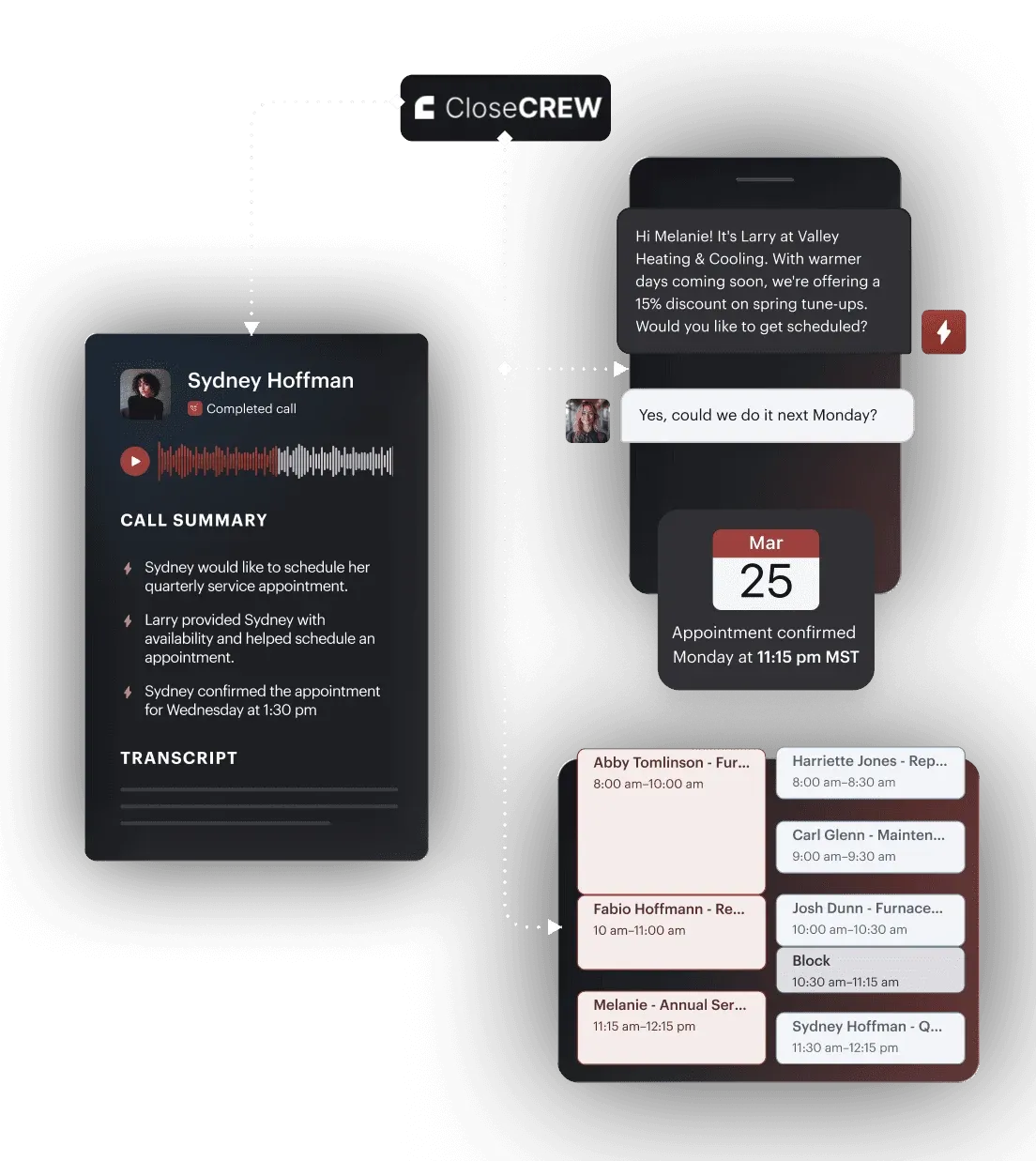
Larry, CloseCrew's AI employee, responds to all calls, texts, and web inquiries 24 hours a day, in English or Spanish, from a single inbox. He qualifies each caller, detects an outage emergency from a routine panel question, confirms your availability, and books the job into your CRM or scheduling tool via 200+ integrations. Then he works in the background, confirming appointments to reduce no-shows, following up on unsold estimates, re-engaging dormant customers, and requesting feedback. The marketing fills the funnel, your systems keep the work consistent, and Larry ensures that nothing leaks out due to an unanswered phone call. Book a demo to see Larry handle a real call.

ai marketing tools closecrew.webp

10. Know Your "Why"

People become exhausted when they pursue growth solely for its own sake. Before you scale, understand why you're doing it and what kind of life you want on the other side. Owning a business solely to avoid having a boss is a weak motivation that rarely survives the tough times.

Be honest about your strengths. A brilliant electrician is not automatically a strong financial manager, and that is fine. If the numbers are not your gift, hire or partner with someone whose they are, rather than letting weak financial control quietly cap your growth. Keep work-life balance in view as a real constraint, not an afterthought, and let your "why" guide which opportunities you say yes to and which you let pass.

The Bottom Line

Growing an electrical business in 2026 requires creating something that does not rely on you: a clear plan, a deep and well-trained team, a culture that people want to stay in, systems that ensure consistent quality, focused marketing aimed at the right customers, and a lead-capture process that allows nothing to slip away.

The demand is there and rising. The contractors who win it will be the ones who get their house in order and answer every call. Size your biggest leak with the missed call cost calculator, then book a CloseCrew demo to see how Larry turns the demand you generate into booked, profitable work.

Still mapping out where to start? Our team can walk you through your operations and lead flow.

Frequently asked questions

How fast can an electrical business realistically grow?

It depends on your market and how systematized you are, but contractors who tighten operations and stop losing leads commonly add meaningful revenue within a year without proportionally adding overhead. The ceiling is usually set by hiring and process, not demand.

Two things: a small pool of trained electricians and leads lost due to missed calls and slow follow-up. Both are fixable. The first adopts a permanent recruiting habit, while the second implements a system that answers and books every inquiry.

Begin with the most intent-driven channels: Google Business Profile, Local Services Ads, search, and reviews. Once the basics are converted, add PPC with dedicated landing pages and email or direct response campaigns. Always track which channels generate booked revenue.

Not until your core business is profitable without you. Master one service and customer segment, then create the systems and add a branch. Premature diversification is one of the most common reasons why growing businesses fail.

Run the numbers with a free missed call cost calculator. Enter your call volume, miss rate, conversion rate, and ticket values, and you will see the monthly and annual leak, plus what you could recover by answering more calls.

Related tools

Run the numbers before you update your price book or field software.

Contractor Blog

Cross-trade guides on hiring, marketing, and operations for every home services business.

View all guides

Electrical Licensing

State licensing requirements, exams, and renewal rules for electrical contractors.

View states

Meet Larry

AI receptionist built for Electrical — answers calls, books jobs, and follows up on leads 24/7.

See Larry for Electrical

Related articles

Marketing and Leads

SEO Tips for Electrical Business (2026 Complete Guide)

Want more electrical jobs without relying on paid ads? This guide covers everything electricians need to improve Google rankings, dominate local search, optimize Google Business Profile, create SEO-friendly content, and turn more website visitors into booked customers in 2026.

Read guide

Never miss a Electrical service call again. Let Larry, your AI receptionist, book jobs while your crew is in the field.

We will run your numbers on the call and tell you if the maths does not work for a shop your size. That happens, and it is a cheaper conversation than finding out three months in.

Get a demo