Marketing and Leads

11 Tips for a High-Converting Plumbing Landing Page

A plumbing landing page has one job: turn an expensive ad click into a booked job. Most pages leak that traffic because the headline does not match the ad, the page loads slowly on a phone, the call to action is vague, or worst of all, the lead that finally fills out the form sits in an inbox while a competitor calls back first. This guide fixes all of that.

12 min readPublished June 22, 2026Updated July 14, 2026

You can spend a fortune driving traffic to a plumbing landing page and still come away with almost nothing to show for it. The ad does its job: the visitor clicks, then lands on a page that does not quite deliver, so they bounce and call the next company on the list.

Conversion is where marketing budgets are won or lost. A page that turns 8 percent of visitors into leads, instead of 3 percent, does not just edge out the competition; it more than doubles the return on every dollar you spend getting people there. And the gains compound because a higher-converting page also tends to secure cheaper ad placements and better search visibility.

The good news is that high-converting pages are not magic. They follow a handful of well-understood principles, each one designed to remove friction and prove value at the exact moment a visitor is deciding whether to trust you. Here are 11 of them, with the data behind why they work.

Part of the Marketing and Leads section in the Plumbing Business Blog.
What Is a Plumbing Landing Page?

A plumbing landing page is a standalone web page built to capture and convert leads from a specific marketing campaign. Unlike a homepage, which tries to serve everyone, a landing page has a single focus: persuade the visitor who clicked your ad to take one action, whether that is calling, requesting an estimate, or booking online.

Because it is tied to a campaign, every element on the page should reinforce the promise that brought the visitor there. When the message, the proof, and the call to action all line up, conversions climb. When they fight, visitors leave. The tips below cover how to get every element pulling in the same direction.

And once this is in place, the next step is figuring out how to actually grow revenue from it without adding more headcount.

The 11 Tips for a High-Converting Plumbing Landing Page

1

Write a Headline That Matches the Ad and the Need

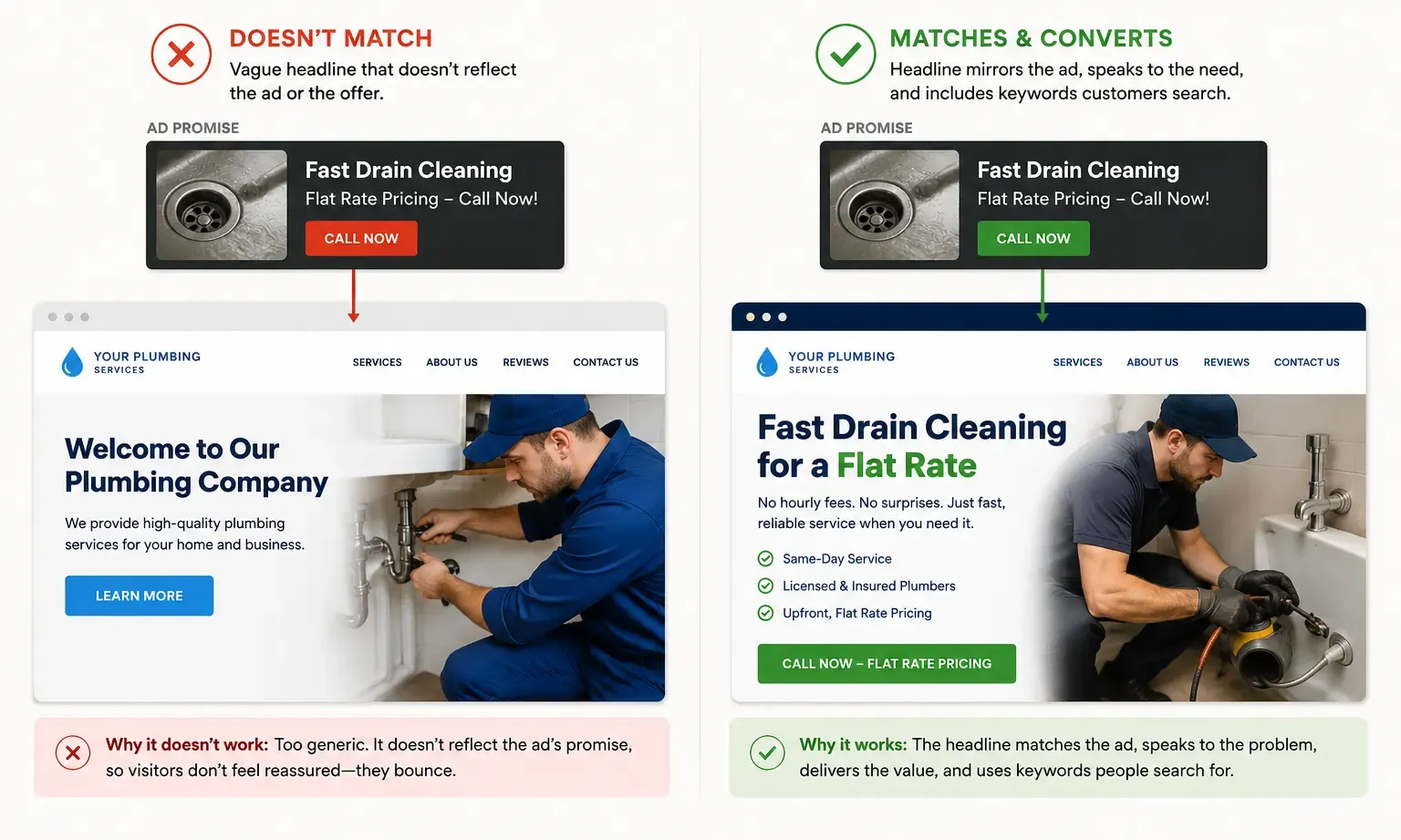
Your headline is the first thing a visitor reads, and often the only thing they read before deciding to stay or go. Make it count by tying it directly to the promise in your ad. If your ad offers fast drain cleaning for a flat rate, the headline should echo that exact offer, not introduce a new one.

A strong plumbing headline does three things at once: it speaks to the visitor's problem, it states your value clearly, and it includes the keywords people actually search for. Keep it short and specific. You have the rest of the page to elaborate, so resist the urge to cram everything into one line. For more on choosing the right terms, our guide to SEO best practices for the trades is a useful companion.

win on mobile.webp
2

Sell Specific Benefits, Not Generic Claims

A headline earns attention, but benefits earn the conversion. Visitors want to know what is in it for them, so spell it out. The catch is that generic promises like "fast, friendly service" do nothing, because every competitor says the same thing.

Find the benefits only you offer, or that you communicate better than anyone else. Maybe you text the customer the plumber's name and photo before arrival, guarantee a two-hour window, or never charge for overtime. Those concrete, differentiated benefits are what move a visitor from interested to convinced. Write them in plain language, break them up with subheadings, and skip the jargon.

3

Build Trust With Social Proof

Reviews are no longer optional. According to BrightLocal's Local Consumer Review Survey, roughly three in four consumers read online reviews regularly when researching a local business, only about 4 percent never read them at all, and most people check more than one review platform before deciding. For a plumber arriving in someone's home, that trust gap is everything.

So put your proof where visitors can see it. Feature recent, specific testimonials from real customers, match them to your audience (homeowners for residential ads, facility managers for commercial), and display your overall star rating. The deeper challenge is generating a steady stream of fresh reviews in the first place, since the most recent ones carry the most weight. This is one place an AI assistant earns its keep: CloseCrew's Larry can automatically request a review from every satisfied customer and help you respond to the ones that come in, keeping your proof current without adding work for your team.

4

Make Your CTA Clear, Specific, and Impossible to Miss

Your call to action is the hinge the whole page turns on. It should tell visitors exactly what happens next, so swap vague labels like "Submit" or "Learn More" for action-and-outcome phrasing like "Get My Free Estimate" or "Book a Plumber Today."

Design matters as much as wording. Use a button color that contrasts sharply with the rest of the page, make the text large and legible, and surround it with white space so nothing competes with it. Repeat the CTA at a few natural points down the page so a ready-to-act visitor never has to scroll to find it. And remember that the click is only the start: what happens in the minutes after someone submits that form determines whether it becomes a job, which brings us to a few tips ahead.

5

Match the Landing Page to the Ad

Message match is one of the most common conversion killers. If your ad promises 50 dollars off a service call, the visitor expects to see that same offer, in the same tone, the instant the page loads. Any gap between the ad and the page creates doubt, and doubt creates bounces.

Keep the offer, the wording, and the visual style consistent from ad to page. This also protects the money you spend on ads in an often-overlooked way: every paid click that turns into a phone call needs to be answered, or the spend is wasted. Pairing tight message match with a system that captures every resulting call, so no paid lead rings out to voicemail, is how you stop pouring budget down the drain. For the broader picture, see our roundup of marketing ideas for service businesses.

6

Win on Mobile and Page Speed

Most local service searches happen on a phone, and "plumber near me" is about as high-intent as search gets. Google's research has long shown that these mobile searchers often contact or visit a business within a day, which means your page has to perform flawlessly on a small screen.

Speed is the make-or-break factor. Google has found that more than half of mobile visitors abandon a page that takes longer than three seconds to load and that the probability of a bounce jumps sharply with every extra second. Compress your images, cut unnecessary scripts, and test the page on a real phone over a cellular connection. Make buttons thumb-friendly, keep forms short, and ensure the click-to-call button is always within reach. If your web setup needs an overhaul, our guide to building a high-performing service website is a good starting point. You can also check any page against Google's own speed tools.

7

Respond to Every Lead Instantly

This is the tip that quietly decides who wins. A landing page can do everything right and still lose the job in the gap between form submission and first contact. The research here is overwhelming: a Harvard Business Review study famously found that the quality of an online lead drops dramatically after just five minutes. And analysis from MIT showed that contacting a lead within five minutes makes you many times more likely to qualify it than waiting half an hour. Across studies, the first business to respond wins a large majority of the deals, as Harvard Business Review documented.

For an emergency trade like plumbing, where a homeowner with a burst pipe is calling several companies at once, this is decisive. Yet most businesses take hours to respond. Closing that gap is exactly what Larry, CloseCrew's AI employee, is built to do: he answers every call, text, and web inquiry the moment it arrives, day or night, qualifies the customer, and books the job straight into your calendar before a competitor ever picks up the phone.

8

Show Your Credentials and Guarantees

Inviting a stranger into your home is an act of trust, and credentials lower the perceived risk. Display your state license number, proof of insurance and bonding, manufacturer certifications, and any industry awards. Trust marks from recognized bodies like the Better Business Bureau carry real weight, and green credentials such as LEED can set you apart for eco-conscious customers.

Use badges rather than long paragraphs so the page stays clean. Back the credentials with a concrete guarantee, such as a satisfaction promise or a workmanship warranty, since risk reversal removes one of the last objections standing between a visitor and a call. Make sure your own coverage is solid too, and our overview of business insurance for contractors explains what to confirm.

9

Answer Objections Before They Cause a Bounce

Every visitor arrives with unspoken hesitations. Is this going to be expensive? Why should I pick you over the company down the street? What if you let me down like my last plumber did? A page that leaves those questions hanging loses the conversion.

Surface the real objections by asking your office and field teams what customers worry about most, then answer them directly. A short FAQ section handles the common ones, transparent pricing or "no surprise fees" language tackles cost concerns, and a live chat option lets visitors ask anything in the moment. Larry can field those chat and text questions around the clock, turning a hesitant visitor into a booked appointment instead of a bounce.

10

Use Authentic Visuals, Not Stock Photos

People process and remember images far faster than text, and they attach feelings to what they see. A generic stock photo of a smiling model in a clean uniform can actually work against you, because savvy visitors recognize it as fake and quietly discount your credibility.

Use real photos of your actual team, trucks, and completed work. Authentic images build a genuine connection, reinforce your brand, and prove you are a real local business rather than a faceless lead funnel. If you must use a stock image, customize it with your branding and campaign-specific text so it does not feel borrowed.

11

Cut the Fluff and Write for Scanners

Visitors do not read landing pages so much as scan them. Decades of usability research from the Nielsen Norman Group show that people skim web content in predictable patterns, latching onto headings, short paragraphs, and bolded phrases while skipping dense blocks of text.

Write for that behavior. Keep paragraphs to a few lines, use plenty of descriptive subheadings, turn long sentences into bullet points, and make every line earn its place. If a sentence does not move the visitor closer to converting, cut it. Clear, scannable copy is not just easier to read, it signals relevance to search engines and keeps visitors moving toward your call to action.

Turn Landing Page Clicks Into Booked Jobs

Notice how many of the tips above point to the same truth: a landing page generates the lead, but the booking is won or lost in what happens next. You can perfect every headline, button, and badge, and still watch revenue slip away if the phone rings out after hours or the web form sits unanswered until morning.

This is the gap CloseCrew is built to close. Larry answers every inbound lead 24 hours a day, in English or Spanish, across calls, texts, and web chat from a single inbox. He qualifies each one, checks your availability, and books the job directly into the CRM or scheduling tool you already use, with 200-plus integrations. Then he keeps working: confirming appointments to cut no-shows, following up on unsold estimates, requesting reviews, and re-engaging past customers. Your landing page fills the top of the funnel, and Larry makes sure the leads it generates actually convert into revenue. Book a demo to see Larry in action.

Over to You

A high-converting plumbing landing page is all about making the decision easy. Visitors should quickly understand what you offer, why they should choose you, and how to get in touch. A clear headline, trust signals, customer reviews, fast loading, and a strong call to action all help.

Get those right and you will turn more of your hard-won traffic into leads. Then make sure those leads turn into jobs by responding to each one instantly. Book a CloseCrew demo to see how Larry captures and books the leads your landing page works so hard to create.

Still deciding how an instant-response system fits with your current marketing? Our team can walk you through it.

Frequently asked questions

What is a good conversion rate for a plumbing landing page?

It varies by traffic source and offer, but many home services pages convert in the low- to mid-single digits, and well-optimized pages can reach 10 percent or higher. Rather than chasing a universal number, track your own baseline and work to beat it with the tips above.

A homepage introduces your whole business to a broad audience. A landing page is built for one campaign and one action, with everything stripped down to support a single conversion goal. Sending ad traffic to your homepage instead of a focused landing page almost always lowers conversions.

Response speed. The data is consistent across studies: the first company to respond wins the large majority of jobs, and lead quality falls off a cliff after the first few minutes. A great page paired with instant follow-up beats a great page alone every time.

Ideally, yes. A page dedicated to water heater repair will convert that traffic far better than a general plumbing page, because the headline, proof, and offer all match exactly what the visitor searched for.

Automate the ask. Requesting a review from every happy customer right after the job, then responding to the ones that come in, keeps your proof current. Tools like CloseCrew can handle that outreach for you so the flow never dries up.

Related tools

Run the numbers before you update your price book or field software.

Contractor Blog

Cross-trade guides on hiring, marketing, and operations for every home services business.

View all guides

Plumbing Licensing

State licensing requirements, exams, and renewal rules for plumbing contractors.

View states

Meet Larry

AI receptionist built for Plumbing — answers calls, books jobs, and follows up on leads 24/7.

See Larry for Plumbing

Related articles

Marketing and Leads

30+ Essential Plumbing Tools Every Pro Needs in 2026

This guide breaks down the 34 essential plumbing tools every pro needs in 2026 into two main categories: physical hand tools and digital business tools. The hand tools cover wrenches, pipe cutters, drain machines, safety gear, and specialty equipment like PEX tools and inspection cameras, with clear pricing and selection tips for each.

Read guide

Never miss a Plumbing service call again. Let Larry, your AI receptionist, book jobs while your crew is in the field.