Equipment and Tools

Common Plumbing Symbols and Their Meanings: A Complete Guide

This guide is a complete, plain-language reference to the symbols you will meet on plumbing plans: pipeline and service-line symbols with their abbreviations, piping and fitting symbols, valves, instruments, fixtures, equipment, fire-protection symbols, and the building-context marks that share the page.

10 min readPublished June 30, 2026Updated July 14, 2026

Plumbing symbols are a compact visual language. Designers use them to pack an entire water, drainage, gas, and vent design onto a drawing that every trade on the job can read, and you use them to turn that drawing into a working system. Because some symbols vary slightly between firms, the safest habit is to read the drawing's legend first, then work from a solid mental library of the standards, which is what this guide builds.

Below, the symbols are grouped the way you actually encounter them. If you also work across trades, our companion guide to common HVAC symbols covers the overlap you will see on mechanical sets.

Part of the Equipment and Tools section in the Plumbing Business Blog.

What Are Plumbing Symbols?

Plumbing symbols are standardized graphic marks used on construction drawings to represent the components and layout of a plumbing system, including pipes, valves, fittings, fixtures, and equipment. They appear across construction documents, so anyone designing, installing, or repairing a system needs to read them fluently. Many follow conventions set by bodies like the American Society of Plumbing Engineers, while fire-protection symbols follow NFPA 170.

Knowing the symbols helps you do the job right. The right tools help you win more jobs and run your business more efficiently.

Why Plumbing Symbols Matter

Getting symbols right protects your time, your budget, and your reputation. Accurate installation depends on recognizing each mark so you can follow the design as intended rather than improvise. Maintenance is faster when you can spot a valve, fitting, or fixture straight from the drawing. Troubleshooting speeds up when a symbol points you to the exact component at fault. And avoiding misreads means avoiding leaks, failures, delays, and safety risks.

Plumbing Pipeline and Service-Line Symbols

These represent the type of fluid or gas a line carries. On drawings they are shown as distinct line styles, and they are almost always labeled with an abbreviation.

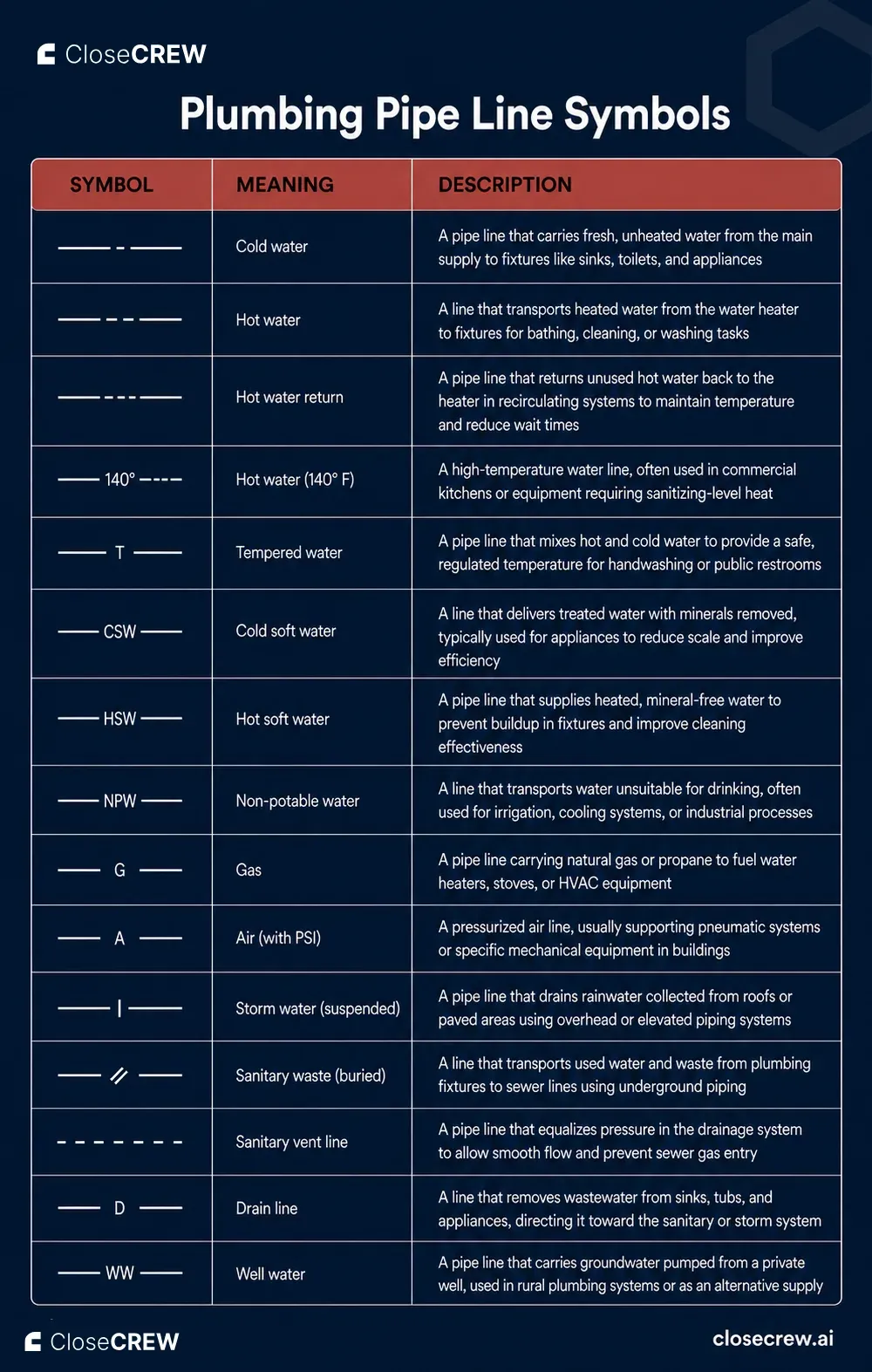
Here are the key Plumbing Pipe Line symbols and their meanings:

plumbing pipeline symbols.webp

Common Plumbing Pipe Line symbols and their meanings:

Line

Abbreviation

What it carries

Cold water

CW

Potable cold-water supply

Hot water supply

HW

Domestic hot supply, commonly 140°F

Hot water recirculating

HWR

Return loop that keeps hot water ready at the tap

Tempered water / recirculating

TW / TWR

Blended lower-temperature supply and its return

Drinking water supply / recirculating

DWS / DWR

Dedicated potable drinking lines

Soft water

SW

Softened supply

Distilled water

DI

Distilled supply

Deionized water

DE

Deionized supply

Chilled water supply / return

CWS / CWR

HVAC chilled-water loop

Condensate drain

CD

Carries condensate away from equipment

Soil / sanitary sewer

S, SAN, SS

Waste from toilets and similar fixtures

Waste

W

Greywater from sinks, tubs, and showers

Vent

V

Admits air to protect trap seals

Storm / rainwater drain

SD, ST

Roof and surface runoff

Subsoil / footing drain

SSD

Groundwater around foundations

Indirect drain

D

Discharges through an air gap

Acid waste / acid vent

AW / AV

Corrosion-resistant lab waste and its vent

Pump discharge

PD

Pressurized line leaving a pump

Gas, low / medium / high pressure

G / MG / HG

Fuel gas at the rated pressure

Gas vent

GV

Vent for gas appliances

Fuel oil supply / return / vent

FOS / FOR / FOV

Heating-oil lines

Lubricating oil / vent

LO / LOV

Lubricating-oil service

Waste oil / vent

WO / WOV

Used-oil collection

Oxygen / liquid oxygen

OX / LOX

Medical or industrial oxygen

Compressed air

A (X#A by pressure)

Shop, medical (MA), or lab (LA) air

Nitrogen / nitrous oxide / carbon dioxide

N / N2O / CO2

Medical and specialty gases

Vacuum

V, MV, SV, LV

General, medical, surgical, and lab vacuum

Wet / dry vacuum cleaning

WVC / DVC

Central vacuum systems

Steam supply, low / medium / high

LPS / MPS / HPS

Steam distribution by pressure class

Condensate, low / medium / high

LPC / MPC / HPC

Steam condensate return

Atmospheric vent

ATV

Vents steam or hot vapor to atmosphere

Heating hot water supply / return

HHWS / HHWR

Hydronic heating loop

Fire protection water supply

F

Dedicated fire line

Lawn sprinkler supply

LS

Irrigation supply

Line styles to know: a thick solid line is a major pipeline, a medium line is a connecting branch, a thin line is a standard pipe run, a dashed line is future or not-yet-installed pipe, a line with an arrow shows flow direction, and long-short dashes mark a battery limit (a boundary of responsibility).

Piping, Fitting, and Connection Symbols

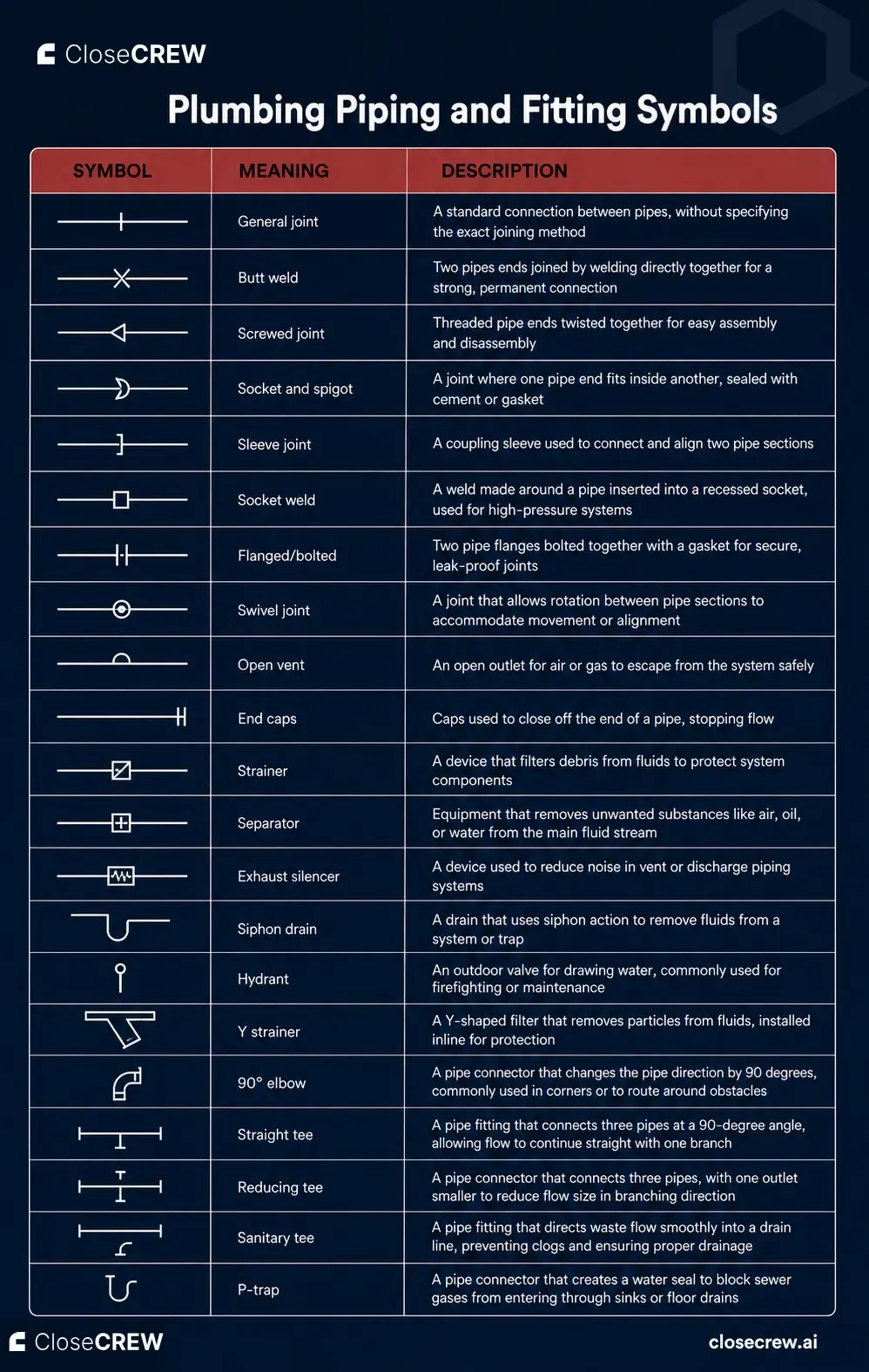
plumbing piping and fitting symbols.webp

These Plumbing Symbols show how pipes join and how flow is redirected or divided.

Symbol

What it represents

Screwed (threaded) connection

Male and female threads engage, common on small-diameter gas and water lines

Soldered or solvent joint

Copper solder or PVC and CPVC solvent cement, typical in domestic plumbing

Welded connection / butt weld / socket weld

Fused steel joints for higher-pressure piping

Flange

A bolted ring that lets pipe be joined and separated, common at equipment and valves

Union (screwed or flanged)

A removable fitting that lets a section come out without cutting, used near equipment

Mechanical coupling

A bolted or clamped joint that can be taken apart for service

Sleeve joint

A slip coupling over two pipe ends, common on low-pressure drain and vent

Cap

Closes the end of a pipe

Tee

A branch connection off a main run

Elbow / riser up / riser down

A change of direction or a vertical transition

Concentric / eccentric reducer

Transitions between two pipe diameters

Expansion joint

A bellows that absorbs thermal expansion and contraction

Flexible connector

Isolates vibration and slight movement at equipment

Pipe anchor / pipe guide

Restrains or aligns a pipe run

Branch top / bottom / side connection

Shows where and how a branch ties into a main

Air chamber

AC, a cushion that absorbs water hammer

Valve Symbols

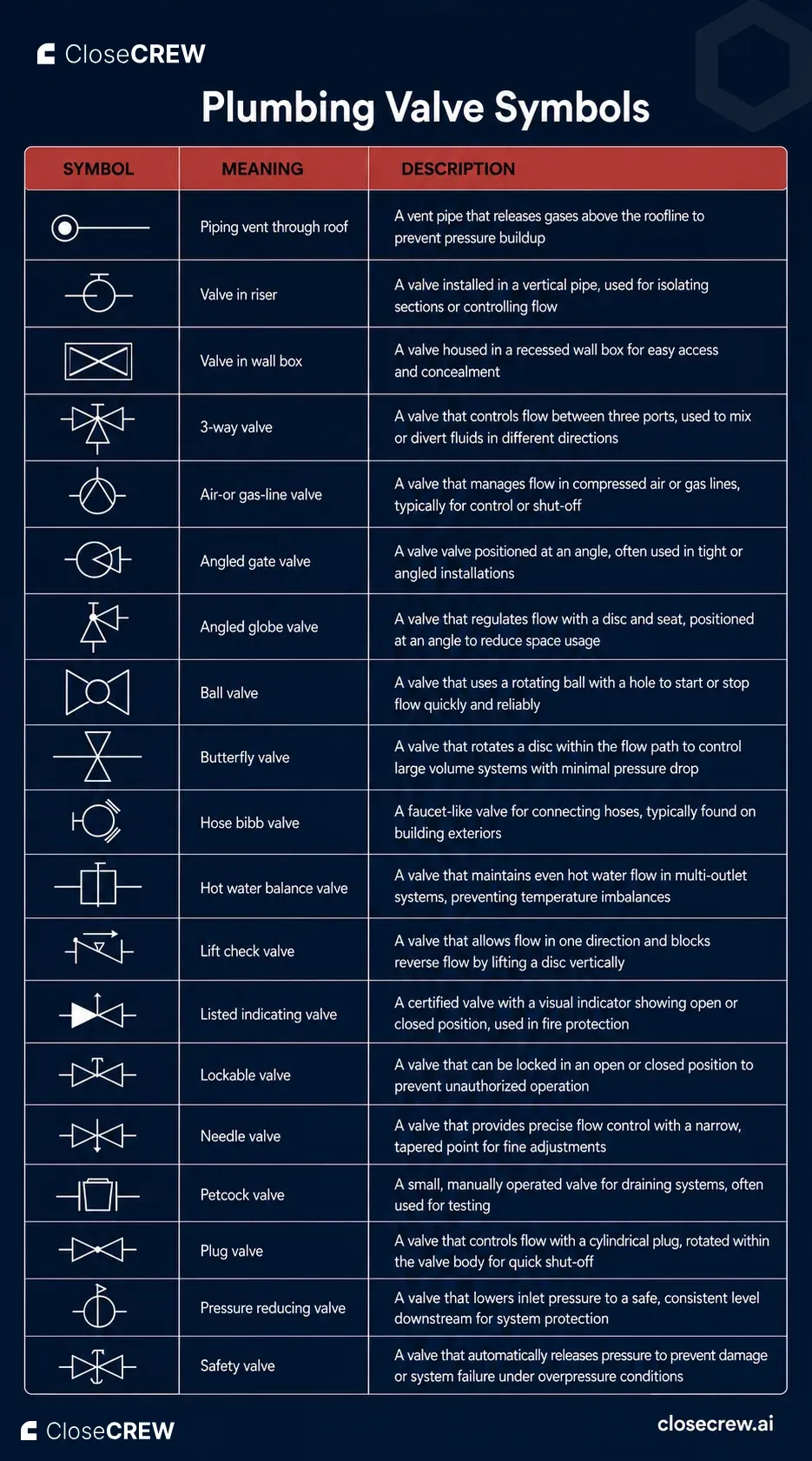
plumbing valve symbols.webp

Valves control, isolate, or protect flow. The symbol shows where each sits and what it does.

Valve

Abbreviation

Function

Gate valve

GV

Full open or closed isolation

Globe valve

GLV

Throttling and flow regulation

Angle valve

AV

Combines a 90-degree turn with control

Ball valve

BV

Quarter-turn isolation

Butterfly valve

BFV

Quarter-turn disc for isolation or throttling

Plug valve

PV

Quarter-turn tapered plug

Check valve

CV

Allows flow in one direction only

Balancing valve

BLV

Sets and holds a target flow rate

Diverter valve

Redirects flow between outlets, as in a shower diverter

Gas cock / gas stop

Manual shutoff on a gas line

Solenoid valve

Opens or closes electrically

Motor-operated valve

Driven by a powered actuator

Pressure-reducing valve

PRV

Lowers downstream pressure

Pressure-relief valve

RV

Relieves dangerous overpressure

Temperature and pressure relief valve

TPV

The safety valve on water heaters

Reduced-zone backflow preventer

RZBP

High-hazard cross-connection control

Double-check backflow preventer

DCBP

Lower-hazard backflow protection

Hose bibb / wall hydrant / yard box valve

HB / WH / YB

Outdoor and accessible supply points

Instruments and Flow-Control Devices

Device

Abbreviation

What it does

Pressure gauge with cock

PG

Reads line pressure

Thermometer

Reads temperature at a point

Aquastat

Temperature-based control switch

Flow switch / pressure switch

FS / PS

Triggers on flow or pressure change

Water hammer arrester

WHA

Absorbs shock from fast-closing valves

Automatic air vent

AAV

Bleeds trapped air from the system

Strainer (Y-type or basket)

Filters debris ahead of pumps and equipment

Orifice plate

Measures flow or creates a controlled pressure drop

Flow indicator

Shows the presence and direction of flow

Steam trap

Drains condensate while holding back live steam

Plumbing Fixture Symbols

Fixtures are shown in plan view, usually simplified outlines.

Fixture

Abbreviation

How it appears

Sink / lavatory / basin

A rectangle or oval at a wall or counter, often with faucet notation

Water closet (toilet)

An oval bowl, with a rectangular tank on tank-type units

Urinal

A wall-mounted bowl outline

Bathtub

A large rounded-end rectangle

Shower head

A circle with radiating spray dots

Floor drain

FD

A drain at floor level, usually with a P-trap

Cleanout (floor / wall / yard)

CO, FCO, WCO

An access point for clearing the line

Hose bibb / wall hydrant

HB / WH

An exterior supply outlet

P-trap / syphon drain

A U-shaped water seal that blocks sewer gas

Towel rail

A horizontal bar on bathroom layouts

Equipment Symbols

Equipment

What it represents

Boiler

A fuel-fired vessel that heats water or makes steam

Water heater

A storage or tankless unit for domestic hot water

Heat exchanger

Transfers heat between two fluids without mixing them

Pump

Moves liquid through the system, shown with a flow arrow

Radiator / convector / radiant panel

Heat-emitting devices for hydronic heating

Open tank / closed tank

Atmospheric or pressurized storage vessels

Pipe coil

A coiled length used to add heat-transfer area

Separator / in-line mixer

Splits phases or blends fluids within the line

Fire-Protection Symbols (NFPA 170)

Fire-protection plans use their own standardized set, governed by NFPA 170.

Symbol

Abbreviation

Meaning

Fire main / riser

The supply main and vertical riser for sprinkler systems

Hydrant

An outdoor supply point; variants add a pumper connection

Siamese fire department connection

FDC

Where the fire department pumps water into the system

Fire pump / test header

Boosts system pressure; the header is used for flow testing

Upright / pendant / sidewall sprinkler

Sprinkler heads by mounting orientation

Alarm check / dry pipe / deluge / preaction valve

System valves for wet, dry, and specialized sprinkler setups

Fire hose rack / cabinet

FHR / FHC

Hose storage, surface-mounted or recessed

Portable fire extinguisher

A located, rated extinguisher

Sprinklered / partially / non-sprinklered space

Designates how an area is protected

Fire alarm control panel

The system's control and monitoring point

Knowing the symbols is one half of working a job cleanly. Keeping the schedule full enough to use that skill is the other half.

Building-Context Symbols on Plumbing Plans

Plumbing plans also carry the building shell, because walls, columns, doors, and windows all affect pipe routing and fixture placement.

Symbol

What it represents

Wall

Thick double lines for exterior, thinner lines for interior partitions

Curved or curtain wall

Non-rectilinear or glass-and-metal facade that routing must respect

Column (rectangular or circular)

A structural support that pipe runs must avoid

Pilaster

A shallow column against a wall, affecting clearances

Beam

An overhead member shown dashed, affecting overhead routing

Grid line / grid origin

Reference lines used to dimension fixture and pipe locations

Door (single, double, sliding, folding, bi-fold, overhead, revolving)

Openings whose swing path fixtures and access panels must clear

Window (standard, casement, glider, bay)

Openings to note when fixtures sit on or below a wall

Tips for Reading Plumbing Schematics

A methodical approach cuts mistakes and speeds up the work:

  • Start with the legend. Even standardized symbols vary between firms, so read the drawing's key first.

  • Find the main components. Locate the main water line, heaters, and pumps before tracing smaller branches.

  • Trace the flow logically. Follow each route from the source through distribution to the fixtures to confirm everything connects.

  • Mark it up. Use color or digital markup to separate hot, cold, and waste lines and track your progress.

  • Ask when unclear. A quick question to a senior tech or the designer beats rework later.

  • Learn the neighboring trades. Plumbing overlaps HVAC and electrical, so knowing those symbols helps you avoid clashes.

  • Keep a reference handy. Save a cheat sheet on your phone or bookmark this guide for fast on-site lookups.

How CloseCrew Helps Plumbers Win and Book More Work

Reading a schematic correctly keeps a job clean. The harder problem for most shops is making sure there is always a next job and that the calls that earn you that work actually get answered.

That is where CloseCrew comes in. Larry, CloseCrew's AI employee, answers every call, text, and web inquiry around the clock in English or Spanish, qualifies the caller, and books the job straight into your schedule, then confirms appointments, follows up on unsold estimates, and requests reviews. It is the front desk that turns a ringing phone into booked, paid work while your crew stays focused in the field.

A couple of free plumbing tools help on the technical side too. Size lines correctly before you quote with the pipe sizing calculator, see what unanswered calls are costing you with the missed call cost calculator, and browse the rest of the free plumbing tools. When choosing software to run pricing and estimates, our roundup of the best plumbing pricing apps is a good place to start.

The Bottom Line

Reading plumbing symbols fluently gives you a real edge, whether you are designing systems, installing them, or chasing down a problem. Start every drawing with the legend, trace the flow from source to fixture, and lean on a reference like this one until the marks are second nature.

Then make that skill pay. Book a CloseCrew demo to see how Larry answers and books every call so your team spends more time on the tools and less time chasing the phone.

Want this as a quick-access cheat sheet on the truck? Bookmark this page, and reach out if our team can help.

Frequently asked questions

Are plumbing symbols standardized?

Largely, yes. Many follow conventions from bodies like the American Society of Plumbing Engineers, and fire-protection symbols follow NFPA 170. Still, firms vary, so always check the drawing's legend first.

A soil line carries discharge from toilets and similar fixtures, while a waste line carries greywater from sinks, tubs, and showers. Both tie into the drainage and vent system.

CW is cold water, HW is hot water supply, and HWR is the hot water recirculating line that keeps hot water ready at distant fixtures.

By their symbol shape and label. Gate (GV) and ball (BV) valves isolate flow, globe valves (GLV) throttle it, check valves (CV) allow one-way flow, and relief valves (RV, TPV) protect against overpressure. Why do plumbing plans show walls, doors, and windows? Because the building shell drives pipe routing and fixture placement. Door swings, columns, and beams all dictate where pipe can run and where access panels and fixtures will fit.

Related tools

Run the numbers before you update your price book or field software.

Contractor Blog

Cross-trade guides on hiring, marketing, and operations for every home services business.

View all guides

Plumbing Licensing

State licensing requirements, exams, and renewal rules for plumbing contractors.

View states

Meet Larry

AI receptionist built for Plumbing — answers calls, books jobs, and follows up on leads 24/7.

See Larry for Plumbing

Related articles

Equipment and Tools

Best Plumbing Gloves for 2026: The Complete Guide

No single pair does everything, though. A smart plumber keeps a few types stocked in the van and reaches for the right one per job. This guide rounds up the best plumbing gloves in six categories: disposable, cut-resistant, chemical-resistant, grip, heat-resistant, and cold-weather.

Read guide
Equipment and Tools

10 Best Plumbing Pricing Apps to Price Plumbing Jobs Profitably

Pricing is where plumbing businesses quietly win or lose money. Charge too little and you eat your margin on every third job; charge inconsistently and your books become a mess. The right pricing app fixes both by giving every tech an accurate, up-to-date pricebook and the tools to build professional estimates in seconds.

Read guide

Never miss a Plumbing service call again. Let Larry, your AI receptionist, book jobs while your crew is in the field.