Business Tips

Common Electrical Blueprint Symbols, Meanings, and Abbreviations (Free Cheatsheets)

An electrical blueprint is a language of symbols, lines, and abbreviations. The success of every job, whether it’s wiring a new building, upgrading a panel, or tracking down a fault, depends on how well you decode it. Use a ground instead of a neutral or the wrong switch in a fire alarm circuit, and you could have a short, a failed inspection, or a safety hazard. This guide is a complete, plain-language reference to the symbols you encounter on electrical drawings.

9 min readPublished July 2, 2026Updated July 20, 2026

Electrical symbols are a shorthand way to draw them. Rather than specifying every device, designers use standardized marks for switches, outlets, breakers, transformers, etc. Now a whole system can fit on a sheet that is readable by every trade. Your job is to turn those marks back into a working, code-compliant install.

Almost every electrician remembers staring at the first set of prints, which resembled a wall of hieroglyphics. The fact that the language is finite is reassuring: once you learn the symbols, they will remain with you for the rest of your career. We structured them below in the order they appear on the page.

Part of the Business Tips section in the Electrical Business Blog.
New to the Electrical Business? Start Here

There is a business learning curve that runs alongside the technical one, of course. If you are still getting the shop itself off the ground while you sharpen your blueprint skills, our guide on how to start an electrical business walks through the licensing and setup. You can also check our guide on electrical company name ideas for inspiration if you’re still deciding on your brand name. 

Get the brand and the foundation right early, and everything that comes after, from winning bigger jobs to scaling the crew, gets a whole lot easier with the right systems behind you.

What Are Electrical Symbols?

Electrical symbols are standard graphic representations used on blueprints and schematics to show components and connections: switches, outlets, breakers, transformers, panels, and the wiring between them. Many adhere to conventions related to the National Electrical Code (NFPA 70) and fire alarm symbols are designed to NFPA 72. Once you understand what each symbol means, you will be able to read a design and perform installations or repairs quickly and accurately.

Why Electrical Symbols Matter

Safe work starts with reading symbols correctly. The proper installation of each device, as shown in the design, depends on its precise location. “You can tell from the drawing what panels, relays, and controls mean, so it’s easier to service. If you can trace a circuit and find a fault without backtracking, troubleshooting will be faster. And avoiding misreads, like confusing a ground with neutral, prevents shorts, code violations, and serious safety hazards.

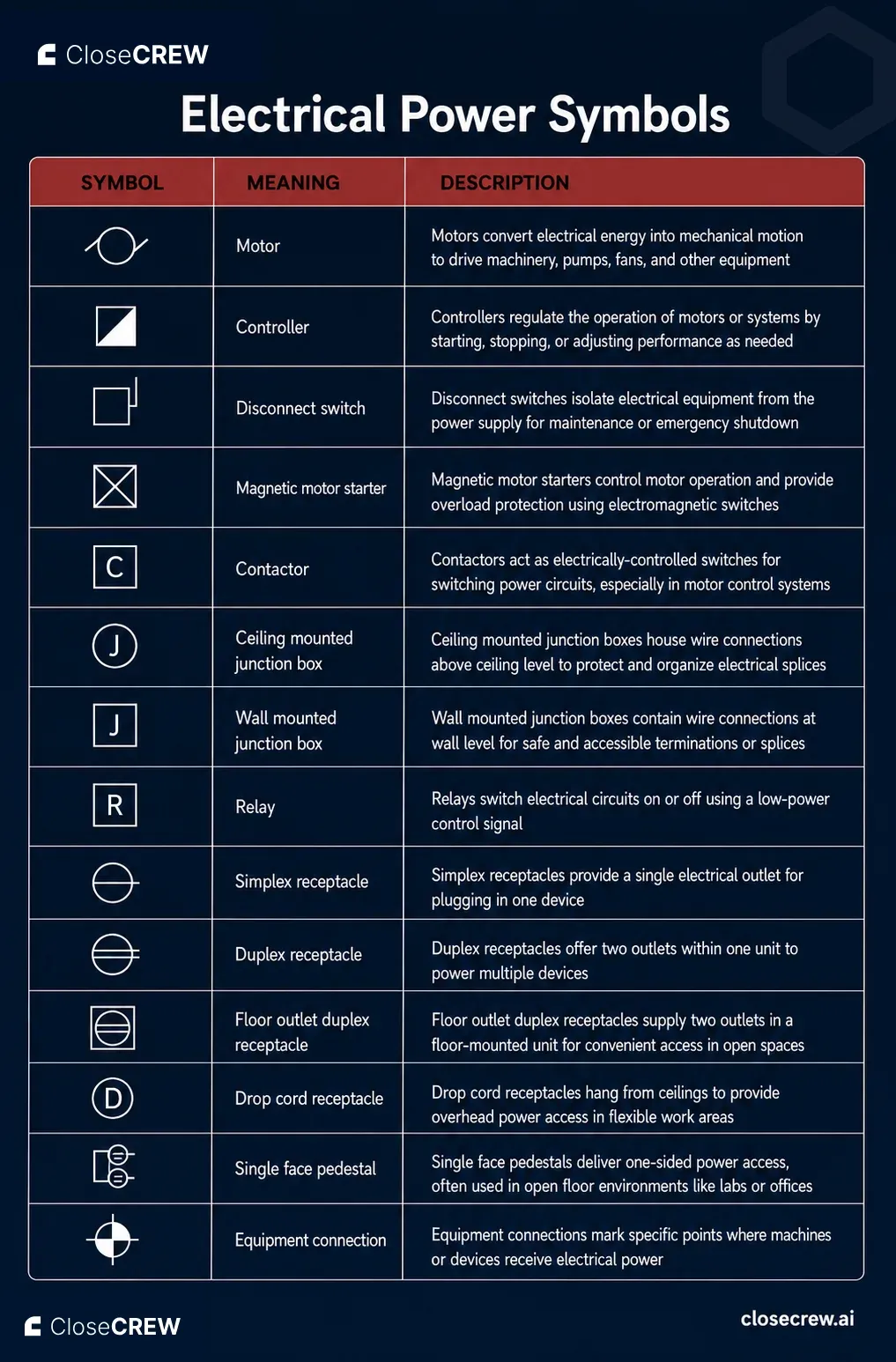
Electrical Power Symbols

electriacal power symbols.webp

These represent power distribution: outlets, switches, breakers, panels, and the components that move electricity from the service to the load.

Component

Abbreviation

What it represents

Duplex receptacle

Standard two-outlet wall receptacle

GFCI receptacle

GFCI

Ground-fault protected outlet for wet or outdoor areas

Weatherproof receptacle

WP

Outdoor-rated outlet

Special-purpose outlet

Dedicated 240V outlet for ranges, dryers, and the like

Single-pole switch

S

Basic on and off control

Three-way switch

S3

Controls one light from two locations

Four-way switch

S4

Adds control from a third location

Circuit breaker

Trips on overload or short to protect a circuit

Main circuit breaker

MCB

Main service protection and disconnect

Panelboard / load center

Distributes branch circuits

Main switchboard

MSB

Primary service distribution

Transformer

Steps voltage up or down

Motor

M

An electric motor load

Motor control center

MCC

Grouped motor controllers and starters

Disconnect switch

Safety disconnect for equipment

Meter

Measures energy consumption

Generator

Standby or backup power source

Ground

GND

Connection to earth

Junction box

Enclosure where conductors are joined

Fuse

Overcurrent protection device

Conduit / homerun

C

Raceway for conductors, with arrows for the run to the panel

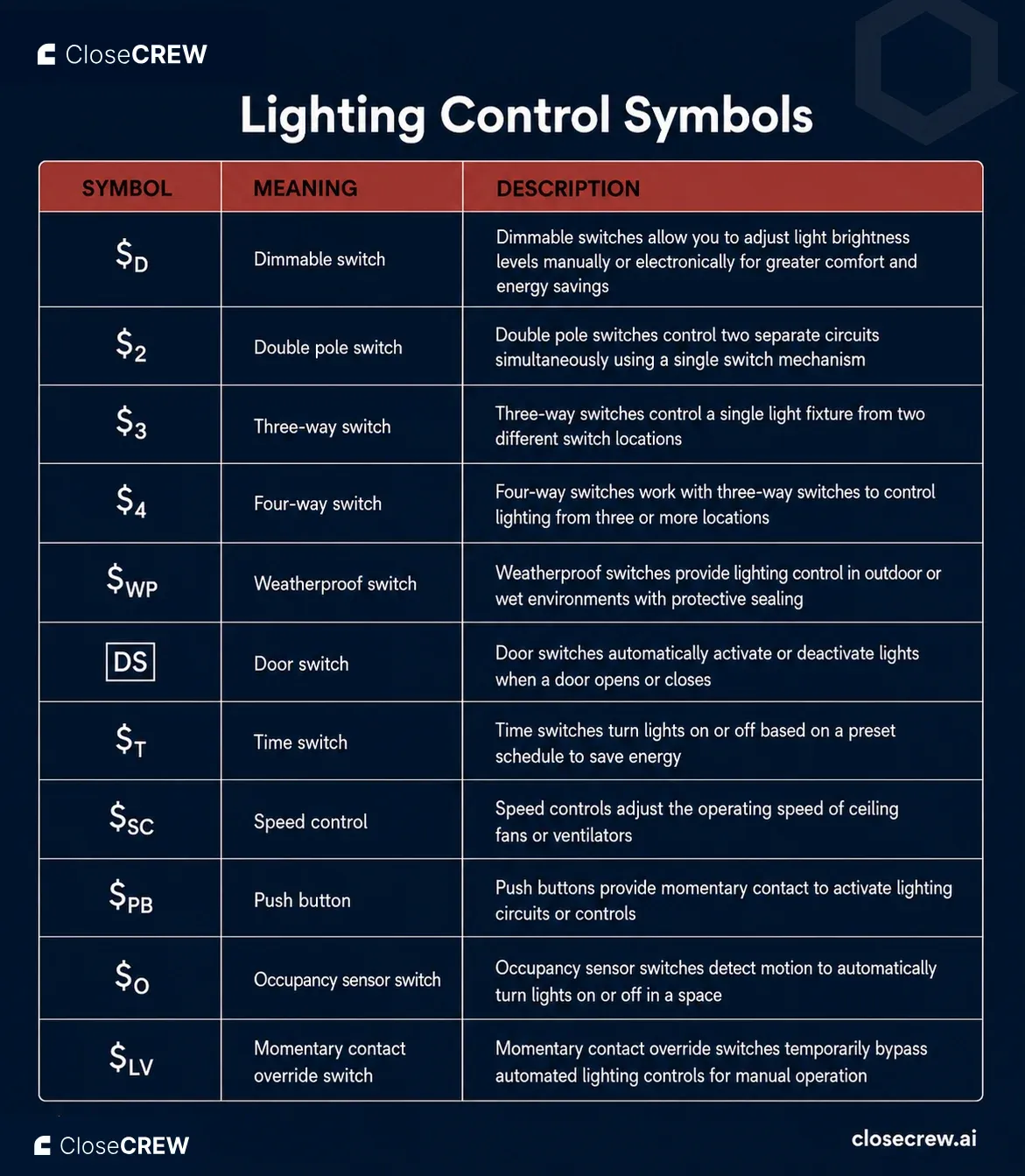
Lighting Control Symbols

lightning control symbols.webp

These cover fixtures and the switches, dimmers, and sensors that manage them.

Component

Abbreviation

What it represents

Ceiling luminaire

A surface-mounted ceiling light

Recessed luminaire

A recessed can or downlight

Wall luminaire

A wall-mounted sconce

Fluorescent or linear fixture

A strip or troffer fixture

Track lighting

A mounted track with adjustable heads

Exit sign

An illuminated egress sign

Emergency light

A battery-backed egress light

Dimmer switch

D

Adjusts light level

Three-way / four-way switch

S3 / S4

Multi-location control

Occupancy / motion sensor

OS

Switches lights by presence

Photocell

Switches by daylight level

Timer switch

Switches on a schedule

Pilot-light switch

SP

A switch with an indicator lamp

Ceiling fan

A paddle fan, often with a light kit

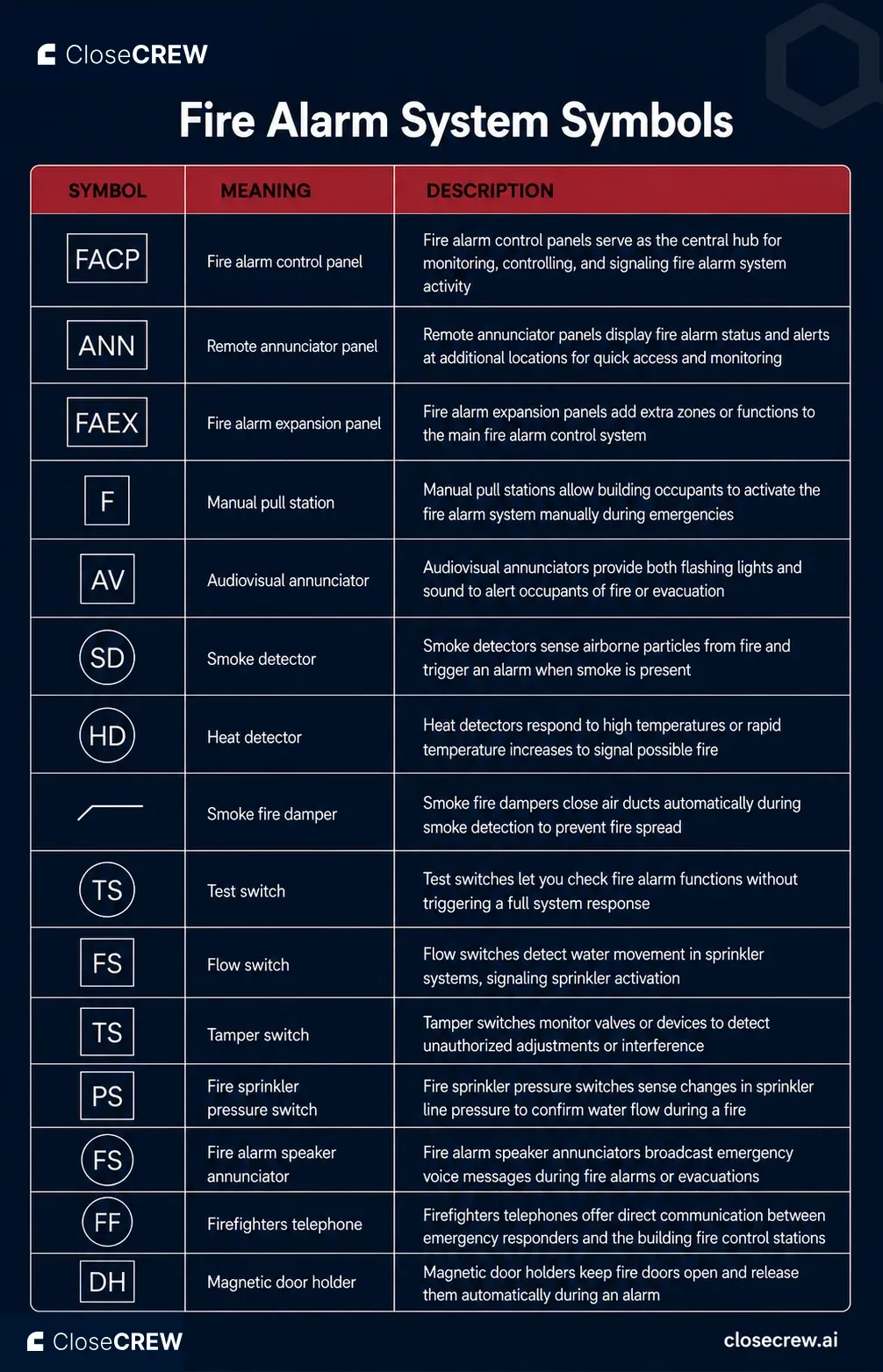
Fire Alarm System Symbols

fire alarm symbols.webp

These identify detection, notification, and control devices that must meet life-safety code.

Component

Abbreviation

What it represents

Smoke detector

SD

Senses smoke

Heat detector

HD

Senses a rapid temperature rise

Duct smoke detector

Detects smoke inside HVAC ductwork

Manual pull station

A hand-operated alarm trigger

Horn

An audible notification device

Strobe

A visual notification device

Horn and strobe

Combined audible and visual alarm

Speaker

Voice evacuation output

Fire alarm control panel

FACP

The system's central controller

Annunciator

A remote status and location display

Magnetic door holder

Releases held-open doors on alarm

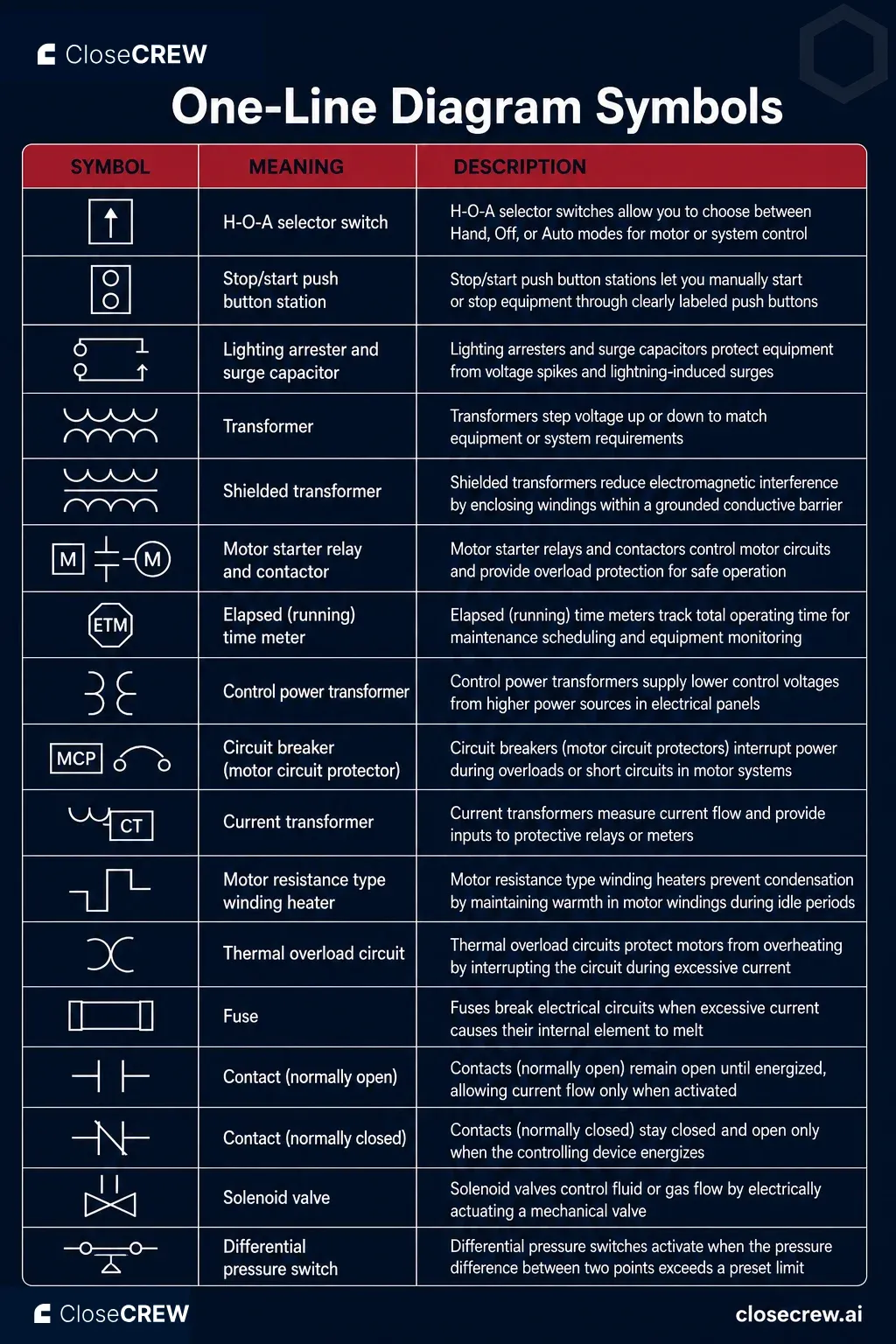
One-Line Diagram Symbols

one line diagram symbols.webp

A one-line diagram simplifies the entire system to a single line, showing the main power path.

Component

Abbreviation

What it represents

Utility source

Incoming power from the utility

Transformer

A voltage change between sections

Main breaker

Main overcurrent protection

Switchgear / switchboard

Primary distribution equipment

Bus / busbar

The conductor that distribution taps off

Current transformer

CT

Senses current for metering or protection

Potential transformer

PT

Senses voltage for metering or protection

Automatic transfer switch

ATS

Switches load to backup power

Generator

A standby power source

Disconnect switch

Isolates a section of the system

Capacitor bank

Corrects power factor

Meter

Measures system energy or demand

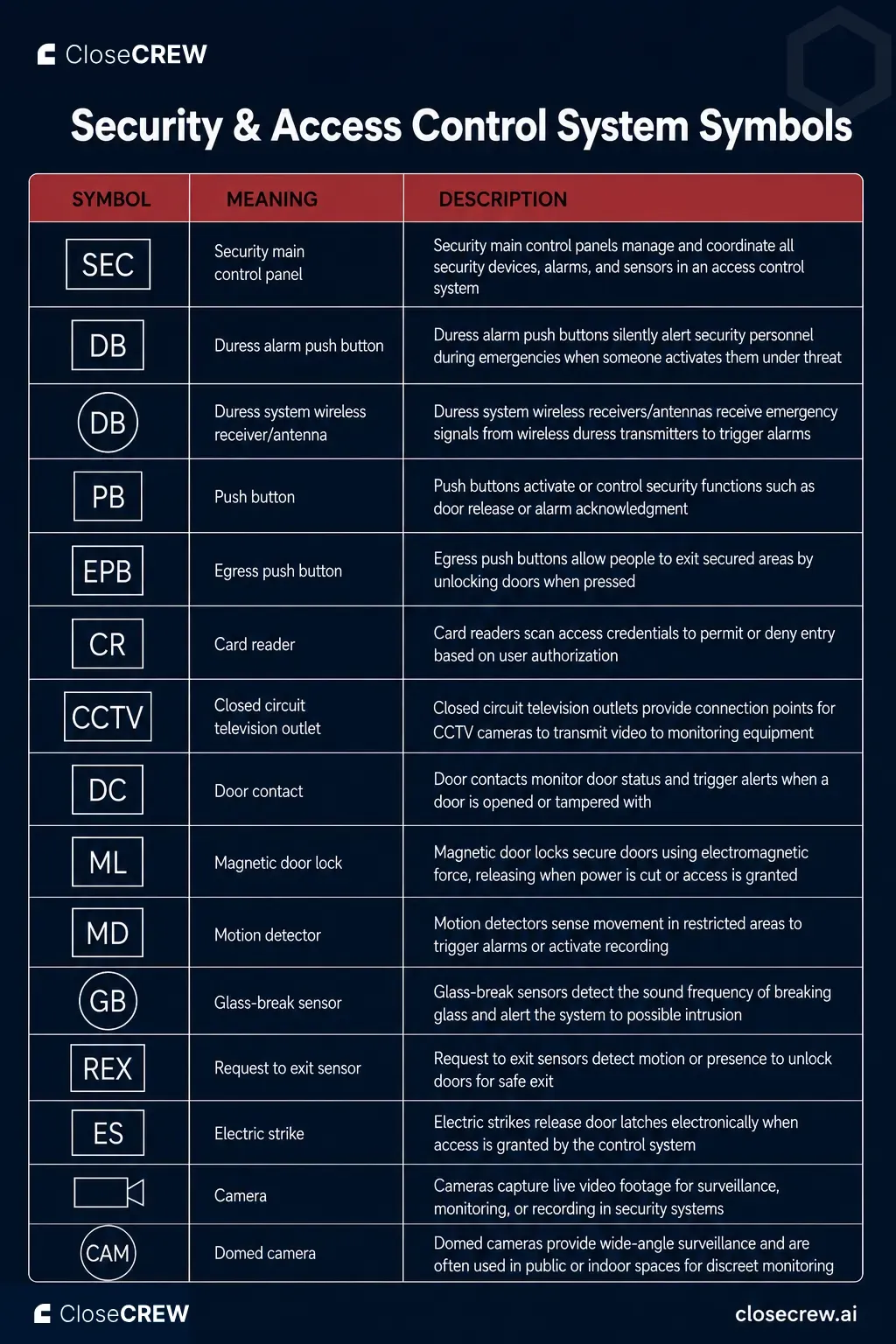
Security and Access Control Symbols

security and access control symbols.webp

These represent the devices that manage entry, monitor activity, and protect a building.

Component

Abbreviation

What it represents

Surveillance camera

CCTV

Fixed, dome, or pan-tilt-zoom camera

Card reader

Credential-based entry device

Keypad

Code-based entry device

Door contact

Senses whether a door is open or closed

Motion detector

PIR

Detects movement in a zone

Glass-break sensor

Detects the sound or shock of breaking glass

Electric strike / magnetic lock

Releases or secures a door electrically

Request-to-exit device

REX

Allows free egress without an alarm

Alarm control panel

The security system's controller

Intercom / call station

Two-way communication at an entry

Common Electrical Abbreviations

Abbreviations save space on a crowded drawing and appear next to symbols, in equipment labels, and in legends. The ones you will see most:

Abbreviation

Meaning

A

Ampere

AIC

Ampere interrupting capacity

AFCI

Arc-fault circuit interrupter

AWG

American wire gauge

BLDG

Building

C

Conduit

CT

Current transformer

EF

Exhaust fan

EGC

Equipment grounding conductor

ELEC

Electric

EMT

Electrical metallic tubing

FACP

Fire alarm control panel

FLA

Full load amps

GFCI

Ground-fault circuit interrupter

GND

Ground

HOA

Hand-off-auto

HTR

Heater

kVA

Kilovolt-ampere

kcmil

Thousand circular mils

LTG

Lighting

MCB

Main circuit breaker

MCC

Motor control center

MSB

Main switchboard

NEC

National Electrical Code

OCPD

Overcurrent protective device

OL

Overload

SW

Switch

UG

Underground

WP

Weatherproof

Knowing the symbols is half the battle. Keeping the schedule full enough to use that skill is the other half.

Tips for Reading Electrical Blueprints

A structured approach saves time and prevents rework:

  • Start with the legend and title block. They define the symbols, abbreviations, scale, and revisions, so read them before tracing a single circuit.

  • Identify major components first. Find the main panels, transformers, and service entrance before studying branch circuits, so the overall logic is clear.

  • Trace circuits step by step. Follow each one from the source to its loads to catch missing connections or conflicts before you install.

  • Use color-coding or digital markup. Highlighting circuits on a tablet makes emergency power and low-voltage systems easier to separate.

  • Cross-check other disciplines. Electrical shares space with HVAC and plumbing, so compare drawings early and raise overlaps with the designer. Our HVAC symbols and plumbing symbols guides help.

  • Keep a personal reference. Save a quick chart of common symbols on your phone or bookmark this page, for unfamiliar projects.

Free Electrical Business Tools

Free calculators and templates built for electrical contractors. Price jobs, size conductors, and grow your shop without paying for generic software. Browse all electrical tools.

Start with the ones contractors use most, several of which pull straight off the blueprint symbols above:

  • Wire Size Calculator. Size copper or aluminum conductors per NEC Table 310.16 ampacity, with ambient temperature correction, bundling derating, a voltage drop check, an OCPD recommendation, and the equipment grounding conductor per Table 250.122.

  • Voltage Drop Calculator. Calculate voltage drop over a conductor run using NEC Chapter 9 Table 8: check drop percent and find the minimum wire size or the maximum circuit distance for branch circuits and feeders.

  • Job Pricing Calculator. Price jobs with cost-plus formulas covering loaded labor, materials with a waste factor, overhead recovery, and a target net margin using the industry divisor method.

  • Labor Rate Calculator. Find your fully loaded billable hourly rate from base wage, payroll burden, workers' comp, benefits, overhead recovery, and target net profit.

  • Profit Margin Calculator. Calculate net profit per job, including materials and labor.

  • Missed Call Cost Calculator. Quantify the revenue lost when calls go unanswered, segmented across routine service, emergency, and high-value project leads.

Electrical contractors are taking emergency calls, seasonal demand, flat-rate pricing, and crew scheduling, often from the cab of a truck. Free tools to help you quote faster, document consistently, and catch margin problems before they hit your P&L. For more on the gear and software side, see our roundups of the best electrician tools and the best CRMs for electrical contractors.

How CloseCrew Helps Electricians in the Field

Reading a blueprint correctly keeps a job clean. The harder problem for most shops is making sure there is always a next job and that the calls earning that work actually get answered.

That’s where CloseCrew comes in. Larry is the AI employee that answers every call, text, and web inquiry 24/7 in English or Spanish, qualifies the caller, and books the job straight into your schedule. Then he confirms appointments, follows up on unsold estimates, re-engages quiet customers, and requests reviews. The front desk is what converts a ringing phone into booked, paid work while your crew can concentrate on the install.

Pair that with the free tools above to look established from day one: run the missed call cost calculator to see what voicemail is costing you, size conductors and price jobs in the field, and let Larry handle the phone. Once you are scaling, it is also worth getting the basics right, including the right electrical business insurance.

The Bottom Line

Understanding electrical symbols, meanings, and abbreviations will allow you to work more quickly, avoid costly mistakes, and communicate clearly throughout all phases of a project. Begin each sketch with the legend, trace the circuits from source to load, and keep a reference like this one handy until the marks become second nature.

Then make that skill pay. Book a CloseCrew demo to see how Larry answers and books every call, so your team spends more time on the tools and less time chasing the phone.

Want a quick-access cheat sheet on the truck? Bookmark this page, and reach out if our team can help.

Frequently asked questions

Are electrical symbols standardized?

Mostly, yes. Many are built to the National Electrical Code (NFPA 70). Fire alarm symbols are per NFPA 72. Always read the legend and title block of the drawing first as companies still vary.

A one-line diagram simplifies the system into single lines that show the main power path and major equipment, providing a high-level overview. A wiring diagram shows the detailed point-to-point connections needed to actually wire devices.

GFCI is a ground-fault circuit interrupter, a receptacle or breaker that cuts power when it detects a ground fault, required in wet and outdoor locations.

By the symbol and its subscript. S is a single-pole switch, S3 a three-way, and S4 a four-way, while D marks a dimmer and OS an occupancy sensor.

That depends on load, conductor material, temperature, and distance. Our free wire size and voltage drop calculators size conductors per NEC Table 310.16 and check voltage drop so you do not have to work it by hand.

Related tools

Run the numbers before you update your price book or field software.

Contractor Blog

Cross-trade guides on hiring, marketing, and operations for every home services business.

View all guides

Electrical Licensing

State licensing requirements, exams, and renewal rules for electrical contractors.

View states

Meet Larry

AI receptionist built for Electrical — answers calls, books jobs, and follows up on leads 24/7.

See Larry for Electrical

Related articles

Never miss a Electrical service call again. Let Larry, your AI receptionist, book jobs while your crew is in the field.