Operations and Tech

8 Best Practices for Scaling a Multi-Branch Plumbing Business

In this plumbing business guide, we covered eight practical practices for scaling a multi-branch plumbing business, from knowing when to expand and standardizing pricing to managing branch performance, maintaining brand consistency, and building systems that grow with you.

11 min readPublished September 10, 2026

Managing a multi-branch plumbing business means giving up the thing that got your business off the ground in the first place: you, personally, catching every problem before it gets expensive. Your first shop ran on instincts built over years, the kind where a dispatcher just knows which customers pay on time and which jobs are worth prioritizing without anyone writing it down.

None of that transfers automatically when you open a second location. The new branch has its own crew, its own customer list, and its own emerging version of "how we do things." If you don't standardize quickly, that new branch will develop its own version of "how we lose money" too, and you won't notice until the numbers are already bad.

That's the shift this guide is built around: moving from a single location that runs on your instincts to a multi-branch operation that actually runs on systems. Some of what follows matters most the moment you're deciding whether to open location two. Other parts matter more once you're already running four or five branches and starting to notice the cracks between them. Either way, it's the same underlying problem: instincts don't scale, and systems do.

This is the operational reality behind most stalled expansions: the first location ran clean for years, but the second one quietly drags down overall margins while the owner is too busy putting out fires to notice until the damage is already done.

The eight practices below separate plumbing companies that add genuinely profitable locations from those that just add locations. We'll also give straight answers on when you're actually ready to expand and how to launch a new branch without repeating the same mistakes at a larger scale.

Part of the Operations and Tech section in the Plumbing Business Blog.
1. Know When Your Plumbing Business Is Actually Ready to Expand

Most plumbing companies expand because the phone won't stop ringing, not because the business itself is genuinely ready to run two locations at once. Confusing busyness with readiness is how a profitable single-location shop turns into two locations that both lose money.

Three signals matter more than raw call volume:

Your current territory is running near capacity. Technicians should be booked on real jobs year-round, not just during a seasonal spike that happens to line up with when you're deciding to expand.

Your pricing, dispatching, and invoicing run on documented processes, not your personal sign-off. If you're currently the bottleneck at one location, you'll be a worse bottleneck spread across two.

Your margins have held steady for at least two years. Industry benchmarks commonly put the threshold around 15 to 20 percent EBITDA margins sustained over two straight years, enough of a cash cushion to absorb a new location's break-even period without starving the branch that's already working.

That last signal gets skipped constantly. Owners look at revenue instead of margin when deciding they're ready to grow, and revenue growth from a new branch is genuinely easy to generate. Profitable revenue growth depends on knowing your real booking rate, not whatever number your field service software reports by default.

Real booking rates tell a more sobering story than most owners expect. Industry benchmarks put booking rates for strong-performing inbound call handling somewhere around 25 to 35 percent, often noticeably lower than what shows up internally once unbooked calls quietly get reclassified as "non-leads" instead of missed opportunities. If you don't know that number cold for your existing branch, applying the same loose math to a second one just gives you two blind spots instead of one.

The operational fix: pull your last 24 months of monthly P&Ls, your real booking rate, and technician utilization before you sign a lease on a second location. If any of those numbers genuinely surprise you, fix the first branch before you open a second one.

Before you commit to a second location, make sure your first one is actually ready to support the growth.

2. Choose the Right Route Into a New Market

Once you've confirmed you're actually ready, the next decision is how you enter the new market, and this choice shapes almost everything that follows.

Organic build-out means starting from zero in the new territory: leasing a space, hiring a local crew, and building the customer base from the ground up. It's the slowest route, but it gives you the most control over culture, pricing, and standards from day one, since you don't have to unwind anything inherited later.

Acquisition means buying an existing plumbing business already operating in the target market. It's faster to reach meaningful revenue, since you inherit an existing customer base and trained crew, but it also means inheriting whatever bad habits, pricing inconsistencies, or culture problems came with the purchase. A clean acquisition audit before closing, reviewing the same P&L, booking rate, and utilization numbers you'd check for your own branch, matters just as much here as it does when deciding to expand in the first place.

A satellite or hub-and-spoke model means operating the new territory as a lighter-footprint extension of your existing branch, sharing back-office functions, dispatch, or even a shared technician pool during the ramp-up period, before eventually spinning it off into a fully independent branch. This tends to be the lowest-risk option for a first expansion, since it limits how much new overhead you're carrying before the new territory proves itself.

There's no universally correct choice here. A market with strong existing competitors but weak service quality tends to favor acquisition, since you're buying market share you'd otherwise have to fight for. A genuinely underserved market with room to build a reputation from scratch tends to favor organic build-out instead.

Quick Cheatsheet

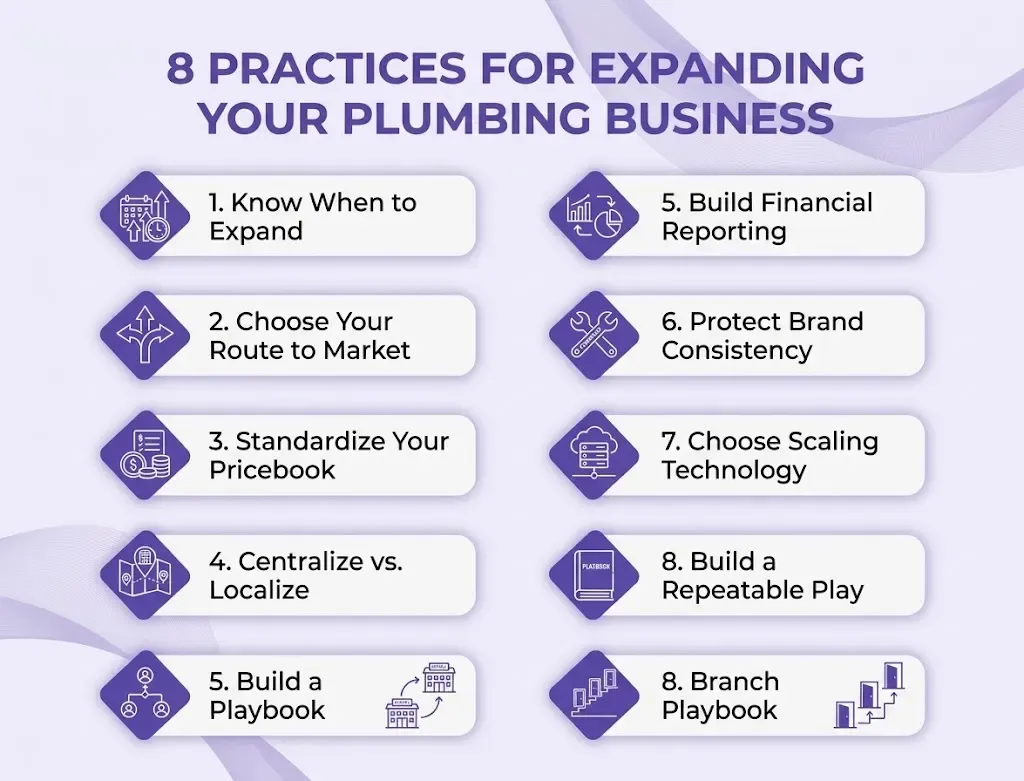
Here's a quick cheatsheet you can save and refer back to whenever you're planning your next branch.

8 practices for plumbing business.webp

3. Standardize Your Pricebook Before You Standardize Anything Else

A pricebook that lives in one owner's head, or worse, varies branch by branch based on whoever's quoting the job, is one of the fastest ways to quietly bleed margin across a growing company. Before opening a second location, your pricing needs to exist as a documented, transferable system, not tribal knowledge specific to your original crew.

That means real labor rate calculations that account for actual overhead per branch (rent and local costs vary by market, even if your labor rate framework doesn't), consistent markup rules across materials, and a shared method for building tiered estimates that any trained CSR or technician can execute consistently, regardless of which branch they're working out of. If your current pricing process is still informal, it's worth reviewing dedicated plumbing pricing tools built to standardize this before you try to reconcile two different pricing cultures at once.

4. Decide What Gets Centralized and What Stays Local

Not everything should be centralized just because it's more efficient on paper, and not everything should stay local just because "that's how we've always done it." Getting this split right early saves a lot of painful restructuring later.

Things that generally benefit from centralization: pricing standards, brand guidelines, financial reporting, hiring criteria, and call handling. A customer calling your business should get a consistent, professional experience regardless of which branch dispatches the job, and that consistency is genuinely hard to maintain if every branch trains its own CSRs from scratch with no shared standard.

Things that generally benefit from staying local: specific vendor relationships, some scheduling nuances tied to local traffic patterns or customer habits, and community-specific marketing. A branch manager who knows the local market intimately should have real authority over decisions that only make sense with that local context.

Keeping call handling consistent across every branch is easier when one system manages it for you. See how CloseCrew helps growing plumbing businesses handle calls and book jobs across locations.

5. Build Financial Reporting That Actually Compares Branches Fairly

Once you're running more than one location, your reporting needs to answer a specific question cleanly: Is branch two actually profitable, or is branch one subsidizing it without anyone noticing?

That requires consistent cost categorization across branches, shared overhead allocated by a documented formula rather than guesswork, and a reporting cadence tight enough that a struggling branch gets flagged in weeks, not discovered at year-end when the damage is already done. Many owners get this wrong by comparing raw revenue across branches instead of margin, which flatters a busy-but-unprofitable branch and can mask a real problem for months.

6. Protect Brand Consistency as You Grow

A customer who's had a great experience with your original branch should get the same experience if they happen to call the new one, and a lot of that consistency comes down to details that are easy to overlook while you're focused on bigger operational questions: consistent vehicle branding, the same tone and professionalism on every call, uniform pricing presentation, and the same quality standards for how a job site gets left when the work is done.

This matters more than it sounds. Inconsistent branding across locations doesn't just look unpolished; it actively undermines the trust that took years to build at your original location, and it's far easier to protect that consistency early than to repair it after a customer has a bad experience at a new branch and assumes it reflects the whole company.

7. Choose Technology That Scales With You, Not Against You

The software and systems that worked fine for a single location often break down quietly once you add a second one, not because they stop functioning, but because they were never built to give you a clean, comparable view across multiple branches at once.

This is where a genuinely multi-location-capable CRM earns its keep: it keeps customer history, scheduling, and job data consistent and comparable across every branch, instead of siloed in separate systems that don't talk to each other. The same logic applies to how calls get answered. Hiring and training a dedicated CSR team from scratch for every new branch is expensive and slow and produces exactly the kind of inconsistency you're trying to avoid, one branch answers calls warmly and efficiently, another leaves customers on hold or, worse, sends calls to voicemail during a busy afternoon.

CloseCrew's Crew solves this specific problem directly. Because Crew is an AI receptionist rather than a locally hired and trained team, expanding to a new branch doesn't mean rebuilding your call-handling standard from zero. The same trained scripts, qualifying questions, and 24/7 coverage extend to a new location the moment it opens, so call quality doesn't quietly degrade every time you add a branch. Every call gets logged with a full transcript, which solves the booking-rate blind spot mentioned earlier: Instead of estimating your real booking rate from imperfect field service reports, you can see precisely how many calls came in, how many got booked, and where the gap actually is, branch by branch.

  • 24/7 call answering: every branch gets the same reliable coverage, day or night.

  • Smart appointment booking: checks real availability per branch and confirms bookings automatically.

  • Lead qualification: consistent intake standards across every location, not whichever CSR happens to be on shift.

  • CRM & calendar sync: jobs flow into your existing multi-branch scheduling software automatically.

  • Call recordings & transcripts: a real, accurate booking rate for every branch, not an estimate.

  • Custom scripts per trade: built for plumbing, and consistent no matter which branch is answering.

8. Build a Repeatable Branch Launch Playbook

The first branch you open after your original location teaches you more than any amount of planning can. Most owners treat each new branch as a unique project instead of capturing what worked (and what didn't) in a documented playbook for the next one.

A real launch playbook should cover the pricing standardization work from practice three, the centralization decisions from practice four, the reporting structure from practice five, the branding checklist from practice six, and the technology rollout from practice seven, all as a repeatable sequence rather than something reinvented from scratch each time. Businesses that genuinely scale well tend to treat branch four as a smoother, faster version of branch two, not a completely separate challenge. That's really the entire point of building systems in the first place: the tenth branch should be easier to open than the second one, not harder.

The Real Difference Between Adding Locations and Adding Profit

Scaling a plumbing business past a single location is less about ambition and more about discipline: knowing your real numbers before you expand, standardizing what should be standardized, protecting what makes your brand trustworthy, and choosing systems that get simpler to extend with every new branch instead of more fragile.

Getting the call-handling piece right early is one of the more overlooked parts of that discipline, and it's also one of the easiest to fix. If lead flow into a new market is still a question mark, this guide to generating more plumbing leads is worth reading alongside your expansion plan, since a new branch with weak lead flow struggles regardless of how well everything else is standardized.

Want to see how CloseCrew helps growing plumbing businesses keep call quality consistent across every branch, from the first location to the tenth? Book a demo or see pricing to get started.

Related tools

Run the numbers before you update your price book or field software.

Contractor Blog

Cross-trade guides on hiring, marketing, and operations for every home services business.

View all guides

Plumbing Licensing

State licensing requirements, exams, and renewal rules for plumbing contractors.

View states

Meet Larry

AI receptionist built for Plumbing — answers calls, books jobs, and follows up on leads 24/7.

See Larry for Plumbing

Related articles

business-tips

Top 10 Plumbing Trade Shows and Conferences for 2026-2027

Trade shows give plumbing professionals the chance to see new products, network with peers, and earn continuing education. This guide covers 10 upcoming shows from late 2026 through early 2027 with verified dates, locations, and strategies for turning trade show connections into business growth.

Read guide
business-tips

Plumbing Van Wraps: What You Need to Know (2026)

Plumbing van wraps generate thousands of daily impressions at the lowest cost per impression of any advertising method. This guide covers wrap types, design best practices, costs, maintenance, and the strategy that turns daily impressions into actual booked revenue for your plumbing business.

Read guide

Never miss a Plumbing service call again. Let Larry, your AI receptionist, book jobs while your crew is in the field.

We will run your numbers on the call and tell you if the maths does not work for a shop your size. That happens, and it is a cheaper conversation than finding out three months in.

Get a demo