How to Get More Plumbing Leads in 2026: Strategies, Channels, and Cost-Per-Lead Benchmarks
Generating plumbing leads in 2026 is about building a consistent system, not relying on one source. With high competition and rising ad costs, plumbers need a mix of Google Business Profile, Local Services Ads, SEO, reviews, referrals, and paid ads to stay visible.
Lead quality matters more than volume, with emergency and high-intent calls converting the best. The most successful businesses combine paid channels for quick results with SEO and reviews for long-term, low-cost growth.
Speed, tracking, and follow-up decide success. Companies that respond faster and convert more leads from the same traffic consistently outperform competitors.
21 min readPublished June 11, 2026Updated July 14, 2026
There is no shortage of people who need a plumber. The problem is getting them to call you instead of the company one zip code over. Plumbing is one of the most competitive categories in local search, with hundreds of thousands of "plumber near me" searches every month and a Google Ads competition score of around 72 out of 100, which means you are bidding against franchises and national aggregators for the same customers. It is why so many owners burn through $2,000 to $4,000 on ads and get only a handful of leads.
The plumbers who scale past a quiet, referral-only existence all share one thing: a predictable system that produces leads every week, not just when the phone happens to ring. This guide covers the channels that actually generate plumbing leads in 2026, real cost-per-lead benchmarks for each, an honest take on which to skip, and the step most companies overlook that quietly wastes the rest.
Over the years, CloseCrew has helped thousands of plumbing, HVAC, and electrical companies grow with our AI-powered communications and booking platform. At the center is Larry, an AI Employee who runs your phones, fills your calendar, and grows your memberships so your team can focus on the work.
What the wrong tools cost you: Most contractors are running on five tools held together with duct tape. Leads that come in after hours go cold before anyone calls back. Your team is on the phone chasing callbacks instead of running jobs. A missed call is a missed job. Memberships only get pitched when a tech remembers. Revenue slips through the cracks between the call, the estimate, and the follow-up. CloseCrew replaces all of that with one system.
In the strategies below, we'll show you how CloseCrew and Larry can help you execute many of these lead generation tactics automatically.
Not all leads are equal: quality beats quantity
A plumbing lead is any potential customer who takes a deliberate action to contact you, such as making a phone call, submitting a form, or sending a message through your Google Business Profile. The key word is action. Someone who drove past your van is not a lead yet.
And the leads are not worth the same. A homeowner with water pouring through the ceiling at 11 PM is worth far more than someone casually pricing a bathroom remodel for next year. In fact, emergency searches convert at several times the rate of planned-service searches, because the emergency caller is hiring, not shopping. The best lead generation attracts high-intent inquiries in your service area and converts them fast, rather than chasing raw volume.
What plumbing leads actually cost in 2026
Before choosing channels, it helps to know what each one costs per lead. The table below shows typical 2026 benchmarks for residential plumbing in the United States. Emergency work and major metros sit at the high end of each range, and commercial leads usually run 30 to 50 percent higher.
Lead source
Typical cost per lead
Speed to first lead
Long-term value
Google Business Profile
$0 to $20
1 to 2 weeks
Very high
Local SEO (your website)
$5 to $35 (after ~6 months)
3 to 6 months
Very high
Reviews and referrals
$0 to $30
Ongoing
Very high
AI search (ChatGPT, Perplexity)
$3 to $15 (after ~6 months)
2 to 3 months
Very high
Google Local Services Ads
$15 to $100
About 1 week
High
Google Search Ads (PPC)
$25 to $200
1 to 2 weeks
Medium
Facebook and Instagram ads
$30 to $200+
About 1 week
Medium
Shared leads (Angi, HomeAdvisor)
$15 to $45
1 to 2 days
Low
Exclusive leads (aggregators)
$50 to $150
1 to 2 days
Low to medium
Direct mail
$40 to $300
2 to 4 weeks
Situational
A healthy blended cost per lead across a good mix of channels lands between $15 and $55 for service calls and $50 and $150 for larger install jobs. If your overall number is much higher than that, your market is unusually expensive, or your channel mix is broken. The most successful plumbing companies run five to seven of these channels at once, using paid sources to fill the pipeline now while building owned sources that get cheaper over time.
Why plumbing lead generation is different
Plumbing is mostly emergency-driven, so lead volume stays fairly steady year-round instead of spiking with the seasons. But you are really chasing two kinds of customers. There are urgent jobs, the burst pipe and the clogged main, where the customer calls the first credible plumber they find. And there are higher-ticket jobs like water heater replacement, repiping, and sewer work, where homeowners research for days before deciding.
Good lead generation captures both. Paid ads and your Google Business Profile catch the urgent, ready-to-call searches, while local SEO and a strong review profile build the trust that wins the bigger, slower decisions. That is why the most successful service businesses use multiple lead sources rather than betting everything on one.
1. Claim and optimize your Google Business Profile
Claiming and optimizing your Google Business Profile helps your plumbing business appear in local search results, increasing website traffic and making it easier for potential customers to find and contact your services. Since 84% of homeowners use Google before choosing a home-service provider or contractor, having a strong presence on the platform is essential for attracting local leads.
Your Google Business Profile provides a quick snapshot of your business, including your contact details, logo, service area, business hours, customer reviews, and photos of your work. This helps potential customers quickly understand what you offer and decide whether to reach out.
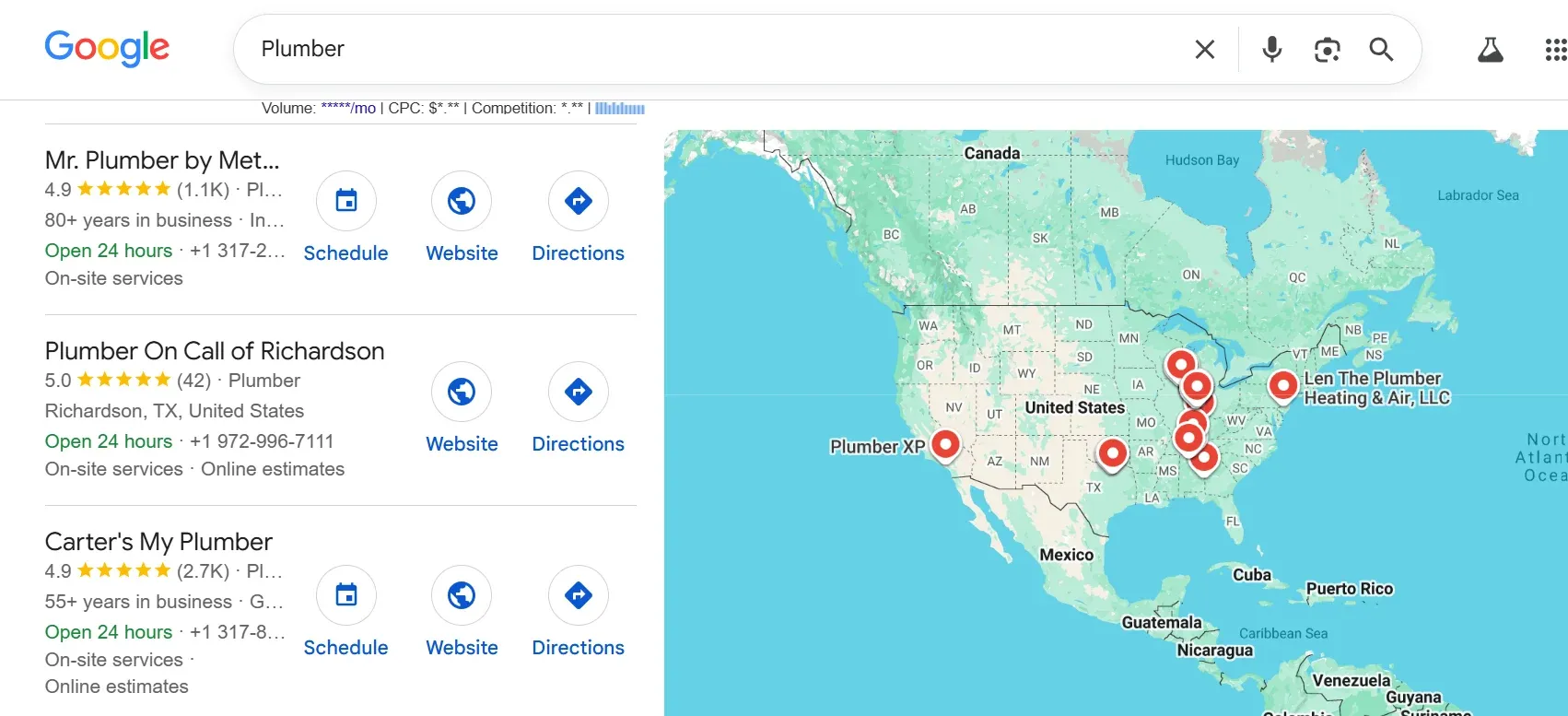
Here’s what your Google Business Profile will look like when a new customer searches for a plumber in your area.
How CloseCrew Captures Every Lead Your GBP Generates
Your Google Business Profile makes the phone ring. Larry, CloseCrew's AI Employee, makes sure someone answers. When a homeowner finds your listing at 9 PM and taps "Call," Larry picks up instantly, qualifies the job (emergency or scheduled), and books the appointment directly into your FSM calendar. Larry knows your routes and technicians' skill sets, so he suggests appointments with available, nearby techs.
GBP leads that come through webchat or the messaging feature flow into CloseCrew's single unified inbox, alongside calls, texts, and third-party leads, and are accessible to Larry and your entire team. No more checking five different apps to see who contacted you. One system, every lead, every channel.
2. Run Google Local Services Ads
When someone searches for an emergency plumber, Local Services Ads (LSAs) appear at the very top of Google search results, above both organic listings and traditional ads. These ads include a Google Guaranteed badge, which helps build immediate trust with potential customers who need urgent plumbing services.
LSAs are widely seen as one of the fastest ways to generate plumbing leads because you only pay for actual leads instead of clicks, and Google screens inquiries to reduce spam and irrelevant requests. Many plumbing businesses start receiving their first calls within the first week of launching.
To get the best results, it is recommended to begin with a controlled weekly budget, regularly review and dispute low-quality or out-of-area leads, and continuously improve your business profile. When Local Services Ads are combined with a well-optimized Google Business Profile, businesses often see a significant reduction in cost per lead, sometimes by 30 to 40 percent.
How CloseCrew Maximizes Your LSA Performance
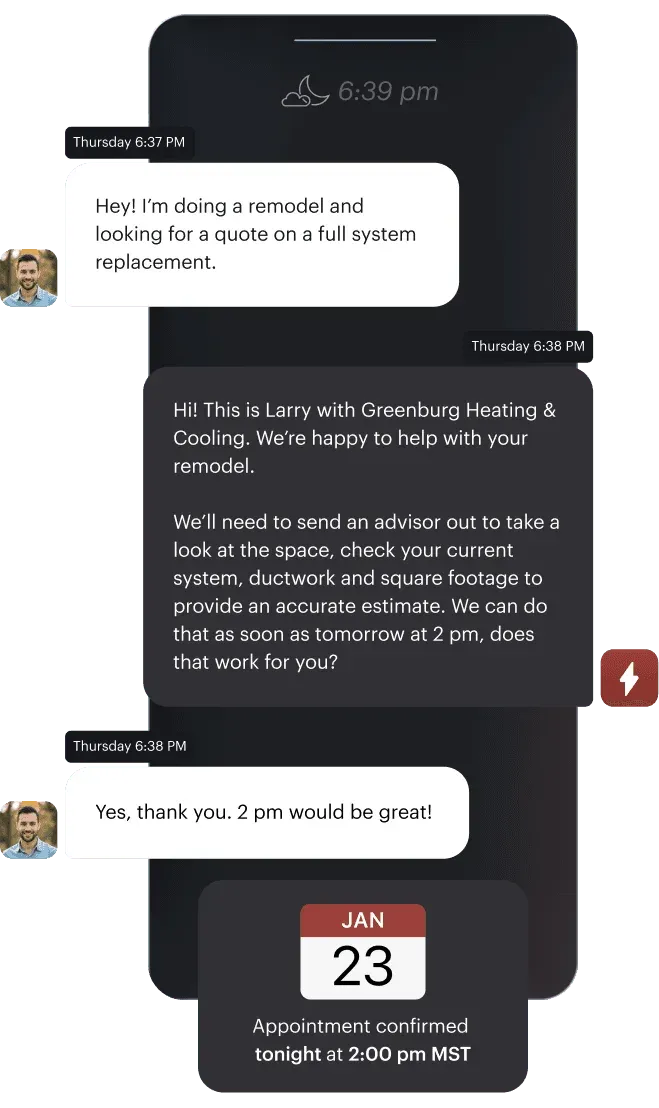
Your LSA ranking is directly tied to response speed. Google rewards businesses that answer fast. Larry answers every LSA lead instantly, 24/7, using Voice AI that sounds like your best employee. That immediate response rate signals to Google that your business is highly responsive, pushing your ad ranking higher and reducing your cost per lead.
Larry doesn't just answer. He follows through. He qualifies the lead, books the job directly into your FSM calendar, and sends the customer an automatic text confirmation to reduce no-shows.
Premier Heating and Air cut their response time from 12 minutes to under 1 minute after Larry started handling incoming calls and converted 3x more leads as a result.
3. Use Google Ads for high-intent searches
Standard Google Ads work alongside Local Services Ads by helping you reach people actively searching for plumbing services in your area. These ads appear in search results when users type relevant queries, giving your business additional visibility beyond LSAs and organic listings.
The key challenge with Google Ads is competition, which can quickly drive up costs if not managed carefully. That is why it is important to use tightly focused, hyper-local targeting so your ads only show to people in your service area. For urgent queries like emergency plumbing, call-only ads can be especially effective because they make it easy for customers to contact you directly.
To improve performance, build and update a weekly negative keyword list to filter out irrelevant traffic like job seekers or DIY-related searches. Instead of sending users to your homepage, direct them to a dedicated landing page designed for conversions, which can significantly improve lead quality and reduce drop-offs. Watch your cost per lead closely, since plumbing search ads average around $52 per lead and climb fast in crowded metros.
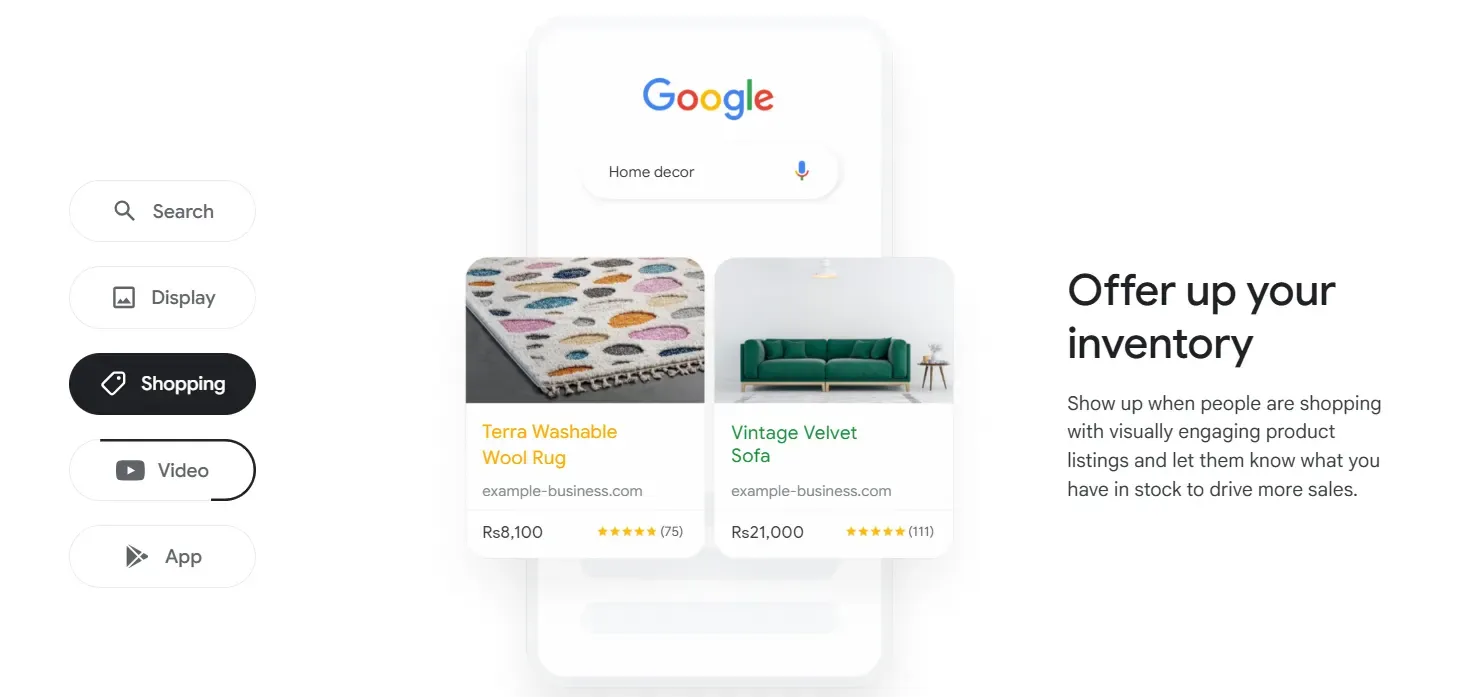
Here’s an example of how your ads look in Google search:
How CloseCrew Turns Ad Clicks into Booked Jobs
The biggest leak in most plumbing ad budgets isn't a bad campaign. It's leads that never get booked. 40% of home services calls come in after hours. Larry responds to every inbound lead the moment it comes in, day, night, weekend. When your conversion rate goes up, your cost per acquisition goes down, even without changing your ad spend.
Air Texas saved $2,000/month by converting leads that they had previously lost to voicemail. One contractor booked a $20,000 job after hours because Larry answered, qualified, and booked it. Without CloseCrew, that lead goes to voicemail, and the customer calls someone else.
4. Invest in local SEO, the channel that compounds
Paid ads stop the moment your budget does. Local SEO keeps working. It is slower to start, taking roughly four to six months to move rankings and eight to twelve months to produce steady volume, which is exactly why you run ads in parallel during that window. The payoff is that once you rank, those leads cost almost nothing per click, and combining organic and local-pack presence can cut your blended cost per lead by about 25 percent.
The single biggest local SEO lever for plumbers is building dedicated pages instead of one generic "Services" page: one page per core service and one page per city you serve. A page titled "Emergency Plumber in [Town]" will outrank a catch-all page every time. Keep your name, address, and phone identical across your site and every directory listing, add LocalBusiness and review schema, and make sure everything loads fast on mobile, where most emergency searches happen.
5. Build a fast, mobile-friendly website that converts
Adding lead channels to a website that does not convert is like pouring traffic into a system that cannot handle it. Even strong marketing underperforms if the website fails to turn visitors into calls or bookings. A high-converting plumbing site at around 5% conversion can make every channel roughly 2 to 3 times more efficient than a weak site at 2%.
The basics matter most. Your website should load in under three seconds, especially on mobile, where most local searches happen. Speed and user experience directly impact both rankings and conversions. Mobile optimization is critical because most "near me" searches happen on phones, and users expect instant actions like tap-to-call. A clear call button above the fold is essential. Trust signals also drive conversions: Google reviews, license info, real job photos, and testimonials placed throughout the site instead of stock images.
In most cases, improving the website converts better than increasing ad spend, because every visitor becomes more valuable.
How CloseCrew Converts Your Website Traffic into Booked Jobs
A well-optimized site drives traffic, but you need to convert those visitors into appointments. Larry responds instantly to webchat inquiries, answers phone calls 24/7 with Voice AI, and books jobs directly into your scheduling system. When a homeowner clicks "Call Now" at 10 PM, Larry picks up, qualifies the lead, and schedules the appointment before they consider calling a competitor.
Larry handles complex scenarios by using your business context: your calendar, memberships, customer profiles, pricing, and job history to personalize every interaction. He doesn't just answer questions. He drives to the outcomes you determine, reflecting how you would handle every call.
CloseCrew consolidates leads from contact forms, webchat, calls, texts, and third-party lead providers into a single unified inbox. No matter how a customer reaches you, whether tapping a phone number on mobile, filling a form on desktop, or sending a text, every lead gets an instant response and a booked appointment.
6. Get and manage online reviews
Reviews play a major role in customer decisions, not just as feedback but as trust signals. About 9 in 10 consumers read local reviews before choosing a service. Most people will not consider a business under four stars. Strong ratings can generate around 32% more revenue than lower-rated competitors. Leads from reviews and referrals also convert much higher than cold ad clicks.
Leads from reviews and referrals usually convert better than cold ads because trust is already established. To grow reviews, make it part of your workflow. Ask satisfied customers right after the job, and send a review link by text within a few hours while the experience is still fresh. Also, respond to every review, positive or negative, as professional replies help build trust with future customers.
Automate Review Generation with CloseCrew
Asking for reviews is easy to remember on a good day and easy to forget on a busy one. CloseCrew's reputation management tools automate the entire process. After every completed job, a personalized review request is sent automatically via text. CloseCrew also monitors and responds to incoming reviews, so your online reputation grows on autopilot with a steady stream of fresh 5-star reviews that boost Google rankings and build trust. No manual follow-up. No missed opportunities.
7. Turn happy customers into referrals
Word of mouth is still the most trusted and highest-converting lead source, yet most plumbers leave it to chance. Set up a simple structure: a small credit or cash reward for any referral that books, two business cards handed over at the end of every job, and a quick reminder that you would love to be recommended. Partnerships work too, with realtors, property managers, water-damage restoration companies, and HVAC or electrical contractors who serve the same homeowners and can send steady work your way.
8. Use email to bring past customers back
Your existing customer list is your cheapest lead source, and reactivating a past customer costs a fraction of acquiring a new one. Email open rates in home services run around 40 to 45 percent, well above most industries. Collect an email at every job, then send seasonal maintenance reminders, the occasional promotion, and useful tips to stay top of mind. A simple tool is enough to start.
Use CloseCrew's AI Marketing Tools to Supercharge Your Email Strategy
CloseCrew's AI marketing tools automatically mine your customer database, identifying customers due for maintenance, following up on unsold estimates, sending renewal reminders for maintenance agreements, and re-engaging lapsed customers. Each campaign runs without your team having to build lists or write sequences.
Larry also proactively manages your maintenance memberships. He pitches memberships at the right moment, handles renewals and upsells, and keeps your calendar full during the shoulder season when new leads slow down. Air Design Heating and Cooling booked 13 additional appointments in the first 30 days because Larry automatically follows up on every estimate. Their estimated conversion went from 5-10% to near 100%.
Directory listings on Angi, Thumbtack, HomeAdvisor, and Yelp generate some direct leads and strengthen your local SEO through consistent citations. But be careful with paid lead platforms, because the model matters:
Shared leads sell the same inquiry to three to five plumbers at once and typically close at only 8 to 15 percent. For emergency plumbing, this is especially weak, since the homeowner books whoever calls back first and the lead is often cold by the time it reaches you.
Exclusive leads cost more, often $50 to $150 each, but only go to you and close far higher, in the 25 to 40 percent range.
Bought leads can fill gaps in a slow month or help a brand-new shop build its first reviews, but they are training wheels, not a foundation. If they make up more than about a third of your monthly leads, you are over-dependent on a channel you do not control. Track cost per booked job, not cost per lead, and lean toward channels where you own the lead.
10. Get recommended by AI search
A fast-growing and still-underused channel: when a homeowner asks ChatGPT, Perplexity, or Google's AI overviews "who is the best plumber in [city]," those tools return one to three names, not ten links. Being one of them is becoming a real lead source, and most competitors have not started optimizing for it. The same fundamentals apply here: detailed FAQ content that answers the exact questions people ask, structured data (LocalBusiness, Service, and FAQ schema), consistent business citations across trusted directories, and brand mentions on authoritative sites. Get this right early, and you capture demand before your competitors even realize the channel exists.
The step most plumbers skip: answer the leads you generate
Here is the hard truth. Every strategy above exists to make your phone ring. None of it matters if you cannot pick up. Home services have a 14 percent missed-call rate; most people will not leave a voicemail or answer a callback from an unknown number, and 78 percent of customers hire whoever responds first. Add in that 41 percent of online bookings come in after hours, and a missed call is not a missed call. It is a paid-for lead handed straight to a competitor.
The trouble is you cannot answer the phone with your hands inside a wall, and a full-time receptionist is a high cost for a growing shop. That is exactly the gap CloseCrew is built to close.
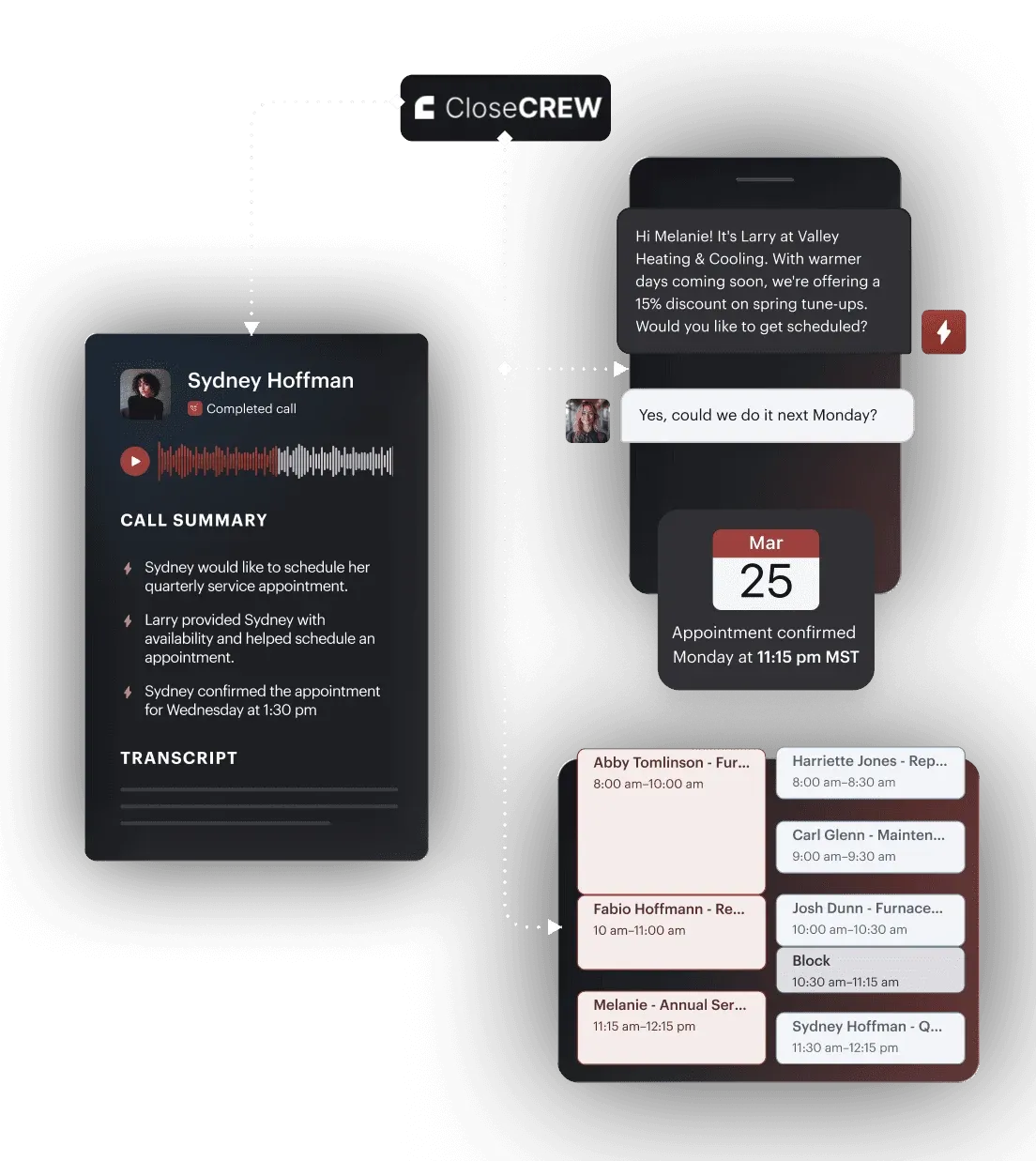
Larry doesn't just respond. He closes. Most AI stops at the answer. Larry goes further because he works inside the same system that runs your business. He answers before your competitors do. He books jobs, follows up on estimates, requests reviews, and keeps your membership list up to date. No reminders needed. He gets smarter because everything is connected: one complete view of every customer, job history, past conversations, and membership status. So Larry always knows who he's talking to and what to do next.
Arctic Air hired Larry and saw 30% more revenue in one year. They added a truck to their fleet and haven't looked back. Businesses using CloseCrew handle 40% more calls without adding staff.
Your best employee doesn't take days off. Ready to hire Larry and grow your business?
How much should you spend on plumbing marketing?
Most successful service businesses reinvest a set percentage of gross revenue into marketing, typically 5 to 10 percent, with the percentage weighted higher when you are breaking into a market and lower once you are holding a strong position. More useful than a percentage is a sensible starting allocation. For a small business, a monthly budget of about $4,000 might be divided as follows:
Channel
Suggested monthly spend
What it buys
Google Business Profile
$0 plus a few hours weekly
Your best free local lead source
Local SEO and content
~$1,500
Compounding organic leads
Google Local Services Ads
~$1,800
Immediate high-intent calls
Reviews and referral system
~$200
Trust that lifts every channel
Facebook remarketing with an offer
~$500
Re-engages past site visitors
That kind of mix typically produces dozens of leads a month at a blended cost that pays for itself against an average plumbing ticket. Start lean across a few channels, track the cost per booked job for each channel, and allocate budget to whatever is actually filling your schedule.
How CloseCrew Tracks and Reports on Every Lead
CloseCrew brings every lead source, whether calls, texts, webchats, third-party providers, or email, into a single unified platform. You can see which channel generated each lead, whether it was booked, and how much revenue it produced. This gives you true ROI visibility without cobbling together data from five different tools, helping you focus marketing dollars on the campaigns that actually make money.
Track what works, and double down
You cannot improve what you do not measure. Tag your lead sources so you know which channels book jobs, then watch a few numbers: cost per lead by channel, how many calls convert to scheduled work, and your return on each marketing dollar. The goal is not to run every tactic forever. It is about finding the handful of sources that pay off in your market and pouring more into the winners.
Want to see exactly how those calls get answered and booked before a competitor picks up? Watch it run on a plumbing workflow like yours.
Common lead generation mistakes to avoid
Relying on a single source. Even a channel that works well leaves you one algorithm update or price hike away from a quiet month. Diversify across five to seven channels.
Buying shared leads as a foundation. They close low, and you build no lasting asset. Use them only to fill gaps.
Ignoring past customers. New leads cost money; reactivating an old customer costs almost nothing. Follow up.
Slow response times. Speed to lead is often the deciding factor. If you cannot answer live, have a system that responds instantly on your behalf.
Stop paying for leads you let slip away with CloseCrew
Every lead is a job waiting to happen. Larry makes sure it does. After all the work and money it takes to make the phone ring, the fastest win is making sure every call gets answered and booked. Larry handles your inbound calls, books the job, follows up on estimates, grows your memberships, and automates review requests, so the leads your marketing generates turn into booked work rather than voicemails.
Getting started is fast. CloseCrew's onboarding team aims to have you up and running in days, not months: white-glove onboarding within 48 hours of signing, data migration from your existing software (customers, jobs, history), a dedicated team to answer questions, and staff training for your entire crew. We test and refine Larry until he reflects your business.
Not sure how it would slot in with your current ad and booking setup? Ask the team.
Frequently asked questions
What is the fastest way to get plumbing leads?
Google Local Services Ads and Google Ads are the fastest, often producing leads within a week, because they put you at the top of search in front of high-intent customers. Pair them with a complete Google Business Profile to capture free local-pack traffic while the paid campaigns run.
How much does a plumbing lead cost?
It depends on the channel. Local Services Ads run about $15 to $100 per lead; Google Ads, $25 to $200 for emergency keywords; exclusive aggregator leads, $50 to $150; and shared leads, $15 to $45. Owned channels like SEO, reviews, and AI search are cheapest over time at roughly $3 to $35 per lead after the first six months. A healthy blended cost per lead is about $15 to $55 for service calls.
How long does SEO take to generate plumbing leads?
Expect about four to six months for meaningful ranking movement and eight to twelve months for consistent volume in competitive markets. That slow ramp is why most plumbers run paid ads at the same time, then lean more on organic traffic as it grows, since those leads cost almost nothing per click.
Are shared leads from Angi or HomeAdvisor worth it?
For most established plumbers, no. Shared leads close at only 8 to 15 percent because the same inquiry goes to several companies, and emergency callers book whoever answers first. They can help a brand-new shop get started, but treat them as temporary and track your cost per booked job rather than the headline cost per lead.
How many marketing channels should a plumbing business use?
The most successful companies run five to seven at once. A common, effective stack is a tuned Google Business Profile, local SEO, Local Services Ads, and a review-and-referral system, with paid search or remarketing layered on for volume.
How much should a plumber budget for marketing?
Most home service businesses reinvest about 5 to 10 percent of gross revenue, higher when growing and lower when maintaining. Rather than fixating on the percentage, track the cost per booked job for each channel and shift budget toward the ones that consistently fill your schedule.
Related tools
Run the numbers before you update your price book or field software.
Free Plumbing Templates
Invoices, estimates, and flat-rate pricing sheets for plumbing contractors.
A plumbing landing page has one job: turn an expensive ad click into a booked job. Most pages leak that traffic because the headline does not match the ad, the page loads slowly on a phone, the call to action is vague, or worst of all, the lead that finally fills out the form sits in an inbox while a competitor calls back first. This guide fixes all of that.
This guide breaks down the 34 essential plumbing tools every pro needs in 2026 into two main categories: physical hand tools and digital business tools. The hand tools cover wrenches, pipe cutters, drain machines, safety gear, and specialty equipment like PEX tools and inspection cameras, with clear pricing and selection tips for each.
Never miss a Plumbing service call again. Let Larry, your AI receptionist, book jobs while your crew is in the field.
We will run your numbers on the call and tell you if the maths does not work for a shop your size. That happens, and it is a cheaper conversation than finding out three months in.