HVAC Owner Salary in 2027 and 10 Tips to Boost Your Earnings
How much does an HVAC business owner earn? Most online data is unreliable because owner income comes from profit, not salary. This guide covers realistic ranges by company size, an income growth timeline, and 10 tips for maximizing earnings through systems, pricing, recurring revenue, and 24/7 call answering.
How much does an HVAC business owner earn? Every online source gives a different number. Most of those numbers should be viewed with skepticism. Here's why.
Most HVAC owners don't make a traditional salary. Their income comes from net profit, owner draws, and eventually the sale of their business. A W-2 salary is just one piece of a much larger financial picture.
Owner earnings vary enormously by company size. A solo tech running a one-van operation earns completely differently than a multi-location business owner with 50 technicians. Comparing the two is meaningless.
The most important factor influencing an HVAC owner's income is how effectively the business runs. Revenue matters. But profit margin matters more. And profit margin depends on systems, pricing, and operational efficiency.
This guide covers realistic salary ranges by company size. Why the online data is misleading. And 8 tips for maximizing your earnings as an HVAC business owner.
Most owners pay themselves through W-2 salary, draws, and profit distributions. The structure depends on business type (LLC, S-corp, sole proprietorship).
Two companies generating the same revenue can produce very different take-home pay. One owner reinvests heavily and draws $60,000. Another takes $180,000 from the same revenue. The "salary" data captures only part of the picture.
Profit is where the real money is
Industry experts suggest owners can earn 5% of total revenue. Others recommend targeting 10-15% take-home pay. Some take up to 50% of net profit after taxes.
The real financial equation: salary + profit distributions + equity buildup = total compensation. Your company's sale price (typically 2-4x EBITDA) is often the largest payday.
Don't fixate on salary. Focus on revenue and profit.
These ranges assume the business is profitable. Many owners at every level earn less due to inefficiencies eating their margins.
8 tips to maximize revenue, profit, and earnings
Tip 1: Build business systems that scale
Higher owner income does not come from working longer hours. It comes from building systems that let the business run well without you doing everything yourself.
Start by documenting the processes that keep your HVAC business moving. That includes call handling, dispatching, job documentation, estimates, invoicing, follow-ups, and customer communication. When these processes are clear and consistent, your team knows exactly what to do without constantly coming back to you for answers.
As Al Levi of The 7-Power Contractor puts it, there are three reasons businesses make mistakes: “No system. Wrong system. Or the system isn't being followed.”
That is the real goal of scalable operations. Build the right process, train your team to follow it, and keep improving it as the business grows.
If you're starting an HVAC business, building these systems early can save you a lot of headaches later.
Tip 2: Calculate costs meticulously
Getting financials right determines whether your business generates owner income or just covers expenses.
Startup costs to track: Employee salaries. Insurance (liability and health). Office space. Vehicles. Equipment. Licenses and permits. Taxes.
Know your break-even point. True cost of doing business. Then set pricing above it. Use flat-rate pricing to protect margins. Each job priced to cover overhead plus your target profit.
Use CloseCrew's BTU calculator for sizing jobs accurately. Accurate sizing means accurate pricing. Accurate pricing protects margins.
Tip 3: Recruit and coach your team
Your team determines your income ceiling. You can't grow past what your people can deliver.
Invest in employee growth. Train and promote from within. External hires bring skills but also bad habits. Internal promotions maintain culture and motivate the team.
Track every tech's performance. Revenue generated. Memberships sold. Customer satisfaction. Use data to reward top performers and coach those who need support.
Great customer service is not just a nice extra. It can directly drive revenue. In fact, 65% of consumers say they would pay 5% more for an exceptional customer experience. Happy customers are also more likely to leave 5-star reviews and recommend your business to friends and family.
The experience starts with the first phone call. Your CSR should already know who is calling before they pick up. CloseCrew gives CSRs access to customer history, property details, and open estimates, so conversations feel more personal and informed.
The experience should continue after the call. Customers can receive appointment confirmations and technician tracking, while technicians can have professional bios that help customers feel more comfortable before they arrive.
Small details like these build trust. And in HVAC, trust can turn a one-time service call into a repeat customer and a steady source of referrals.
Tip 6: Manage your online presence
Optimize for local SEO. Searches like “HVAC near me” can determine whether customers find you or a competitor. Use local keywords and keep your Google Business Profile updated.
Get reviews consistently. 98% of consumers read online reviews for local businesses. CloseCrew can automate review requests after every completed job.
Make your website mobile-friendly. Most local searches happen on phones. A slow or cluttered mobile site can quickly cost you customers.
For HVAC SEO tips to improve your local rankings, check out our SEO guide.
Tip 9: Build recurring revenue with maintenance agreements
One-time service calls create unpredictable income. Maintenance agreements create predictable monthly revenue. Every agreement sold reduces your dependence on emergency calls and seasonal swings.
Higher company valuation at exit (recurring revenue commands premium multiples)
Target 20-30% of revenue from maintenance agreements. This stabilizes income and increases your company's sale price when you're ready to exit.
For HVAC profit margins and how agreements protect them, see our margins guide.
Tip 10: Answer every call that your marketing generates
This tip can impact owner income more than almost anything else. Every tip above generates leads. Marketing creates awareness. SEO drives searches. Ads generate clicks. Referrals generate calls.
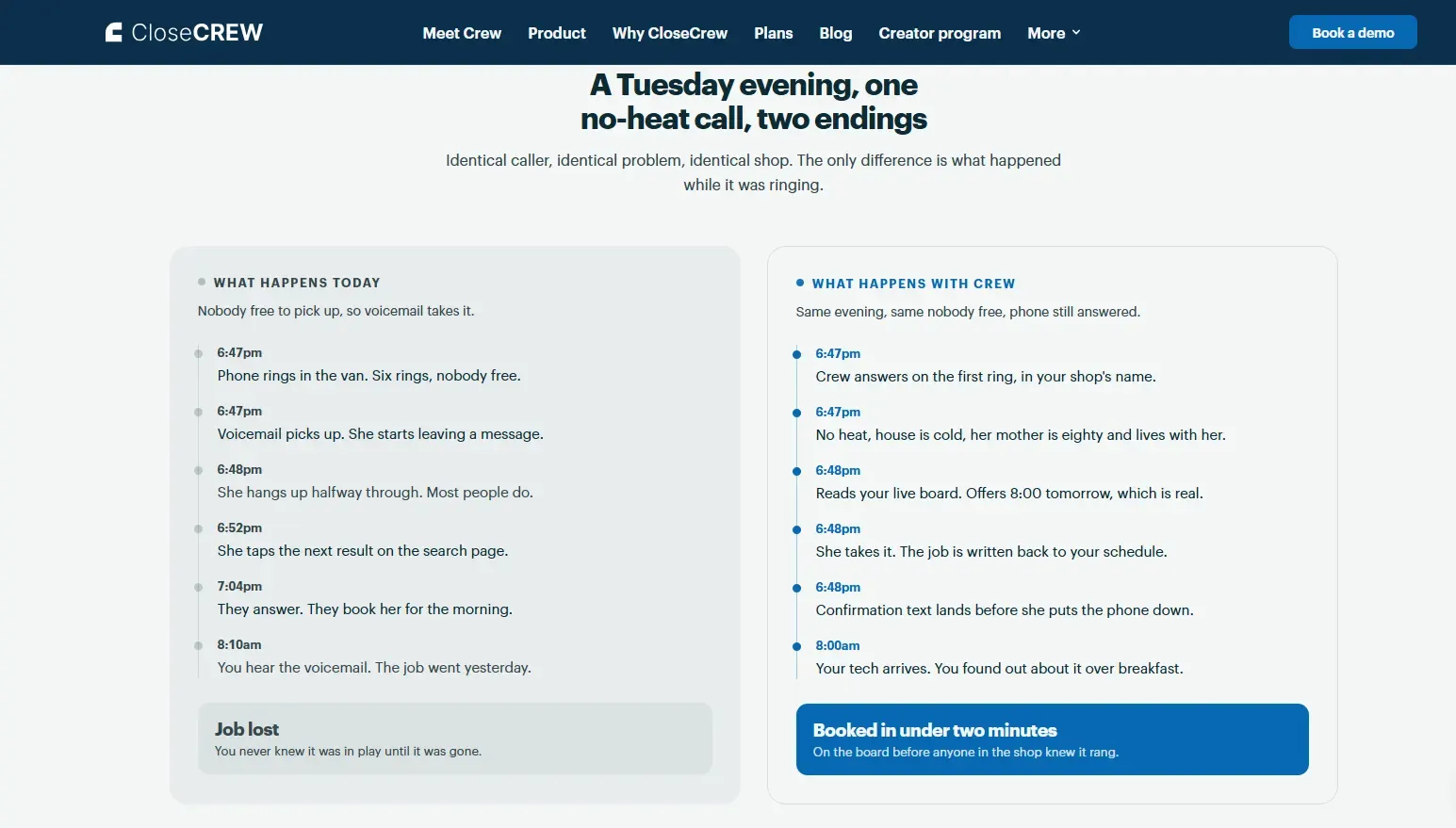
But 41% of home service calls come after hours. If nobody answers, that lead can go to your competitor. Every missed call means lost revenue that could have become owner profit.
Crew, CloseCrew's AI Employee, answers calls 24/7. A $5,000 system replacement call at 7 PM becomes a booked job instead of a voicemail. Your marketing converts, revenue grows, and owner income grows.
Arctic Air saw 30% more revenue in one year. Premier Heating converted 3x more leads. Air Design added 13 extra appointments in 30 days.
What a realistic income growth timeline looks like
Most HVAC business owners don't earn top-end income in year one. Growth takes time. Here's a realistic progression.
Year 1-2 (Solo/startup). Revenue: $150,000-$300,000. Owner income: $50,000-$70,000. You're the tech, the salesperson, and the manager. Most income goes back into the business. Survival mode.
Year 3-4 (First hires). Revenue: $400,000-$800,000. Owner income: $80,000-$120,000. Two to four techs. Office help. You stop running every call and start managing. Margins improve because you're not doing everything alone.
Year 5-7 (Established). Revenue: $1M-$3M. Owner income: $150,000-$250,000. Dedicated CSRs. Dispatchers. Multiple trucks. Systems run the business. You manage the systems. Recurring revenue from maintenance agreements compounds.
Year 8+ (Scaling/exit). Revenue: $3M+. Owner income: $250,000-$500,000+. Multiple crews or locations. The business runs with or without you daily. Your biggest payday may come from selling the company at 2-4x EBITDA.
The owners who progress fastest through these stages share one trait. They invest in systems before they need them. Pricing systems. Dispatch systems. Call answering systems. CRM systems. Each one removes a bottleneck before it limits growth.
Tip 7: Optimize marketing strategies
Email marketing. $36-$42 return for every $1 spent. Target previous customers with renewal reminders. New homeowners with welcome offers. Customers with open estimates with follow-up sequences.
Direct mail. Postcards and flyers to targeted neighborhoods. Track results per campaign.
Google Ads. PPC and Local Services Ads. Pay per lead. Track cost per booked job.
Every marketing dollar should be traceable to revenue. CloseCrew assigns unique tracking to every campaign. You see which channels generate calls, bookings, and revenue. Cut what doesn't work. Increase what does.
Tip 8: Track growth with real data
You need clear visibility into your business performance. Track revenue per tech, close rates, average ticket, customer retention, marketing ROI, and technician productivity.
CloseCrew's reporting dashboard shows these metrics in real time. Filter by KPI, track trends, and make decisions based on data instead of gut feeling.
The owners who earn the most aren't always the ones with the most trucks. They're the ones who know their numbers and keep optimizing.
Your income grows when your business runs smarter
HVAC owner salary data online is unreliable. The range is too wide. The methodology is too inconsistent. What matters is your specific business. Your margins. Your systems. Your ability to capture every opportunity.
Build systems. Price accurately. Automate operations. Track metrics. Answer every call. Follow up on every estimate. These actions determine your actual take-home more than any salary survey ever could.
The difference between a $75,000 owner and a $300,000 owner usually isn't talent. It's systems. The $300,000 owner built processes that run without constant oversight. They answer every call. Follow up on every estimate. Track every metric. And they started doing it early.
Frequently asked questions
How much does an HVAC business owner make?
$70,000-$500,000+ depending on company size, location, and profitability. National average salary data shows $86,197. But top performers and multi-location owners earn $200,000-$500,000+.
Is HVAC owner income a salary or profit?
Both. Most owners take a base salary plus profit distributions. The split depends on business structure. S-corps typically require a "reasonable salary" with remaining income as distributions.
How do I increase my HVAC owner salary?
Focus on profit margin, not just revenue. Automate operations. Answer every call. Follow up on every estimate. Build recurring revenue through maintenance agreements. Track metrics. Optimize continuously.
What profit margin should HVAC owners target?
10-20% net profit after all expenses. Industry average is 8-12%. Top-performing shops hit 15-20%. Every percentage point increase goes directly to owner income.
When should I hire my first employee?
When you're consistently turning away work or can't handle call volume. The first hire should generate more revenue than their cost within 60-90 days. Don't hire to fill time. Hire to capture revenue you're currently missing.
Related tools
Run the numbers before you update your price book or field software.
Free HVAC Templates
Invoices, estimates, maintenance agreements, and flat-rate pricing sheets for heating and cooling contractors.
Never miss an HVAC service call again. Let Larry, your AI receptionist, book jobs while your crew is in the field.
We will run your numbers on the call and tell you if the maths does not work for a shop your size. That happens, and it is a cheaper conversation than finding out three months in.