HVAC Profit Margins Explained and How to Increase Them
Wondering if your HVAC business is actually profitable? Learn the average HVAC profit margins, what affects them, and practical ways to increase your gross and net profit.
Most HVAC owners can tell you their revenue off the top of their head. Fewer can tell you their actual net profit margin, and even fewer can explain why it's higher or lower than last year. That gap between "busy" and "profitable" is where a lot of contracting businesses quietly bleed out.
If any of this sounds familiar, you're in good company:
This guide walks through what a healthy HVAC margin actually looks like based on current industry benchmarking data, the handful of business drivers that move it up or down, the operational leaks that quietly erase it, and a practical process for closing the gap, whether you're running two trucks or twenty. If you're setting up the business itself rather than fine-tuning an existing one, our guide on how to start an HVAC business is a good starting point before the numbers below apply to you.
You worked full crews all season and still cleared a 5% net margin, or nothing at all.
You know your gross margin should be higher, but you can't point to where it's leaking.
You want to fix it, but you don't have a system for tracking it, let alone improving it.
What Counts as a Healthy HVAC Profit Margin?
There are two numbers that matter here, and they're often confused.
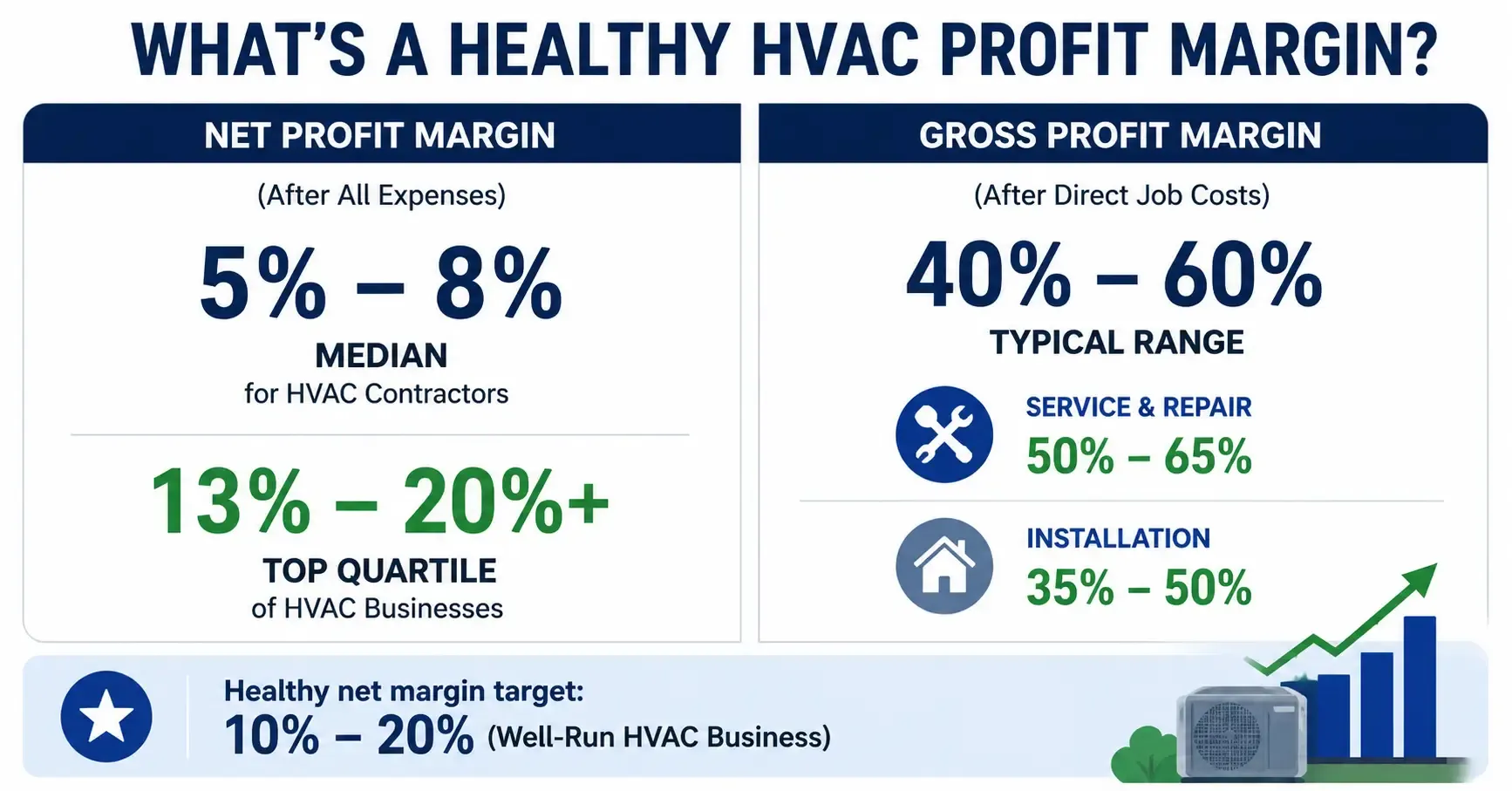
Gross profit margin is what's left of a job's revenue after direct costs: labor, materials, subcontractors, equipment. It's the number you use to judge whether a job or a department is priced correctly.
Net profit margin is what's left after everything: overhead, insurance, financing, taxes. It's the number that tells you whether the business is actually working.
The data tells a fairly consistent, if humbling, story. Industry financial-benchmarking research, including the ACCA's financial benchmarking study, puts the median net profit margin for HVAC contractors at roughly 5 to 8%, with the top quartile of operators averaging closer to 13 to 20%. Gross margins typically run 40 to 60%, and they vary a lot by job type: service and repair work tends to run 50 to 65% gross, while installation work is usually thinner, in the 35 to 50% range. That's a big part of why the highest-margin shops aren't necessarily the ones installing the most systems. They're the ones running the most service calls.
Company size matters too. Solo operators can sometimes net 15 to 30%, but many shops hit an "overhead trap" as they add their first two or three employees: overhead grows faster than revenue for a stretch, and net margin can fall to single digits before the business catches back up with better systems and a stronger service mix.
As a target, a healthy net margin for a well-run residential HVAC company in 2026 sits in the 10 to 20% range, with genuine top performers clearing 20% or more. A double-digit net margin isn't a luxury. It's what lets a business absorb a slow month, a blown compressor on a company truck, or a technician quitting mid-season without the whole operation wobbling. Below that, there's no shock absorber, and every surprise becomes a crisis.
The Five Levers That Actually Move Your Margin
Profit margin isn't one thing you fix. It's the sum of several operational habits. Here's what tends to matter most, roughly in order of impact.
1
How efficiently your techs are actually working
Labor is usually the single biggest controllable cost in an HVAC business, so how much of a technician's paid time is spent on billable work (their "utilization") has an outsized effect on margin. Industry data pegs 30% billable efficiency as roughly average and 50%+ as outstanding. A shop with tight dispatching, high first-time-fix rates, and few callbacks tends to run gross margins 20 to 30 points higher than a shop losing hours to loose scheduling, long drive times, and rework. A useful staffing benchmark: a well-run shop typically generates $150,000 to $450,000 in revenue per technician per year, with a common rule of thumb being roughly five times a tech's total compensation. If you're budgeting for that compensation line, our HVAC technician salary guide breaks down current pay ranges by experience level.
2
Whether overhead is sized to the business, not just growing with it
Office staff, marketing spend, fleet costs, management layers, rent, software, insurance: none of these hit gross margin directly, but they can quietly eat a net margin alive. This is the single biggest reason healthy gross margins don't always show up as healthy net margins. A useful gut check: if any single overhead category creeps past what it was as a share of revenue last year without a clear reason, it's worth a hard look before it becomes permanent.
3
How disciplined your pricing actually is
There's a big difference between "whatever the competitor down the street charges" pricing and pricing built on real job costing and value. Shops that price reactively often see gross margins in the 20 to 35% range with net margins near zero. Shops with a defined pricing structure, consistent markups, and regular margin reviews routinely run 55%+ gross and mid-teens-or-better net on comparable work. Material costs feed directly into that job costing, so who you buy from matters. Our roundup of the best HVAC manufacturers and suppliers is a useful reference when you're reviewing your cost side.
4
How much of your revenue is recurring
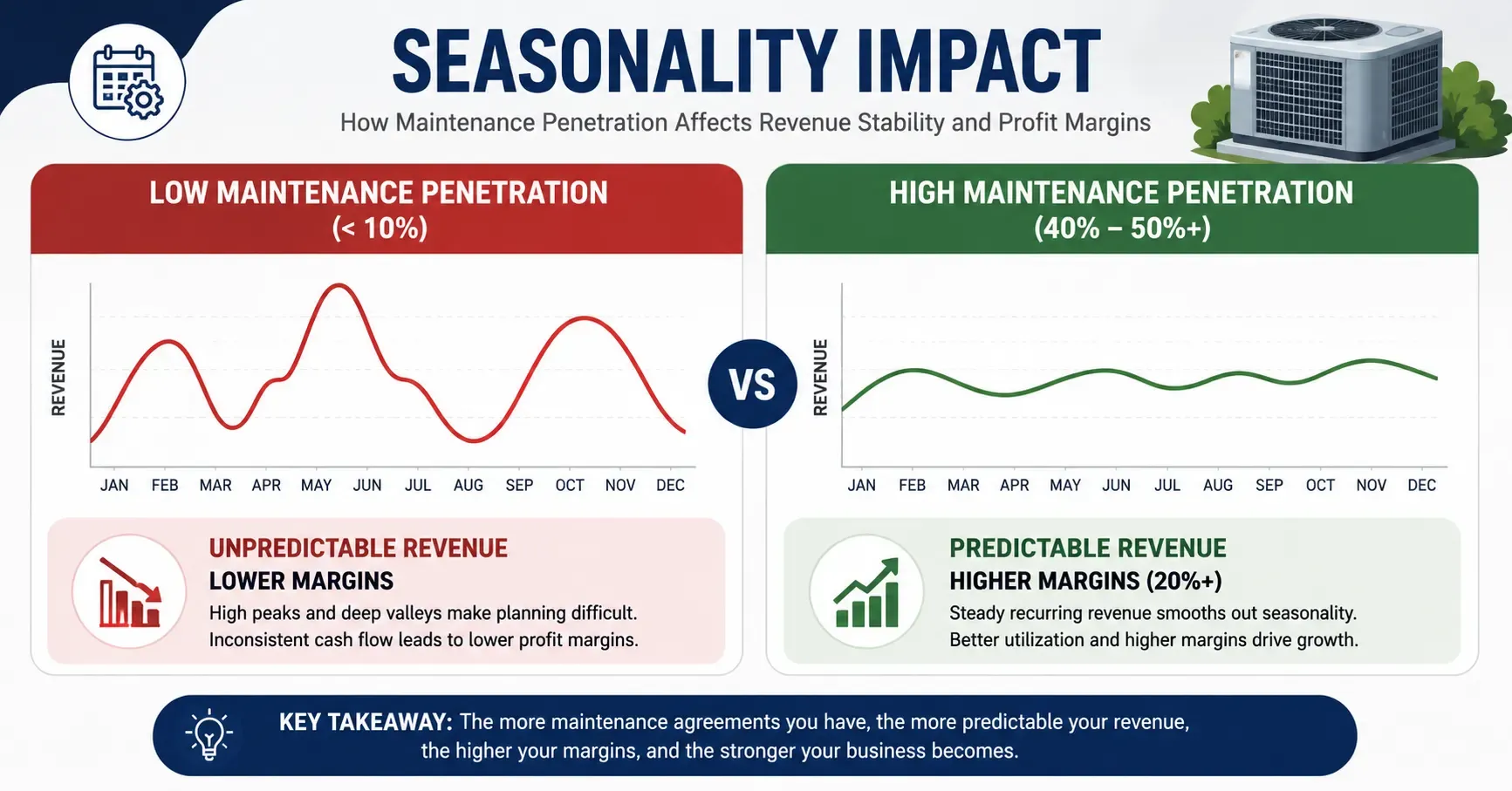
Maintenance agreements do more than generate their own revenue. They smooth out the seasonal whiplash that makes everything else harder to plan. A business with under 10% of customers on a maintenance plan tends to look highly reactive: uneven scheduling, heavy reliance on emergency calls, thin margins. Push that penetration past 40 to 50% and the business starts to look fundamentally different: predictable cash flow, better technician utilization, and materially higher net margins, often north of 20%.
5
What it actually costs you to win a job, and whether the call even gets answered
If you're spending 20%+ of revenue just acquiring the customer, there's very little room left for anything to go wrong on the job itself. Businesses with a strong referral and repeat-customer engine, where customer acquisition cost drops to single digits as a share of revenue, consistently post the healthiest margins on this list. Two things drive that number more than anything else: how well your marketing actually generates demand, and whether the calls it generates get picked up. For the first half, our guides on HVAC marketing ideas,HVAC SEO tips, and the 10 best websites in the industry cover how to bring the phone to ring in the first place.
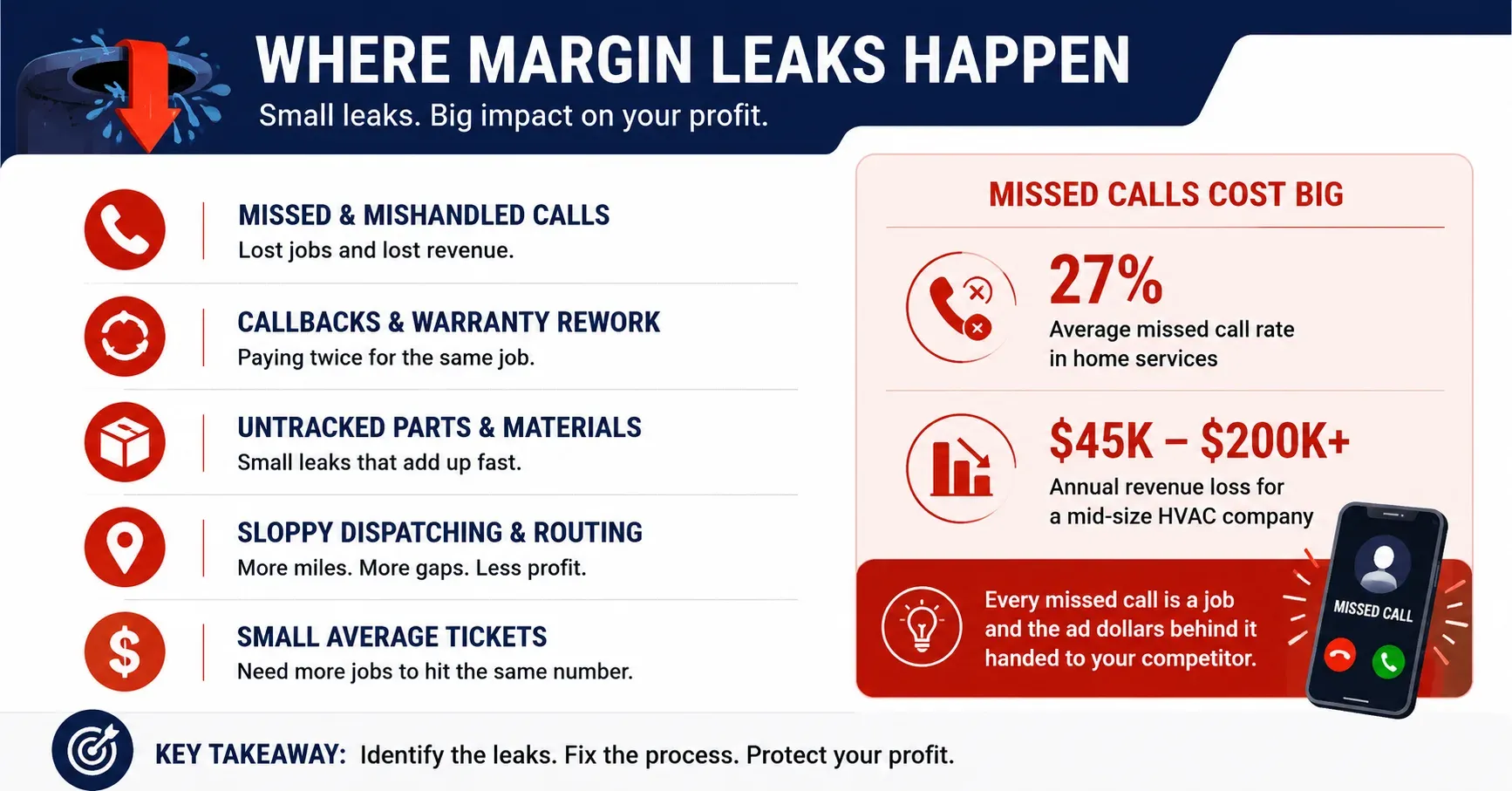
For the second half, the numbers are less forgiving. Call-tracking research from Invoca puts the average missed-call rate for home services businesses at around 27%, and other industry studies looking specifically at small and mid-size home service teams put it much higher, often in the 40 to 60% range during peak hours, after-hours, or whenever the office is short-staffed. The follow-through problem compounds it: research on caller behavior consistently shows that roughly 85% of callers who reach voicemail never leave a message and never call back. They just call the next business on the list.
Put a dollar figure on it and the math gets uncomfortable fast. Industry estimates put the average home services business's annual revenue loss from missed calls at somewhere around $126,000, and a mid-size HVAC company specifically can lose anywhere from $45,000 to well over $200,000 a year this way, especially once you factor in that emergency calls, the highest-ticket jobs on the board, disproportionately come in nights and weekends when nobody's picking up. Every one of those calls was already paid for through marketing spend before it ever rang. A missed call isn't a neutral non-event. It's a booked job, and the ad dollars behind it, handed straight to a competitor.
This is exactly the gap Larry is built to close. It answers every inbound call in seconds, day or night, weekday or weekend, books the job straight onto your schedule, and logs the details so nothing falls through the cracks between a ringing phone and a technician on the truck. For a business trying to move its acquisition-cost lever in the right direction, making sure every paid-for call actually converts is often the single fastest fix available.
Seasonality is the wildcard behind all five. A business that's entirely weather-dependent will always show more margin volatility than one with a real maintenance base and diversified service mix, even if every other factor is identical.
Where Margin Quietly Disappears
Beyond the five levers above, a handful of everyday operational leaks account for most of the "we were busy all year but somehow didn't make money" stories:
Missed and mishandled calls. As covered above, this is often the largest and most fixable leak of all, since the cost is invisible on a P&L. It just looks like lower revenue than the marketing spend should have produced.
Callbacks and warranty rework. Every return trip means paying labor twice on a job that already generated its revenue. Left unchecked, this alone can shave double-digit points off margin.
Untracked parts and materials. Filters, fittings, and small parts pulled from van stock without being billed add up fast, often quietly costing several margin points on jobs that looked profitable on paper.
Sloppy dispatching and routing. Every extra mile and every gap between jobs is paid time that generates no revenue.
Small average tickets. Without structured upselling or diagnostic selling, techs end up needing to run more jobs just to hit the same number, which strains scheduling without growing profit.
A Practical Framework for Improving Your Margin
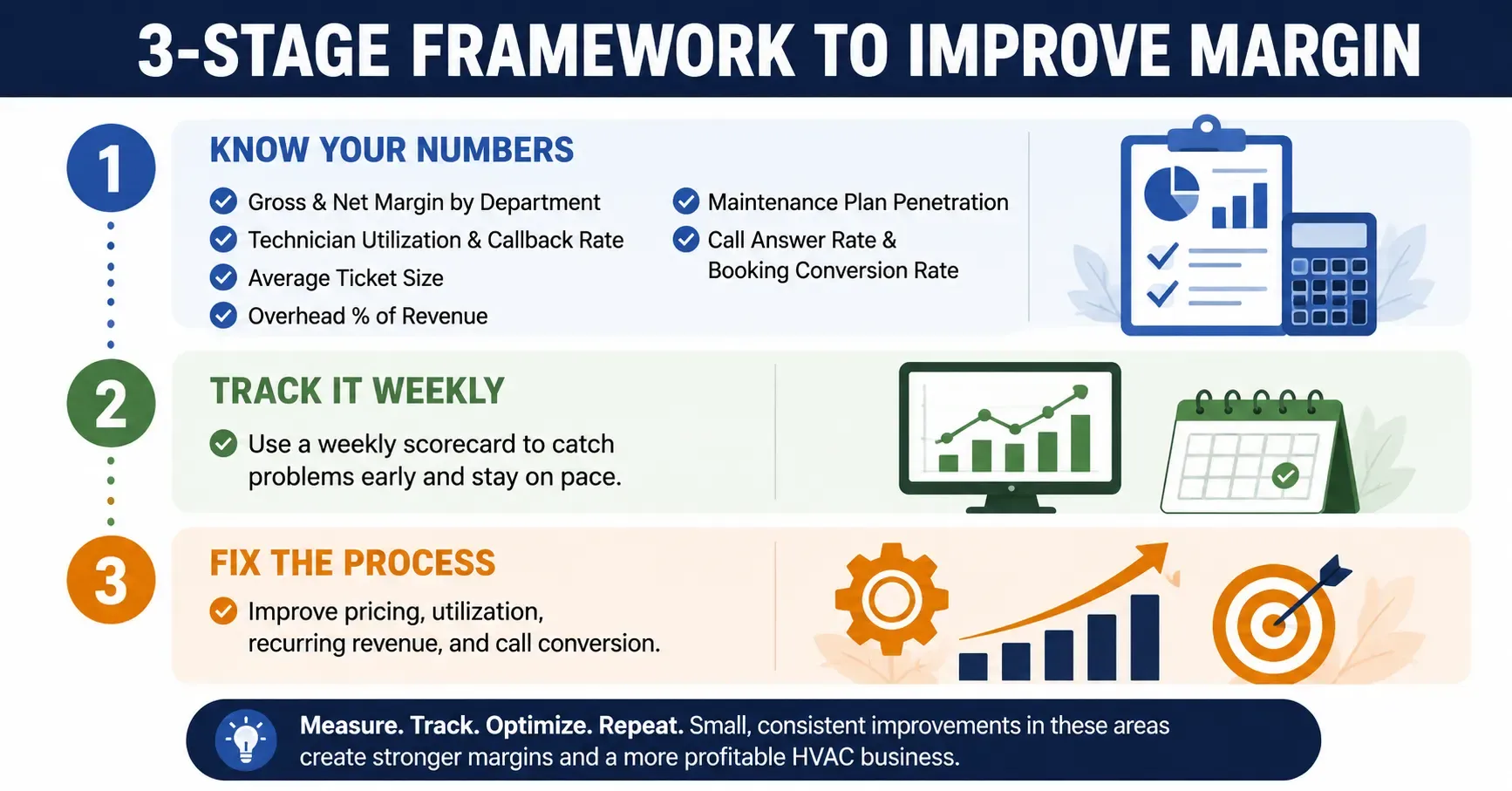
Fixing margin isn't a single initiative. It's a habit built in three stages.
Stage 1: Know your actual numbers
You can't improve what you haven't measured. Before setting any goal, get a clear read on:
Gross and net margin by department (install, service, maintenance, new construction), not just company-wide
Technician utilization and callback rate
Average ticket size and how it's trending
Overhead as a percentage of revenue, and how that's shifted year over year
What percentage of eligible customers are on a maintenance plan
Your call answer rate and call-to-booking conversion rate
That last one is easy to overlook, but well-run shops typically convert 38 to 50% of answered inbound calls into booked jobs. If you don't know your own number, or you don't know how many calls you're missing before they even get a chance to convert, that's the first gap worth closing.
Blending all of this into one company-wide number tends to hide the real story. A strong install department can mask a service department that's losing money, and vice versa. Break it down before you set targets.
Stage 2: Track it weekly, not just annually
Annual reviews tell you where you ended up. Weekly tracking tells you whether you're on pace to get there while there's still time to course-correct. A simple weekly scorecard, covering revenue versus target, gross margin, billable utilization, average ticket, maintenance agreement sales, call answer rate, and callback rate, catches problems in week three instead of month eleven.
The businesses that do this consistently are almost always running some form of centralized software rather than stitching together spreadsheets, a booking tool, and a separate invoicing platform. When the data lives in three places, the review itself becomes the bottleneck. The same logic applies to your phones: if you can't see how many calls came in, how many were answered, and how many turned into booked jobs, you're managing blind on one of the biggest levers in the business.
Stage 3: Fix the process, not just the number
Once you know where the gap is, the fix is usually operational, not aspirational:
Pricing gap? Build a defined pricing structure with regular job-costing reviews instead of ad hoc estimates.
Utilization gap? Tighten dispatching, cut unnecessary drive time, and hold techs accountable to a first-time-fix standard.
Recurring revenue gap? Make offering a maintenance plan a standard part of every eligible call, not an afterthought.
Acquisition cost gap? Invest in the systems that turn more inbound calls into booked, paying jobs, since every call that goes unanswered or unbooked is money already spent for nothing in return.
That last point is often the fastest lever to pull, and the easiest to fix without hiring anyone. Marketing brings the phone to ring; what happens on that call determines whether the spend was worth it. A missed call after hours, a slow follow-up, or an untrained answer can undo weeks of ad spend in seconds. CloseCrew exists specifically to close that gap: it answers every call instantly, qualifies the job, books it onto your calendar, and makes sure a lead you already paid for never goes to voicemail, gets forgotten, or ends up on a competitor's schedule instead. For a shop trying to move net margin from single digits into the double digits, recovering even a fraction of currently missed calls is often the single highest-leverage change available, with no added headcount and no added overhead.
Related tools
Run the numbers before you update your price book or field software.
Free HVAC Templates
Invoices, estimates, maintenance agreements, and flat-rate pricing sheets for heating and cooling contractors.
Automating HVAC processes creates a more efficient, scalable business. This guide covers 7 key areas to automate including timesheets, marketing, dispatching, and billing, plus the 8th automation that makes all the others profitable.
An HVAC van can do more than get your technicians to job sites. A well-designed wrap can turn every drive and service call into local advertising that keeps working for years.
Never miss an HVAC service call again. Let Larry, your AI receptionist, book jobs while your crew is in the field.
We will run your numbers on the call and tell you if the maths does not work for a shop your size. That happens, and it is a cheaper conversation than finding out three months in.