HVAC Pricing Guide for Contractors: How to Price an HVAC Job
Choosing the right HVAC pricing model can make or break profitability. Learn the differences between flat-rate and time-and-materials pricing, how to set profitable rates, and how to avoid common pricing mistakes.
Get HVAC pricing wrong and it doesn't matter how good the work is, the business bleeds money. From working with HVAC contractors across the country, two pricing problems come up again and again:
This guide walks through both problems. You'll get a breakdown of the two main HVAC pricing models, the factors that actually determine whether a price is profitable, and where most businesses lose money implementing pricing they already got right on paper.
The pricing model itself is off, which makes real profitability almost impossible no matter how busy the schedule looks.
Even when the pricing is right on paper, it doesn't get applied consistently through the actual estimates and invoices customers see.
HVAC Pricing Models: Time and Materials vs. Flat-Rate
Before picking a model, it helps to know everything that should be feeding into your numbers in the first place: overhead, billable versus unbillable hours, labor rates, material costs, local competition, installation costs versus replacement costs, energy efficiency ratings, available rebates, and marketing spend. Skip that math and profitability becomes guesswork.
Most HVAC companies land on one of two approaches:
Hourly rate (time and materials): you charge based on the time spent on the job plus the cost of materials used.
Flat-rate pricing: you charge one fixed price for the service, regardless of how long it actually takes.
Time and Materials Pricing Pros and Cons
Time and materials pricing is a familiar model for many customers. They pay for the actual hours worked plus the cost of parts and materials used. Many customers appreciate the transparency of an itemized invoice because they can see exactly where their money is going. This pricing model also works well for large, complex, or ongoing projects where the total scope is difficult to predict upfront.
For contractors, time and materials pricing provides flexibility. If the job changes or unexpected work is required, you can bill for the additional labor and materials without needing to renegotiate a fixed price. It also makes tracking project costs straightforward and helps ensure you are paid for every hour your team works.
There are drawbacks for both sides. Customers may worry about how long a job is taking, especially if they feel delays are increasing the final bill. Unexpected complications can push costs much higher than they originally expected, leading to frustration or billing disputes.
For contractors, time and materials pricing requires accurate time tracking, detailed documentation, and careful record keeping. Administrative work increases, and missing time entries can result in lost revenue. It can also reduce the incentive to complete jobs efficiently because revenue is tied to hours worked instead of the value delivered. Over time, this can limit productivity, reduce the number of jobs completed each day, and cap overall profitability.
Flat-Rate Pricing Pros and Cons
Flat-rate pricing gives customers a clear answer before the work begins: what the repair costs. That eliminates the uncertainty of an open-ended bill and helps build trust because there are no surprise charges if the job takes longer than expected. It also makes it easier for technicians to explain pricing, present options, and close the sale on the spot.
For your business, flat-rate pricing rewards efficiency instead of time spent. Skilled technicians who complete jobs faster do not reduce revenue. They create capacity for more appointments in the same day. It also allows you to price services based on the value you provide rather than the number of hours worked. In many cases, invoices are simpler, payments are collected immediately, and cash flow improves.
Flat-rate pricing also creates consistency across your team. Customers receive the same price for the same service regardless of which technician performs the work, making pricing more predictable and professional. It simplifies quoting, reduces billing disputes, and makes it easier to train new technicians on pricing standards.
There are trade-offs, though. Some customers may question a flat price if they do not understand what is included, especially when the repair is completed quickly. If a job takes much longer than expected because of hidden issues or unexpected complications, your business absorbs the extra labor cost. Flat-rate pricing also requires accurate price books, regular updates for labor and material costs, and well-trained technicians who can properly diagnose problems before quoting a price. Without those systems in place, profits can quickly disappear on underpriced jobs.
Why Most Successful HVAC Businesses Choose Flat-Rate
Across the HVAC companies we've seen operate at scale, flat-rate pricing tends to win out, mainly because time and materials pricing has two structural problems that are hard to design around.
It's a hard sell to the average homeowner. A contractor understands that a $200 or $300 hourly rate is mostly covering overhead, not profit. A homeowner who earns $35 or $50 an hour rarely has that context, and an unfamiliar hourly rate can easily read as a rip-off rather than a fair reflection of running a service business. That skepticism costs you signed jobs.
It rewards the wrong behavior. Under time and materials, a slow, disorganized, or undertrained tech generates more revenue for doing worse work, while your best, fastest techs quietly generate less. Left unaddressed, that dynamic drags down service quality and your reputation along with it.
Flat-rate pricing sidesteps both problems. Customers know their number upfront, so there's no clock-watching and no negotiation drama. Techs are incentivized to work efficiently and take on more jobs, which is good for their paycheck and your revenue at the same time.
3 Make-or-Break Factors for Setting Accurate HVAC Pricing
1
Price on Value, Not on What Competitors Charge
It's tempting to set prices by simply matching what other local HVAC companies charge. It's easier than doing the real work of figuring out your actual costs and margins. But pricing off competitors is how entire markets end up in a race to the bottom, where nobody can sustain real profitability.
The businesses that do best are the ones willing to do the harder math: their own costs, their own profit goals, and the actual value of the work, rather than a number borrowed from someone else's spreadsheet.
2
Build Unbillable Time Into Your Labor Rate
A huge share of pricing mistakes trace back to labor rate calculations that ignore time employees spend not directly on a job. Beyond the obvious (holidays, sick days, vacation), factor in training hours, drive time, meetings, planning, and even routine truck maintenance. If your labor rate doesn't account for all of that non-billable time, your "profitable" price is quietly losing money. This is also worth revisiting alongside current HVAC technician salary benchmarks, since labor cost assumptions that are a year or two out of date will throw off every price built on top of them.
3
Build Membership Discounts Into Your Baseline, Not On Top of It
Most HVAC companies now offer maintenance agreements, often with a 10 to 15 percent loyalty discount, and for good reason: they're a genuinely effective way to build recurring revenue and customer loyalty. The mistake is applying that discount on top of an already-calculated flat rate, which quietly erodes the margin you worked out in the first place.
Instead, build the member discount into your baseline pricing, so the membership price is effectively your standard price, and non-member customers are the ones paying a premium. That one adjustment protects the profitability work you already did.
The Real Challenge: Implementing HVAC Pricing Consistently
Getting the numbers right on paper solves half the problem. The other half is two operational challenges that trip up even well-priced HVAC businesses.
Challenge 1: Keeping Prices Current
Material costs, supplier pricing, and wages all shift over time, and a pricebook built on paper or in a spreadsheet needs constant manual upkeep to keep pace. That upkeep eats into time your office staff could spend on revenue-generating work, and it introduces plenty of room for manual error along the way. There's also usually a lag between when a price actually changes and when your field techs are working off the updated number, which means jobs get quoted at yesterday's price more often than anyone would like to admit.
If your pricebook process still runs on spreadsheets and printouts, it's worth taking a fresh look at what better HVAC software can actually do here before the next price change catches your team off guard again.
Challenge 2: Getting Prices Right on Estimates and Invoices
Even a perfectly up-to-date pricebook doesn't help if the numbers don't translate accurately onto what the customer actually sees. Techs misread a price range, transpose a number, or forget to add a material cost, and the estimate that reaches the customer doesn't reflect the real cost of the job. That gap shows up directly in your margins, job after job.
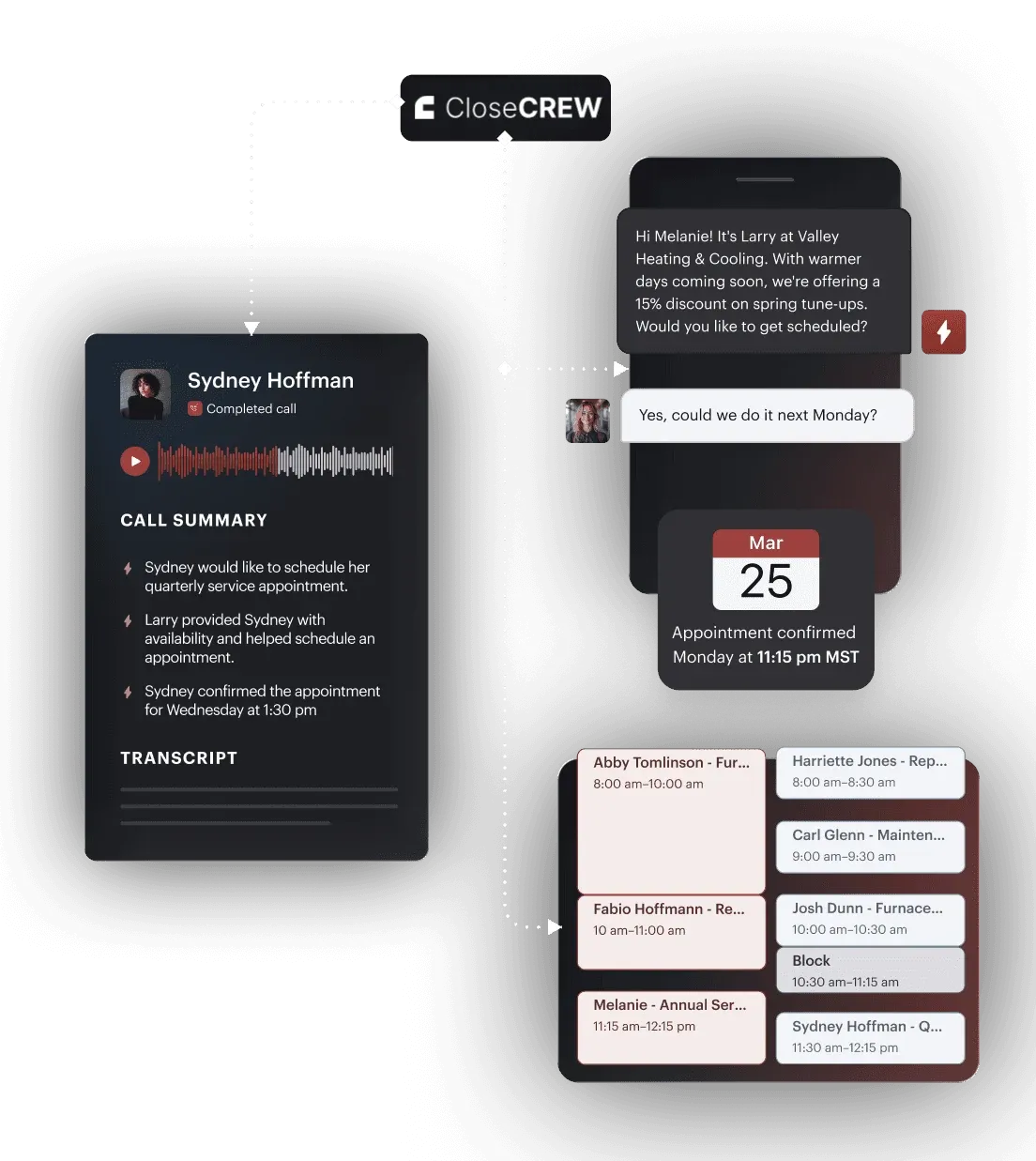
A lot of this starts even earlier than the estimate itself, at the very first phone call. If the person answering doesn't capture the real scope of the job (what's actually broken, what unit or system is involved, what access looks like), the tech walks in working from incomplete information, and the estimate they build on-site inherits that gap. This is one of the reasons CloseCrew's Larry is worth having ahead of your pricing process, not just your scheduling. Larry answers every call 24/7, asks the right qualifying questions for the job type, and passes a full transcript and summary to your team before the truck even leaves, so the tech shows up with an accurate picture instead of a vague callback note. Fewer surprises on-site means fewer estimates that have to be revised after the fact.
Once a customer has an estimate in hand, following up on the ones that don't get approved right away matters just as much as getting the number right in the first place. A polite, persistent follow-up, rather than letting an unapproved estimate quietly disappear, recovers real revenue that a lot of businesses simply write off. Reviewing the original call transcript before that follow-up call, so you're not asking the customer to re-explain a problem they already described once, makes that conversation go a lot smoother.
On the invoicing side, the same principle holds: the more manual translation happens between "what was quoted" and "what gets billed," the more room there is for pricing errors, lost paperwork, and payment delays. Whatever system you use, look for one that lets techs generate and send invoices directly from the field, capture payment on the spot, and sync cleanly with whatever accounting software you already run, so nothing has to be re-entered by hand later.
Other Ways HVAC Businesses Can Increase Profits
Assuming your pricing model and implementation are solid, the next lever is simply bringing in more of the right customers. A few worth focusing on:
Direct mail and email marketing still work well for HVAC specifically, especially for seasonal maintenance reminders sent to customers who already have a system on file with you.
Search visibility matters more every year, since a huge share of HVAC leads start with a search rather than a referral. If your business isn't showing up for the searches that matter in your service area, these HVAC SEO tips are worth working through before you spend more on paid ads chasing the same leads. Pairing that with a broader look at proven HVAC marketing ideas gives you a fuller picture of where new demand is actually coming from.
Customer reviews compound over time and cost almost nothing to collect. A simple automated request sent right after a completed job, while the experience is still fresh, is usually enough to keep a steady stream of recent, positive reviews coming in without anyone on your team having to remember to ask.
Getting Pricing Right Is Only Half the Job
As this guide has covered, correctly calculating your HVAC pricing (labor, materials, overhead, all of it) is only half the battle for real profitability. The other half is making sure that pricing actually makes it, accurately, through every call, every estimate, and every invoice, without quietly eroding on the way.
That second half starts earlier than most contractors think, at the first ring of the phone. CloseCrew's Larry answers every call 24/7, qualifies the job correctly, and books it straight into your calendar, so your team walks into every estimate with accurate information instead of a rushed voicemail summary. Paired with a pricebook and invoicing process that actually keeps up with reality, that's the difference between pricing that looks good on paper and pricing that actually protects your margins.
Want to see how CloseCrew helps HVAC contractors capture every call accurately from the very first ring? Book a demo or see pricing to get started.
Related tools
Run the numbers before you update your price book or field software.
Free HVAC Templates
Invoices, estimates, maintenance agreements, and flat-rate pricing sheets for heating and cooling contractors.
Discover 7 practical systems for scaling a multi-branch HVAC business, including shared scheduling, consistent training, centralized inventory, clear branch leadership, and unified performance tracking.
The right HVAC checklist app helps technicians work consistently and capture accurate inspection data. This guide compares 10 apps with features, pricing, and the guidance you need to choose between standalone checklist tools and integrated field service platforms.
Never miss an HVAC service call again. Let Larry, your AI receptionist, book jobs while your crew is in the field.
We will run your numbers on the call and tell you if the maths does not work for a shop your size. That happens, and it is a cheaper conversation than finding out three months in.