HVAC License Reciprocity by State: 2026 Contractor Guide
Reciprocity is a mutual agreement between two or more states to accept each other's HVAC licenses. Endorsement is different: one state reviews your out-of-state license case by case. It is rarely automatic. Even reciprocal states often require a business and law exam, proof of experience, insurance, bonding, and a clean record. Roughly 19 states offer no HVAC reciprocity at all, so in those you apply through endorsement or an experience-based pathway.
25 min readPublished June 22, 2026Updated July 22, 2026
If you hold an HVAC contractor license in one state and want to work in another, reciprocity can help you avoid starting the process from scratch. Some states recognize out-of-state licenses, especially from partner states, and allow transfer with minimal steps. Others may still require a business or law exam even if the trade test is waived, and many offer no reciprocity at all, meaning you must apply as a new contractor.
Do you know your state’s HVAC license requirements? They vary widely depending on location and whether you are a technician or contractor. Some states have statewide licensing rules, while others regulate HVAC work locally. Technicians may need training, certification, or EPA Section 608 certification, while contractors often need insurance, exams, bonds, and higher fees. This guide breaks down the requirements so you can understand the path from apprentice to licensed HVAC contractor. This guide explains how HVAC reciprocity works, which states have agreements, and the steps to transfer your license without losing time or work.
License reciprocity allows you to use an HVAC license from one state to get licensed in another without having to go through the whole process of applying, testing, and proving experience again. The real benefits are lower fees, less downtime, and the ability to chase profitable work outside of your home turf.
The idea is that skilled HVAC techs are in short supply all across the country, and strict state boundaries would only make that worse. Reciprocity provides qualified contractors a faster way to meet demand wherever it occurs. But that doesn't mean you can cross a state line and start pulling permits the same day. There is still a verification process and usually an exam or two.
A useful distinction to make early on is that reciprocity does not imply endorsement. Reciprocity is a formal mutual agreement between states recognizing each other’s licenses. An endorsement is a one-way review, one state will review your out-of-state credentials, and give you a license on a case-by-case basis. People often interchange these words, but the paperwork and expectations are different.
How HVAC License Reciprocity Works
Reciprocity happens in three general patterns because each state’s licensing rules differ.
Full reciprocity. A handful of states accept another state's exam or certification outright. You submit proof of an active license, documented work hours, and a clean disciplinary history, and you receive the new license with little additional testing.
Partial reciprocity. Many states do not require the technical trade exam, but they do require a business, trade or law exam on their local codes and regulations. You are skipping a part of the process, not the whole thing.
No reciprocity. If there is no agreement, generally you can still apply through an endorsement or experience-based route. That means a detailed work history, certifications like EPA 608, proof of insurance, and usually passing one or more exams to show competency.
The Benefits of Going Reciprocal
When it applies to you, reciprocity is a real competitive edge:
Faster licensing. Starting fresh in a new state can take months. A reciprocity pathway compresses that timeline so you can start earning sooner.
Mobility. You can follow the work across state lines, serve more clients, and move into markets with stronger demand or thinner competition.
Consumer protection. Reciprocity still screens for trained, experienced contractors, which helps maintain standards and protects customers from unsafe work.
More opportunities. Each new state you can legally operate in means more service calls, more installs, and more room to grow.
Lower cost. Waiving exams and duplicate requirements trims the expense of getting licensed in each new state.
The Limits and Fine Print
Reciprocity makes the path smooth; it does not erase it. Every state has guardrails to protect consumers and make sure you understand local rules.
State-specific exams. Some states, Florida among them, still require an exam, usually on state laws, codes, or safety rules, even when your trade skills already qualify.
Experience proof. Expect to document verified work hours, apprenticeship records, or years in the field. If your history falls short of the new state's bar, your application may be delayed or denied.
Insurance and bonding. Requirements vary, so you may need to raise your liability limits, file new bond paperwork, or meet different workers' compensation rules. Our HVAC business insurance guide walks through the coverage most states expect.
Disciplinary history. Unresolved complaints, past violations, or lapsed licenses can block approval.
Which States Offer HVAC Reciprocity
Agreements change, and the details below are a starting point, not gospel, so always confirm directly with the board where you plan to work. With that said, here is how reciprocity commonly shakes out among the states that offer it.
Alabama. Accepts reciprocity only from contractors holding a current, valid license in specific states: Mississippi, Tennessee, Louisiana, West Virginia, and South Carolina. You will also need a performance bond and a fee.
Arizona. Contractors from comparable states can request a waiver to shorten the process, granted at theRegistrar of Contractors' discretion. You can waive trade exams, but you can't waive the Arizona Statutes and Rules exam; that's all state-specific stuff.
Arkansas. Recognizes HVAC licenses from Tennessee, Mississippi, Alabama, Louisiana, and North Carolina.
California. May waive the trade exam for licensees from Arizona, Nevada, or Louisiana, but you still must pass the business and law portion.
Delaware. Accepts HVAC and plumbing contractor licenses from Connecticut, Iowa, and Maryland.
Florida. Treats this as an endorsement rather than a full waiver. You apply with your out-of-state license but must pass Florida's business and finance exam, and it applies only to Alabama, Mississippi, and North Carolina. You can confirm current rules through theDepartment of Business and Professional Regulation.
Mississippi. Offers reciprocity to Alabama, Arkansas, Georgia, Louisiana, North Carolina, South Carolina, and Tennessee. It waives the trade exam for those states but requires its business and law exam.
Ohio. Requires your current license plus its business and law exam (or a board review). Open to contractors from West Virginia, Kentucky, South Carolina, Louisiana, and Tennessee.
Tennessee. Waives its trade exam for contractors from Alabama, Arkansas, Georgia, Louisiana, Mississippi, Ohio, South Carolina, and West Virginia who have held a license in good standing for a set number of years.
West Virginia. Reciprocates with Tennessee, Ohio, and Alabama, though you may still need to prove licensure, pass a local code exam, and meet application requirements.
The pattern to notice is that a cluster of Southern states tends to recognize one another, while large states in the Northeast and West often stand apart.
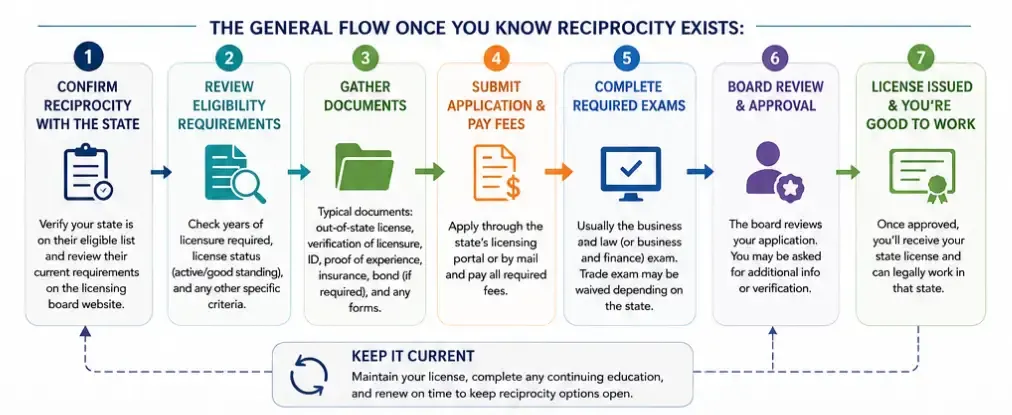
Here is the general flow once you know reciprocity exists:
Why Some States Skip Reciprocity
Several states deliberately stay out of reciprocity agreements, usually for a mix of these reasons:
Different codes. A state may follow the International Mechanical Code, its own mechanical code, or extra rules for environmental protection or cold-weather systems. Even small code differences make alignment hard.
Local regulations. Training length, license categories, and business and law exams vary enough that a new state wants you to learn its standards before working.
Protecting local contractors. With a finite amount of work to go around, some states limit interstate competition to give in-state businesses an edge.
The following states generally do not have HVAC reciprocity: Connecticut, Hawaii, Indiana, Massachusetts, Michigan, Minnesota, Montana, Nebraska, New Jersey, New Mexico, New York, North Dakota, Oregon, Rhode Island, Pennsylvania, South Dakota, Vermont, Wisconsin, and Wyoming. In those states, seek out an experience or endorsement application.
How HVAC Requirements Differ State to State
Even where reciprocity exists, the underlying requirements differ greatly. The pieces that change most frequently:
Examinations. Most states test your knowledge of HVAC systems, electrical work, refrigeration, and local codes. States like Florida, California, and Tennessee add a separate business and law exam.
Experience. Some states, such as Texas, require four to five years of work, apprenticeship, or training hours. Others simply require passing an exam, with no strict hour minimum.
Background checks. Several states screen for criminal history before issuing a license.
EPA Section 608 certification. Under the federal Clean Air Act, anyone who handles refrigerant needs EPA Section 608 certification. There are 4 types, Type I (small appliances), Type II (high-pressure systems), Type III (low-pressure systems), and Universal (all 3). It’s federal, so it’s valid no matter which state you work in.”
Licensing fees. Application and license fees vary by state, and many are charged separately.
Insurance and bonding. Most states want proof of general liability insurance and often a surety bond before they issue or transfer a license. The insurance protects your business; the bond protects your customer by guaranteeing the work.
If you are still mapping out the basics of getting licensed and set up, our guide on how to start an HVAC business covers the full path from license to first job.
Technician vs. Contractor: Two Different Paths
One of the biggest sources of confusion is that "HVAC license" can mean two very different things, and the rules are split sharply by role.
Technicians. In a large share of states, technicians are not licensed at the state level. They need federal EPA Section 608 certification to handle refrigerant and must work under a licensed contractor. Other states license technicians or journeymen directly, usually requiring an apprenticeship or set work hours, a trade exam, and EPA 608. Connecticut (D-2), Delaware, Idaho, Maryland, New Mexico (MM-2), North Carolina, Utah, Virginia, Washington, and West Virginia all license the individual technician.
Contractors. There is a higher standard to run the business. Most often, a contractor license requires a business and law exam, a couple of years of verified experience, liability insurance, and often a surety bond, and minimum project thresholds. Some states license contractors statewide, others leave it up to cities and counties, such as Colorado, Illinois, Indiana, Kansas, Missouri, New York, and South Dakota.
A few patterns and numbers worth holding onto:
EPA Section 608 is the one universal requirement. Every state expects it for refrigerant work, because it is federal.
Project thresholds decide when a license kicks in. A contractor license is required above $25,000 in Tennessee, above $4,000 in North Dakota, around $5,000 in South Carolina and West Virginia, above $500 in Rhode Island, and for residential work or commercial jobs over $50,000 in Mississippi.
Bonds and insurance vary widely. New Jersey wants a $3,000 surety bond, Minnesota a $25,000 mechanical bond, and states like Ohio ($500,000), Rhode Island ($500,000), and Washington ($250,000 combined) set explicit liability minimums.
Experience runs two to five years in most licensing states, from Tennessee's three to five years to the four-plus years common in California, Florida, Hawaii, Nevada, and Oklahoma.
HVAC License Requirements State by State
The rundown below covers who regulates HVAC in each state and the headline requirements for technicians and contractors. Things change, so check with the board before you apply to make sure you have the latest rules and fees.
Alabama
Licensed by the Alabama Board of Heating, Air Conditioning, and Refrigeration Contractors. Technicians need a state license: a notarized application, proof of experience, EPA 608, and the board exam. Contractors must have a trade exam, business registration, liability insurance, a high school diploma or GED, and be at least 18.
Alaska
Handled by the Division of Corporations, Business and Professional Licensing. There is no state technician license. Techs must have EPA 608 and work under a licensed Mechanical Administrator. Contractors must be licensed as Mechanical Administrators, which necessitates four to six years of experience, a trade exam, and a notarized application.
Arizona
Through the Registrar of Contractors. You don't need a state license, just EPA 608, and to work for a licensed contractor. Contractors must apply through a Qualifying Party with at least 4 years of experience that passes both the trade exam and the Arizona Statutes and Rules exam, and holds business registration.
Arkansas
Through the Department of Labor and Licensing. Technicians must be licensed, 18 or older, have 2 years of experience, hold EPA 608 certification, and pass the state exam. Contractors must meet minimum age and experience requirements, submit a notarized application, and pass the contractor exam.
California
Through the Contractors State License Board. No Technician License. Technician must have EPA 608 and work under a C-20 contractor. Contractors must have four years of experience, pass a trade exam, pass a background check, register the business, and have liability insurance to hold a C-20 (Warm-Air Heating, Ventilating, and Air-Conditioning) license.
Colorado
No state HVAC license for technicians or contractors. Both follow local city or county licensing and permitting requirements, and EPA 608 certification is required for refrigerant work.
Connecticut
Through the Department of Consumer Protection. Technicians need a D-2 limited journeyperson license (apprenticeship or equivalent, trade exam, EPA 608). Contractors need a D-1 license, which adds a business exam.
Delaware
Through the Board of Plumbing, HVAC and Refrigeration Examiners. A journeyperson or master HVACR license obtained through a state-approved apprenticeship, the exam, and EPA 608 certification are required for technicians. Contractors must have a Master HVACR license, proof of experience, pass the trade exam, carry liability insurance, and register their business with the Division of Revenue.
Florida
Through the Department of Business and Professional Regulation. No tech license. Techs need EPA 608 certification and to be licensed contractors. Contractors select Class A (unlimited) or Class B (limited): 18 minimum age, 4 years of experience, Trade Knowledge and Business and Finance exams, background check, financial stability, and liability insurance.
Georgia
Through the State Board of Conditioned Air Contractors. No tech license, techs must have EPA 608 and work under a Conditioned Air Contractor. Contractors need that license, which requires a trade exam, professional references, five years of experience, liability insurance, and a business license.
Hawaii
Through the Contractors License Board. No tech license. Techs need EPA 608 certification and to be licensed contractors. Contractors require a C-52 (refrigeration) or C-40 (air conditioning) license, which requires four years of supervisory experience in the last ten years, trade, business, and law exams, and financial statements.
Idaho
Using the Division of Occupational and Professional Licenses. Technicians must be licensed: a four-year, 8,000-hour apprenticeship with 576 classroom hours (or 16,000 hours of experience), the journeyman exam, and EPA 608. Contractors need 2.5 years as a licensed journeyman, the contractor exam, and proof of insurance.
Illinois
No state HVAC contractor or technician license. Technicians must have EPA 608, and contractors must follow local city or county rules.
Indiana
No HVAC license necessary. Technicians need to be EPA 608-certified, and contractors need to follow local regulations, which may include registration, fees, exams, or insurance.
Iowa
Through the Plumbing and Mechanical Systems Board (Department of Inspections, Appeals, and Licensing). No separate license for technicians. Techs need EPA 608 certification and usually work for a contractor. Contractors register with Iowa Workforce Development, provide insurance and workers’ comp, and pass the contractor exam, unless they have an Iowa Master HVACR license.
Kansas
No state HVAC license. All local licensing, registration, and tests. EPA 608 is required for refrigerant work.
Kentucky
Through the Department of Housing, Buildings and Construction. Journeyman mechanics need a state license (two-year apprenticeship, EPA certification, state exam). Contractors need a contractor license: a notarized application, two years of experience, and a business and law exam.
Louisiana
Through the State Licensing Board for Contractors. No state technician license, techs need EPA 608 and a licensed mechanical contractor, but some cities require local registration. Contractors need a Mechanical Work license, trade and business and law exams, and general liability and workers’ comp insurance.
Maine
Through the Office of Professional and Occupational Regulation. Techs who work on oil, solid-fuel, propane or natural-gas equipment need a license through the Fuel Board (training or apprenticeship plus an exam). To work with refrigerants, you need EPA 608 certification. There’s no separate state contractor license, but companies need a licensed Master Technician for each fuel type, plus any local permits.
Maryland
Through the Board of HVACR Contractors. Technicians must obtain a journeyman license through an approved apprenticeship or equivalent experience. To obtain an HVACR contractor license, contractors must pass a trade exam, have 3 to 5 years of experience, and present proof of insurance.
Massachusetts
Through the Office of Public Safety and Inspections, for refrigeration only. There is no general HVAC license, but techs on refrigeration over 10 tons or 10 pounds of refrigerant need a Refrigeration Technician license. Refrigeration contractors need a specialty license: 2,000 hours as a Massachusetts refrigeration technician plus 100 hours of approved training.
Michigan
Through the Department of Licensing and Regulatory Affairs. Technicians must possess an EPA 608 certification and be licensed mechanical contractors; there is no individual technician license. After passing the necessary tests and proving they have 3 years of experience in each category, contractors are licensed as mechanical contractors based on their classification (HVAC equipment, refrigeration, ductwork, hydronic).
Minnesota
Through the Department of Labor and Industry. No state technician license (local regulations apply; EPA 608 for refrigerants). Additionally, there is no state contractor license; however, contractors must adhere to local regulations, submit a $25,000 mechanical contractor bond, and obtain a Residential Building Contractor license for multi-trade work.
Mississippi
Through the State Board of Contractors. No state technician license (EPA 608 plus local rules). Contractors need a state license for residential work and commercial projects over $50,000: trade and Business and Law exams, plus experience, insurance, and financial stability. Work under $10,000 is handled locally.
Missouri
No state HVAC license. Technicians need EPA 608 certification and to follow local rules; contractor licensing is local.
Montana
Through the Department of Labor and Industry. No state technician license (EPA 608 required). Contractors register with the state (either by obtaining an Independent Contractor Exemption Certificate or by obtaining a Construction Contractor Registration) and follow local rules.
Nebraska
Through the Department of Labor. No state technician license (EPA 608 plus possible local rules). Contractors register annually with the Department of Labor and comply with local exam, insurance, and bonding requirements.
Nevada
Through the State Contractors Board. No technician license; techs need EPA 608 and work under a C-21 contractor. Contractors need the C-21 (Refrigeration and Air Conditioning) license: four years of experience in the past decade, plus trade, business, and law exams.
New Hampshire
No state HVAC license; technicians need an EPA 608 certification. Contractors register their business with the Secretary of State, carry workers' comp if they have employees, and obtain local trade permits.
New Jersey
Through the State Board of Examiners of HVACR Contractors. No separate technician license. Techs work under a Master HVACR Contractor (EPA 608 for refrigerants). Contractors must have a Master HVACR Contractor license, be at least 21, have education or apprenticeship, pass trade and business exams, carry liability insurance, and have a $3,000 surety bond.
New Mexico
Through the Regulation and Licensing Department. Technicians are required to hold a journeyman license in the MM-2 classification (4,000 hours and a trade exam). Contractors apply through the Construction Industries Division. Proof of experience. Trade, business, and law exams. Insurance and bonding.
New York
No statewide HVAC license for technicians or contractors; both require a local license. Refrigerants require EPA 608.
North Carolina
Through the State Board of Examiners for Plumbing, Heating, and Fire Sprinkler Contractors. Technicians need a state license (verified experience, an exam, and EPA 608). Contractors need a state license that requires 4,000 hours of experience, plus technical, business, and law exams.
North Dakota
Through the Secretary of State. There is no state technician license (EPA 608, plus possible local rules). For jobs costing more than $4,000, contractors must obtain a state license, business registration, liability and workers' compensation insurance, Workforce Safety requirements, and classification fees.
Ohio
Through the Department of Commerce (OCILB). There is no technician license, but all work is performed by a licensed contractor (EPA 608 for refrigerants). Contractors must have a statewide OCILB license, five years of experience, pass technical, business, and law exams, and carry $500,000 in liability insurance.
Oklahoma
Through the Construction Industries Board. Technicians can be licensed as apprentices, journeymen, or contractors. Journeymen must have three years of experience and pass a state exam. Mechanical Contractor licenses require four years of experience, trade, business, and legal exams, insurance and bonding, annual renewal, and display of the license number on vehicles and in advertisements.
Oregon
Through the Construction Contractors Board. Technicians are licensed as Limited Maintenance Specialty or Limited Energy Technicians (after completing training and exams). Contractors must obtain a CCB license with residential or commercial endorsements, which includes pre-license business and law training, a CCB exam, liability insurance, and a two-year renewal with continuing education.
Pennsylvania
No statewide HVAC license. Technicians need EPA 608 and may face local rules. Contractors register as Home Improvement Contractors with the Attorney General's office if they do over $5,000 a year, plus local municipal licensing.
Rhode Island
Through the Contractors Registration and Licensing Board. Technicians must have a journeyperson license (state-approved apprenticeship, work hours, and trade exam). Contractors must register, take a short training course, have $500,000 in liability insurance, and renew every two years for projects over $500.
South Carolina
Through Labor Licensing Regulation. Technicians working on jobs over $5,000 need a mechanical contractor license; smaller jobs can be done under a licensed contractor with EPA 608. Contractors need a Mechanical Contractor license: two years of experience, technical and Business Management and Law exams, plus bonds and fees.
South Dakota
No statewide HVAC license; technicians need EPA 608, and contractors follow local rules.
Tennessee
Through the Department of Commerce & Insurance (Board for Licensing Contractors). There is no individual technician license; technicians work for a licensed mechanical contractor (EPA 608, for refrigerants). For projects over $25,000, contractors must be at least 18 years old, have 3 to 5 years of experience, pass HVAC trade, business, and law exams, have liability insurance, and carry workers' compensation if they have employees.
Texas
Through the Texas Department of Licensing and Regulation. Technicians register as Registered Technicians (at least 16, a $20 TDLR registration, a background check, working under a contractor) or Certified Technicians (TDLR-approved training plus a state exam). Contractors need a TDLR license with experience, trade, business, and law exams, and liability insurance, in Class A (no capacity limit) or Class B (up to 25 tons of cooling or 1.5 million BTU of heating).
Utah
Through the Division of Professional Licensing. Technicians must be Journeyman HVAC licensed (four-year apprenticeship or equivalent, trade exam, EPA 608). S350 Specialty License: Contractors must complete a 25-hour pre-licensure course. Liability insurance is required, along with registering a business and obtaining workers’ compensation coverage, if you have employees.
Vermont
No statewide HVAC license. Technicians need EPA 608 + local rules, if possible. Contractors who perform residential work over $10,000 must register with the Office of Professional Regulation.
Virginia
Through the Department of Professional and Occupational Regulation. Technicians need a Journeyman or Master Tradesman license (registered apprenticeship, experience, exam, EPA 608). Contractors need a DPOR license under the HVAC classification, with a qualified individual holding two to five years of experience, depending on class (A, B, or C), and an 8-hour pre-license course.
Washington
Through the Department of Labor and Industries. State license. Technicians need a state license. Usually, about 4,000 hours of supervised experience, a trade exam, and EPA 608. General contractors or specialty contractors must register with a UBI number, have at least $250,000 in combined liability insurance, and submit a notarized application.
West Virginia
Through the Division of Labor. Technicians need a state license, 2 years of experience, a trade exam, and EPA 608 certification. Contractors must have a Division of Labor license, be certified technicians with 2,000 hours of experience, and pass a Business and Law exam for residential jobs over $5,000 and commercial jobs over $25,000.
Wisconsin
Through the Department of Safety & Professional Services. No state-wide Technician license (EPA 608 + local rules possible). Contractors are required to register with the DSPS. The HVAC Qualifier certification is optional (four years of experience or education plus an exam). EPA 608 certification is required to work with refrigerants.
Wyoming
No statewide HVAC license; technicians need EPA 608, and contractors follow local city or county rules.
How to Transfer Your HVAC License, Step by Step
Even with reciprocity, transferring a license follows a process. The usual steps:
Confirm reciprocity with the new state. Check whether the state you are moving into recognizes your current state. Southern states like Alabama, Tennessee, Mississippi, Louisiana, South Carolina, and West Virginia frequently reciprocate; New York, New Jersey, and Pennsylvania generally do not.
Gather your license documents. Most boards require a license verification letter from your home state, proof of experience, exam scores (if required), a work history or resume, and trade school or apprenticeship certificates. Request the verification letter early, as boards can take 2 to 6 weeks to produce it.
Submit a reciprocity or endorsement application. Expect to provide personal information, verification of your original license, employer references, financial documents, and proof of insurance or bonding.
Complete any additional requirements. This may mean a business and law exam, a background check, or local permit rules. Many areas also require a separate city or county license before you can legally work there.
Pay the fees. Application and processing fees are usually modest, but note the deadline so you do not have to refile.
Clear background checks or interviews. Some states interview applicants; others run record checks. Florida, North Carolina, and California may require fingerprinting.
Wait for board approval. Timelines run from about two weeks to six weeks on average.
Receive your license and get to work. Once approved, you can advertise, bid, and operate legally in the new state.
How to Check Whether Your License Qualifies
Visit the licensing board website of the state you want to work in, and look for pages that say “Reciprocity,” “Endorsement,” or “Out-of-State Applicants.” Those sections tell you if you have an agreement with your home state and what still applies.
Contact the board for eligibility requirements, as some boards may require licensing or experience levels. Make sure you are reading current information as agreements change over time. While you are waiting for the response, have your license information, exam history, and job history available to quickly compare yourself to the criteria.
Common Mistakes to Avoid
Ignoring state-specific rules. Experience hours, exams, insurance, EPA 608, and business registration all vary, and some states also require additional permits. Compare your current and target states early.
Incomplete paperwork. A single missing document can drag the process out. Double-check everything before submitting.
Booking required exams too late. Reciprocity does not always exempt you from mandatory tests on state law, codes, or compliance. In states with limited exam dates, late scheduling can stall the whole application, so book as soon as you start.
Relying on outdated information. Requirements change regularly. Re-check the board's website rather than assuming last year's rules still hold.
Keep Every New-Market Lead Answered
Expanding across state lines is about more than paperwork. The moment you open a new market, you start getting calls from people who have never heard of you, and missing those calls is the fastest way to waste the license you just worked to transfer. Around 40 percent of home-services calls come in after hours, and a new service area only widens that gap.
This is the operational part that reciprocity omits. Larry, CloseCrew’s AI receptionist, answers every inbound call 24/7, nights and weekends, in English and Spanish. Larry qualifies the caller, answers common questions, and books the job directly into your calendar, and then follows up on estimates and requests reviews later. Calls, texts, webchat, and email all come into one inbox, so a second or third market doesn’t mean a second or third front-desk hire.
That’s the difference between a license that allows you to work in a new state versus a business that actually gets the work done there. Contractors using CloseCrew say they get up to 3x more booked leads and save 5 to 15 hours a week on phone and follow-up tasks. It has white-glove onboarding in about 48 hours and over 200 integrations, so it works with the tools you already use. When you’re scaling into new territory, you’re growing revenue without growing expenses. You can also pressure-test the numbers with the free HVAC profit margin calculator before you commit to a new market.
Ready to Expand Without Dropping Calls?
A reciprocal license opens the door to new states. Making sure every new lead gets answered is what turns that access into revenue. See how CloseCrew keeps your phones covered as you grow.
Frequently asked questions
Is HVAC license reciprocity automatic between states?
No. Even if two states have an agreement, you will generally still be required to submit an application, verify your license and experience and often pass a business and law exam before you can work.
What is the difference between reciprocity and endorsement?
Reciprocity is an agreement between states to formally recognize each other's licenses. Endorsement is a one-way review in which one state reviews your out-of-state license on a case-by-case basis. For example, Florida has an endorsement-based HVAC pathway.
Does my EPA 608 certification transfer to other states?
Yeah. EPA section 608 is a federal certification under the Clean Air Act and not a state license, so it is valid in all states and does not expire.
Which states do not offer HVAC reciprocity?
Roughly 19, including Connecticut, Hawaii, Indiana, Massachusetts, Michigan, Minnesota, Montana, Nebraska, New Jersey, New Mexico, New York, Oregon, Pennsylvania, Rhode Island, South Dakota, North Dakota, Vermont, Wisconsin, and Wyoming. In those, apply by endorsement or an experience-based route.
How much does it cost to get HVAC certified or licensed?
Cost varies by program and state. Trade school or certification programs cost $1,500 - $15,000 plus $50 - $500 for licensing exams and EPA 608. Paid apprenticeships can help combat that by getting paid while you learn.
How long does it take to transfer an HVAC license?
Depends. Document verification takes two to six weeks and board approval takes another two to six weeks. Plan for several weeks total, even with reciprocity in place.
Related tools
Run the numbers before you update your price book or field software.
Free HVAC Templates
Invoices, estimates, maintenance agreements, and flat-rate pricing sheets for heating and cooling contractors.
Automating HVAC processes creates a more efficient, scalable business. This guide covers 7 key areas to automate including timesheets, marketing, dispatching, and billing, plus the 8th automation that makes all the others profitable.
An HVAC van can do more than get your technicians to job sites. A well-designed wrap can turn every drive and service call into local advertising that keeps working for years.
Never miss an HVAC service call again. Let Larry, your AI receptionist, book jobs while your crew is in the field.
We will run your numbers on the call and tell you if the maths does not work for a shop your size. That happens, and it is a cheaper conversation than finding out three months in.