How to Build an Effective Commercial HVAC Sales Process
Winning commercial contracts takes a repeatable process. This guide covers the 3-stage framework top contractors use: discovery, site assessment, and proposal delivery. Plus the CRM and agreement tools that turn a good process into a scalable revenue engine.
Winning commercial HVAC contracts takes more than good technicians. It takes a repeatable sales process. A structured approach that works regardless of who the prospect is.
Some deals come through referrals. Some from service call follow-ups. Some from techs with sales instincts. But these channels have limits. They can't sustain consistent growth.
The companies that scale commercial revenue have a process. Their salespeople follow a proven framework. They qualify prospects systematically. They present solutions with confidence. They close contracts that stick.
This guide covers the three-stage sales framework top contractors use. Discovery. Site assessment. Proposal delivery. We also show how CloseCrew supports your team from first call through long-term contract delivery.
Every deal has quirks. But most successful commercial sales follow three stages. Discovery meeting. On-site assessment. Proposal delivery and review.
This sequence keeps deals moving. It prevents stalling. It gives reps exactly what they need to build compelling agreements.
Stage 1: The discovery meeting
The discovery meeting sets the tone. It's not a pitch. It's a fact-finding conversation. The prospect walks away feeling heard. You walk away with clarity about their needs.
What to uncover
The story behind the meeting. Why are they shopping? Slow response times? Failing equipment? Budget season approaching? Find the real trigger. The answer shapes your entire approach.
Decision-making structure. Who approves contracts? One person or a committee? How does their budget cycle work? A mid-year budget crunch means proposing smaller contracts. An upcoming fiscal year means larger opportunities.
Timeline. Shopping with urgency? Or planning for next quarter? Urgent prospects need fast proposals. Planning prospects need education. Match your pace to theirs.
Pain points. What frustrates them about their current vendor? Response time? Communication? Quality? What does "better" look like in their words? These exact phrases belong in your proposal later.
Current contract details. When does their existing agreement expire? What does it include? What's missing? Understanding the gap helps you fill it.
Build credibility without overwhelming
Share relevant experience with similar facilities. Explain your process briefly. Help them picture what the partnership looks like. Keep it conversational. Not a capabilities dump.
Mention specific results. "We reduced emergency calls by 40% for a similar 50-unit building last year." Concrete numbers build more trust than generic promises.
Lock in the next step
Schedule the site walk before wrapping up. Confirm date, time, and who should attend from their side. If you leave without a confirmed meeting, your opportunity gets shaky.
A call ending with "I.ll send you some info" kills the deal. End with a calendar date. End with a calendar date.
This is where prospects decide if your team is "the one." Bring a technician or service manager alongside your salesperson. This signals seriousness and speeds up proposals.
Document everything
Capture equipment age, condition, and accessibility for every unit. Brand, model, and serial numbers. Note accessibility issues. Roof access requirements. Electrical panel locations. Anything affecting scope or pricing.
CloseCrew's mobile app lets techs scan equipment data directly. Model and serial capture flows into the system. No retyping. No lost notes between the building and the office.
Go deeper than data collection
Ask about energy efficiency concerns. Ask about air quality complaints from tenants. Ask about recurring problems with specific units. Ask how previous vendors handled emergency calls after hours.
These conversations reveal needs your proposal addresses directly. A manager saying "our third floor is always hot" gives you a specific problem. Solve it in your pitch.
Strategic pricing seeds
Large facilities with dozens of units create sticker shock with full-fleet proposals. Instead, identify the 8-10 mission-critical units. Build your initial contract around those. HVAC units serving server rooms, operating rooms, or executive suites are always critical.
Prove reliability first. Expanding to the full facility becomes natural. Not a hard sell.
Q4 site walks often coincide with budget planning. Prospects may accept larger contracts. Mid-summer with budget mostly spent? A smaller agreement is your best move. Match your proposal to their financial calendar.
Confirm the proposal meeting before leaving
Get the date on the calendar before you leave the property. Don't rely on "I'll send it next week." Momentum dies without a confirmed next step.
The revenue opportunity from a well-run commercial pipeline compounds over time. One agreement generates recurring revenue for years. One property manager with 20 buildings represents 20 potential contracts. The sales process that captures these relationships changes your entire business trajectory.
Stage 3: The proposal meeting
Connect discovery to assessment to solution. The best proposals feel like conversations, not pitches.
Recap what you learned
Summarize pain points from discovery. Risks from the site walk. Priority units. Budget timing. This shows you listened. Your proposal was built for them.
Tie pricing to value
Explain your recommended structure. If starting with critical units, explain why. If suggesting add-ons, outline specific benefits for their site.
Prospects rarely object to cost when they understand value. They object when they can't see what they're getting.
Detailed task lists eliminate ambiguity. They make your proposal easier to compare against thinner competitors.
Establish next steps
Walk out with a timeline. When will they decide? Who reviews? When to follow up? Commercial deals average six touches. Consistent follow-up keeps you top of mind.
Keeping deals moving
Before each meeting
Review notes. Outline goals. Coordinate with attendees.
After each meeting
Same-day recap email. Document everything in CRM. Confirm next steps on both sides.
Customer handoff
Clean handoff to operations is critical. Notes, photos, equipment lists, and every commitment. A sloppy handoff erodes trust before the first visit.
Weekly pipeline reviews
Sales managers check in weekly. Catch stalled deals early. Coach on objections. Push for consistent follow-up.
Why good processes still break down
Your team can nail every meeting. And still struggle to convert. Problems happen in the gaps between meetings.
Common breakdowns:
Equipment details from site walks never reach proposals cleanly
Reps rebuild agreements manually. Errors and delays follow.
Notes scatter across emails, spreadsheets, and separate tools
CRM doesn't connect to estimating or agreement building
Operations receives new customers without execution details
Purchasing and accounting play catch-up after the sale
The fix: everything in one system. CRM, site data, proposals, templates, pricing, and field workflows.
How CloseCrew supports commercial sales
CRM pipeline management
Manage a dedicated service agreement pipeline. See agreements in each stage. Qualify, propose, follow up, closed won or lost. Filter by owner, business unit, or source.
Reps work in one workspace. No bouncing between tools.
Standardized agreement templates
Admin-defined templates. Duration, billing schedule, payment terms, rate sheets, margins, and auto-renewal. Reps start from smart defaults. Tweak only when needed.
Equipment-based scoping
Select customer locations. Add equipment from field data. Filter by type or tags. Techs scanned it during the site walk. It flows directly into the quote.
Auto-drafted agreements
One click generates the scope. Visit structure, labor estimates, and material costs. Based on equipment types and maintenance schedules. What takes 10-15 minutes manually happens instantly.
Margin-based pricing
CloseCrew knows labor hours and material costs. It applies your target margin. The rep sees cost, margin, and suggested price. Adjust as needed.
For protecting HVAC profit margins in commercial contracts, see our margins guide.
Version management
Commercial customers negotiate. Duplicate versions. Change scope or pricing. Keep multiple options tied to one opportunity. Every change tracked in the audit trail.
E-signature and activation
Customer signs electronically. CRM updates to Closed Won automatically. Billing and visits go live. No manual syncing.
Field execution
Active agreements generate scheduled visits. Dispatchers see them on scheduling boards. Techs see tied equipment. They capture additional opportunities that flow back to CRM.
Material planning
Materials push into inventory automatically. Purchasing managers see needs by upcoming visits. No spreadsheets between sales and purchasing.
At scale with dozens of agreements, CloseCrew builds the full demand picture. Filters, belts, refrigerant, and consumables. All calculated from the agreement scope. Purchase orders generated without manual assembly.
Accounting and the growth flywheel
Invoices generate according to the billing schedule. Payment terms and revenue recognition are respected. Every action is visible in the audit trail.
From a growth perspective, each agreement feeds a flywheel:
Equipment captured accurately in the field
Data powers fast, accurate agreement estimates
Agreements create recurring revenue and proactive visits
Techs discover new opportunities during inspections
Opportunities enter the CRM pipeline for more projects
Because everything lives in one platform, the system works for you. Less double-entry. Fewer integration headaches. More visibility into your maintenance customer base.
The call that starts everything
Every stage starts with a prospect reaching out. Or your team reaching them. Commercial prospects call during business hours. And after hours. And weekends when facility problems don't wait.
If that first call goes to voicemail, the prospect calls the next contractor. First impressions in commercial sales are final.
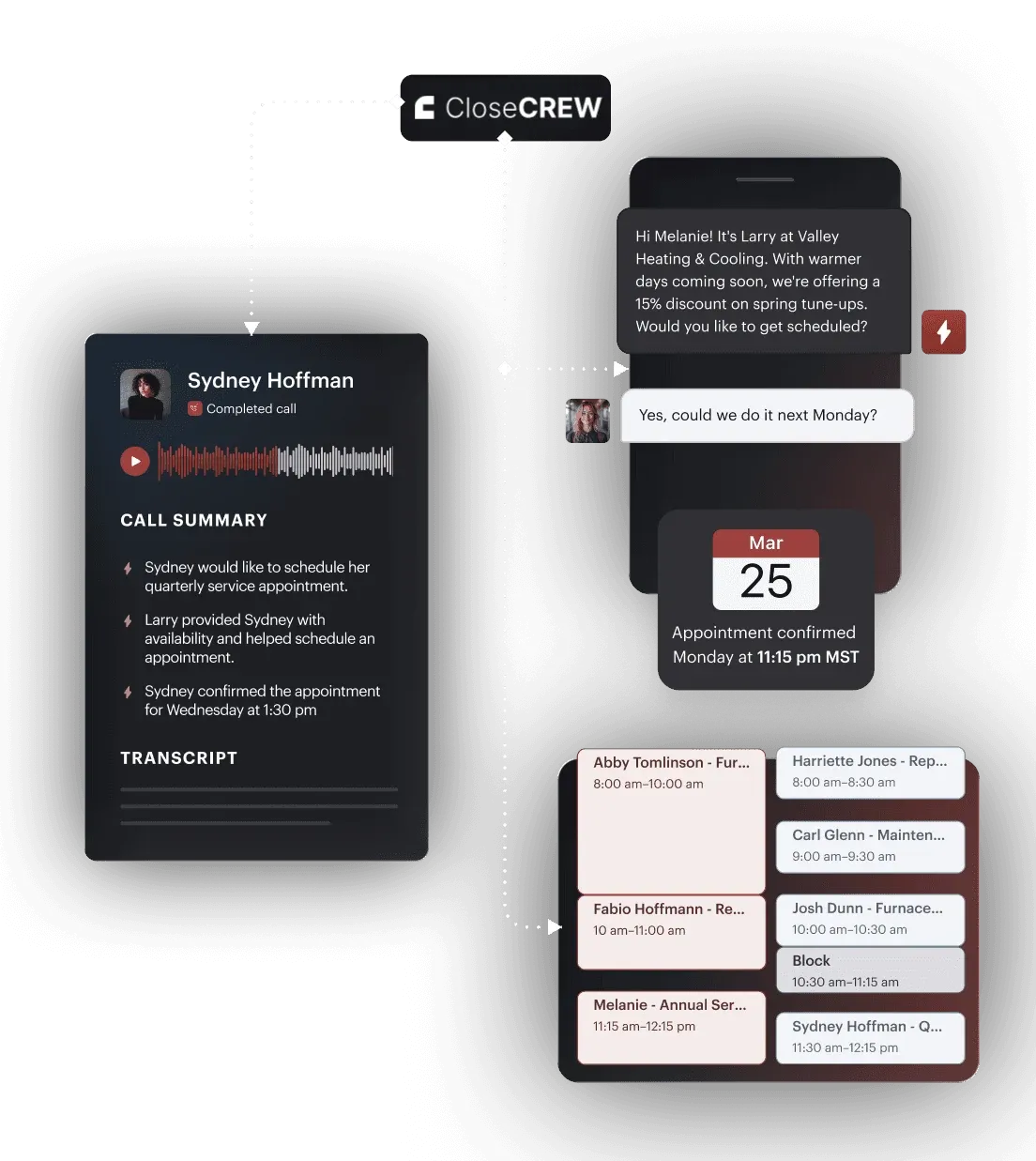
Larry, CloseCrew's AI Employee, answers every call 24/7. He captures prospect details. Qualifies the opportunity. Routes it to your sales team. Books the discovery meeting.
The deal that would have died in voicemail enters your pipeline. Larry doesn't close deals. He opens them. Every time the phone rings.
Your sales process converts prospects into contracts. But prospects need to reach you first. Larry makes sure they do. Day or night. Weekday or weekend.
Imagine your best commercial prospect calls on a Friday at 6 PM. They manage 15 buildings. They need a new maintenance partner. Your office is closed. They get voicemail. Monday morning, they've already scheduled meetings with two competitors.
Now imagine Larry answers that call. Captures the details. Books the discovery meeting for Monday at 10 AM. Your rep walks in first. With context. With preparation. With the advantage.
That's the difference between a reactive sales process and a proactive one.
The commercial growth playbook
Commercial HVAC revenue is the most predictable income a contractor can build. Maintenance agreements renew annually. Each visit creates upsell opportunities. Each satisfied building owner refers another.
But predictable revenue requires a predictable process. Discovery meetings that uncover real needs. Site walks that capture real data. Proposals that reflect real value. And follow-up that never stops.
The contractors who dominate commercial HVAC do five things consistently:
They answer every call. Day and night.
They run structured discovery meetings. Every time.
They document equipment thoroughly during site walks.
They present professional proposals with clear value tiers.
They follow up six times before accepting "no."
CloseCrew supports all five. Larry answers the calls. The CRM manages the pipeline. The mobile app captures equipment. The agreement builder creates proposals. And automated follow-up keeps deals moving.
No spreadsheets. No disconnected tools. No deals dying in the gaps between meetings.
Build a process that scales with confidence
A strong commercial engine isn't built on star reps. It's built on process. Discovery, assessment, and proposal. Disciplined follow-up. Clean handoffs. And every call answered.
CloseCrew gives you the CRM, agreement builder, and field tools to execute. Your sales team moves faster. Pricing stays consistent. Handoffs stop breaking. Larry ensures every prospect reaches you.
Win more agreements. Deliver with confidence. Grow predictably.
Frequently asked questions
How many meetings does a commercial sale require?
Three structured meetings minimum. Plus an average of six total touches before closing. Follow-ups, recaps, and negotiations add to the count.
Should I start with a small contract or full-facility?
Small for most prospects. Cover critical units first. Prove reliability. Expand after trust is established.
How do I handle silent prospects after proposals?
Follow up at day 3, 7, 14, and 30. Add value each time. Reference specific conversations. Don't just "check in."
What margin should I target on commercial agreements?
30% gross margin is standard. Adjust for account size. A flagship account at 25% may be worth the volume. Don't go below 20%.
How do I hand off closed deals to operations cleanly?
Everything in one record. Notes, photos, equipment, and commitments. CloseCrew stores it all. Operations, purchasing, and accounting access the same data. No separate handoff document.
What's the most common commercial sales mistake?
Not following up consistently. Most deals need six touches. Reps who stop after two lose winnable contracts. Set reminders. Use CRM tasks. Follow up on a schedule, not when you remember.
How do I compete with cheaper contractors?
Don't compete on price. Compete on scope and professionalism. Your detailed proposal shows everything included. Their thin proposal hides what's missing. Educated prospects choose value over price. Use clean documentation to make this obvious.
Should I hire dedicated commercial sales reps?
At 10+ trucks, yes. Commercial sales requires different skills than residential service. Dedicated reps manage longer sales cycles, larger contracts, and multi-stakeholder decisions. The ROI justifies the salary quickly.
How do I use HVAC symbols in commercial proposals?
Include system diagrams in your proposals for larger facilities. They demonstrate technical expertise. They help prospects visualize what you're maintaining. CloseCrew's proposal builder supports attachments and documentation.
Related tools
Run the numbers before you update your price book or field software.
Free HVAC Templates
Invoices, estimates, maintenance agreements, and flat-rate pricing sheets for heating and cooling contractors.
HVAC technology is moving beyond basic heating and cooling. These 15 innovations can help contractors improve efficiency, service, and stay competitive in 2026.
The right CRM can make a big difference in how smoothly your HVAC business runs. From scheduling and estimates to customer communication and sales tracking, these are the best HVAC CRM platforms worth considering in 2026.
Never miss an HVAC service call again. Let Larry, your AI receptionist, book jobs while your crew is in the field.
We will run your numbers on the call and tell you if the maths does not work for a shop your size. That happens, and it is a cheaper conversation than finding out three months in.