Most licensed electrical contractors structure their pricing around one of two primary business models: Time & Materials (T&M / Hourly Rates) or Flat-Rate Pricing. Each approach has distinct trade-offs that impact customer satisfaction, field productivity, and your ultimate bottom line.
Time & Materials (Hourly Rates)
Under the Time & Materials model, a contractor bills the client for the actual hours spent on-site (and sometimes in transit), along with the cost of materials used plus a standard markup percentage.
Advantages of T&M
Customer familiarity: Homeowners understand hourly billing because it mirrors traditional professional services.
Scope flexibility: It works well for large-scale, open-ended commercial builds or complex troubleshooting projects where the full scope cannot be determined upfront.
Cost tracking: Contractors can bill incrementally for multi-phase projects as milestones are completed.
Disadvantages of T&M
Micromanagement: Customers often watch the clock, creating anxiety and suspicion if a technician steps out to the truck or takes extra time to do a thorough job.
Penalizes efficiency: The faster and more experienced your master electricians are, the less money your business makes for completing the same task.
Capped earnings: Revenue is strictly constrained by the total number of billable hours your crew can physically perform in a day.
Flat-Rate Pricing
Flat-rate pricing sets a fixed price for a specific service or installation before the work begins, regardless of how long the job ultimately takes.
Advantages of Flat-Rate Pricing
Upfront clarity: Customers know the exact cost before work begins, removing surprise repair bills and building trust.
Incentivizes efficiency: Skilled technicians who complete jobs quickly and safely allow your company to run more calls per day, dramatically increasing total revenue.
Eliminates price haggling: Focuses customer attention on the value and outcome of the service rather than an arbitrary hourly rate.
Simplified sales: Empowers field technicians to present standardized service options with consistent profit margins built in.
Disadvantages of Flat-Rate Pricing
Risk of underestimating: If an unforeseen obstacle arises and the job takes twice as long as anticipated, your profit margin decreases on that specific call.
Requires maintenance: A flat-rate pricebook must be updated continuously to reflect rising vendor material costs and wage adjustments.
While T&M still has its place in long-term commercial contracting, flat-rate pricing has consistently proven to be the most profitable and customer-friendly model for residential electrical service companies.
To establish a bulletproof pricing structure, follow this four-step job costing framework for every electrical service you offer.
Step 1: Work Out Your Operating Costs and Break-Even Rate
Before calculating profit, know your total cost of operating for one month.
Sum all monthly fixed overhead costs: Rent, utilities, insurance, software subscriptions, office staff salaries, marketing, and vehicle payments.
Calculate total monthly billable hours: Multiply your number of field technicians by the hours they spend performing actual revenue-generating work per week (typically 25–30 hours per technician out of a 40-hour week).
Determine overhead cost per billable hour:
Step 2: Scope Out the Work On-Site
Never provide binding quotes for complex residential jobs over the phone. A licensed electrician must evaluate the property in person to identify underlying hazards and specific job requirements.
When inspecting a home, technicians should check:
The main breaker panel age, brand, and available capacity.
Existing wiring condition (e.g., knob-and-tube, aluminum wiring, ungrounded circuits).
Local building code compliance and required permit fees.
Physical access constraints (attic spaces, crawl spaces, drywall cutting).
Performing a comprehensive electrical safety evaluation uncovers necessary repairs that protect the homeowner while expanding job scope naturally.
Step 3: Specify Materials and Quantities
List every component required for the job, including small hardware that often gets overlooked:
Primary equipment (panels, subpanels, EV chargers, generators)
Fixtures, switches, dimmers, and receptacles
Conduit, wire gauge, junction boxes, wire nuts, and staples
Consumables (electrical tape, drywall anchors, drill bits)
Multiply unit material costs by your company’s standard material markup (typically 25% to 50% depending on the item category) to cover handling, storage, and shrinkage.
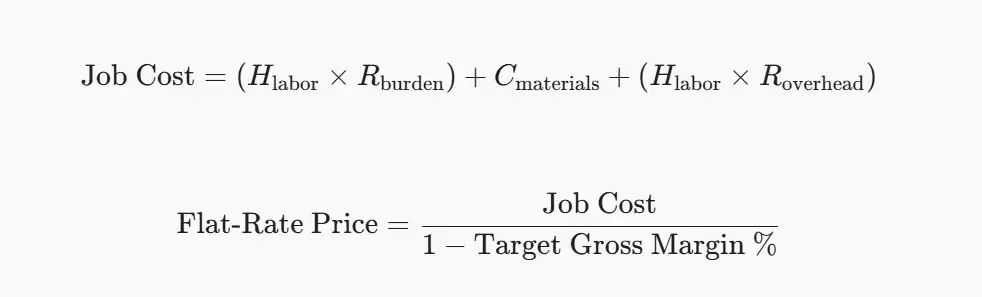
Step 4: Calculate Burdened Labor Costs and Target Margins
Calculate your fully burdened labor rate per hour, which includes base wage, payroll taxes, health insurance, 401(k) matches, and worker's compensation insurance:
To determine the final selling price for a job, combine labor, materials, and overhead, then apply your target gross profit margin (typically aiming for 50% to 60% gross margin across overall operations):
Having a profitable pricing strategy on paper is only half the battle; your field technicians must be able to execute it seamlessly in front of clients. This is where modern contractor management software becomes invaluable.
Streamline Pricebook Management
Software like ServiceTitan and its integrated Pricebook Pro comes pre-loaded with curated, flat-rate electrical services. Tasks are clearly categorized and defined so technicians can easily search for services on a tablet instead of flipping through paper binders.
Dynamic Price Automations
When supplier costs rise, updating catalog items manually across thousands of line items is exhausting. With integrated vendor price feeds, pricebooks update automatically based on defined margin rules. If material costs increase, your flat-rate prices adjust in real time to guard your profit margins.
Good-Better-Best Visual Proposals
Presenting a single price option puts the customer in a "Yes or No" mindset. Using digital estimating software allows field techs to present multi-option proposals (Good, Better, Best) in minutes.
For example, when quoting a panel upgrade:
Good: Standard 200-amp panel replacement with basic surge protection.
Better: 200-amp panel replacement with whole-house surge protection and smart circuit monitoring.
Best: 200-amp panel replacement, whole-house surge protection, smart monitoring, and an EV charger installation package.
Giving homeowners choices shifts their decision from "Should I hire this electrician?" to "Which level of service best fits my home?"—consistently increasing average ticket values.
Integrated Field-to-Office Workflow
Digital pricebook software integrates the entire operational workflow:
Estimating: Tech builds a visual estimate on a mobile tablet on-site.
Approval: Customer signs electronically on the tablet screen.
Execution: Work orders generate purchase orders for materials automatically.
Invoicing & Payment: Tech issues an itemized digital invoice and collects credit card or check payment on the spot.
Accounting: All job data syncs directly with accounting platforms like QuickBooks or Sage Intacct, eliminating double data entry.
By tying your flat-rate pricebook directly to business reporting, management can track essential performance metrics in real time:
Gross margin percentage by job type and service category
Close rates on estimates per technician
Average revenue generated per call
Membership agreement conversion rates
If a specific service type drops below your 60% target gross margin, reporting pinpoints whether the cause was underestimated labor hours, untracked material usage, or incorrect baseline pricing.
Pricing is just one pillar of managing a thriving electrical contracting company. To streamline operations, strengthen your online presence, and build a high-performing field team, explore these additional guides for electrical contractors:
Best Electrical Dispatch Apps: Discover top dispatching and scheduling software designed to reduce travel time, optimize route planning, and increase daily billable hours.
Best Electrician Books: Key reads on business management, leadership, trade estimation, and electrical company scaling.
Marketing & Brand Management
Electrician Reputation Management: Learn how to capture 5-star customer reviews, manage online feedback, and build a local reputation that commands premium rates.
Electrician Social Media Marketing: Proven content strategies to engage local homeowners, highlight completed installations, and build brand awareness on Facebook, Instagram, and LinkedIn.
Electrician Website Templates: Explore high-converting website designs built specifically to turn local search traffic into booked service calls.