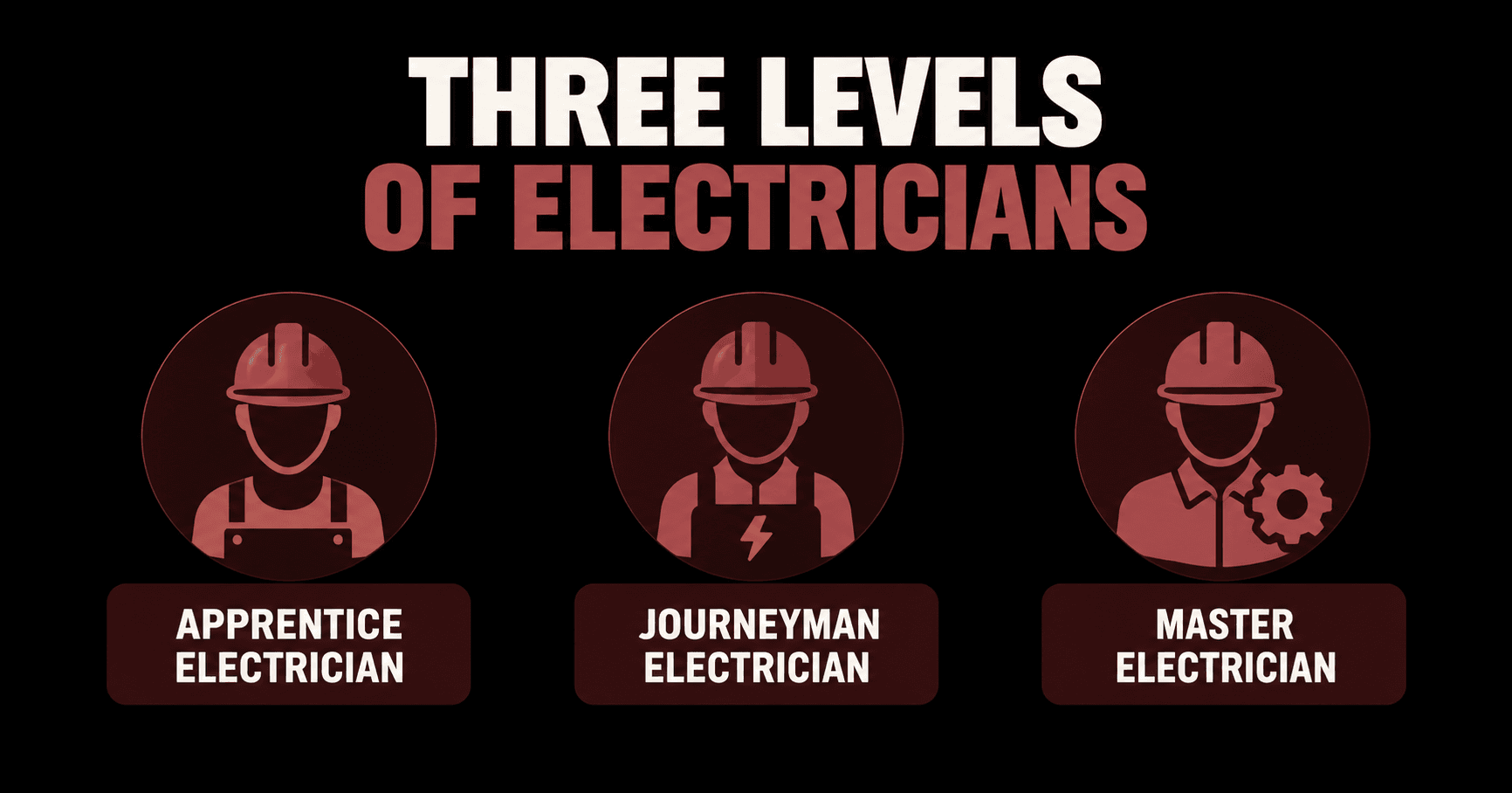
Every electrician starts at the bottom and works their way up. The career ladder has three main levels, each with distinct responsibilities and pay.
Level | Experience Required | Can Work Independently | Can Supervise Others | Can Pull Permits | Average Hourly Pay |
Apprentice | None (in training) | No | No | No | $15 to $20/hour |
Journeyman | 4-5 years + licensing exam | Yes | No | No | $25 to $35/hour |
Master | 7-10 years + advanced exam | Yes | Yes | Yes | $35 to $50/hour |
Apprentice Electrician
Apprentice electricians are at the start of their career. They learn through a mix of classroom instruction and hands-on work. A licensed electrician supervises all of their field work.
Most apprenticeships last four to five years. During that time, apprentices complete around 8,000 hours of on-the-job training. They also take several hundred hours of classroom instruction.
Apprentices typically earn between $15 and $20 per hour. That is lower than licensed electricians but grows steadily each year. Many apprenticeship programs increase pay every six months based on progress.
Journeyman Electrician
A journeyman electrician has completed their apprenticeship fully. They have passed a licensing exam in their state. This license allows them to work independently on most electrical jobs.
Journeymen handle wiring, installations, repairs, and maintenance. They cannot supervise other electricians or pull permits for projects. Most journeymen earn between $25 and $35 per hour depending on their location.
The journeyman level is where most electricians spend the bulk of their career. Some stay here and earn excellent wages for decades. Others pursue the master electrician certification.
Master Electrician
Master electricians sit at the top of the career ladder. They hold the highest level of electrical licensing available. This requires years of experience plus passing an advanced exam.
Master electricians can supervise entire teams on large projects. They pull permits, design electrical systems, and run businesses. Their hourly rates range from $35 to $50 or higher.
Many master electricians go on to start their own contracting businesses. Running a successful electrical company requires more than technical skill. It demands strong business management and customer service systems.
CloseCrew helps master electricians who run their own businesses stay organized. The platform handles scheduling, invoicing, and customer communication automatically. Use our electrical profit margin calculator to make sure your pricing reflects your expertise.
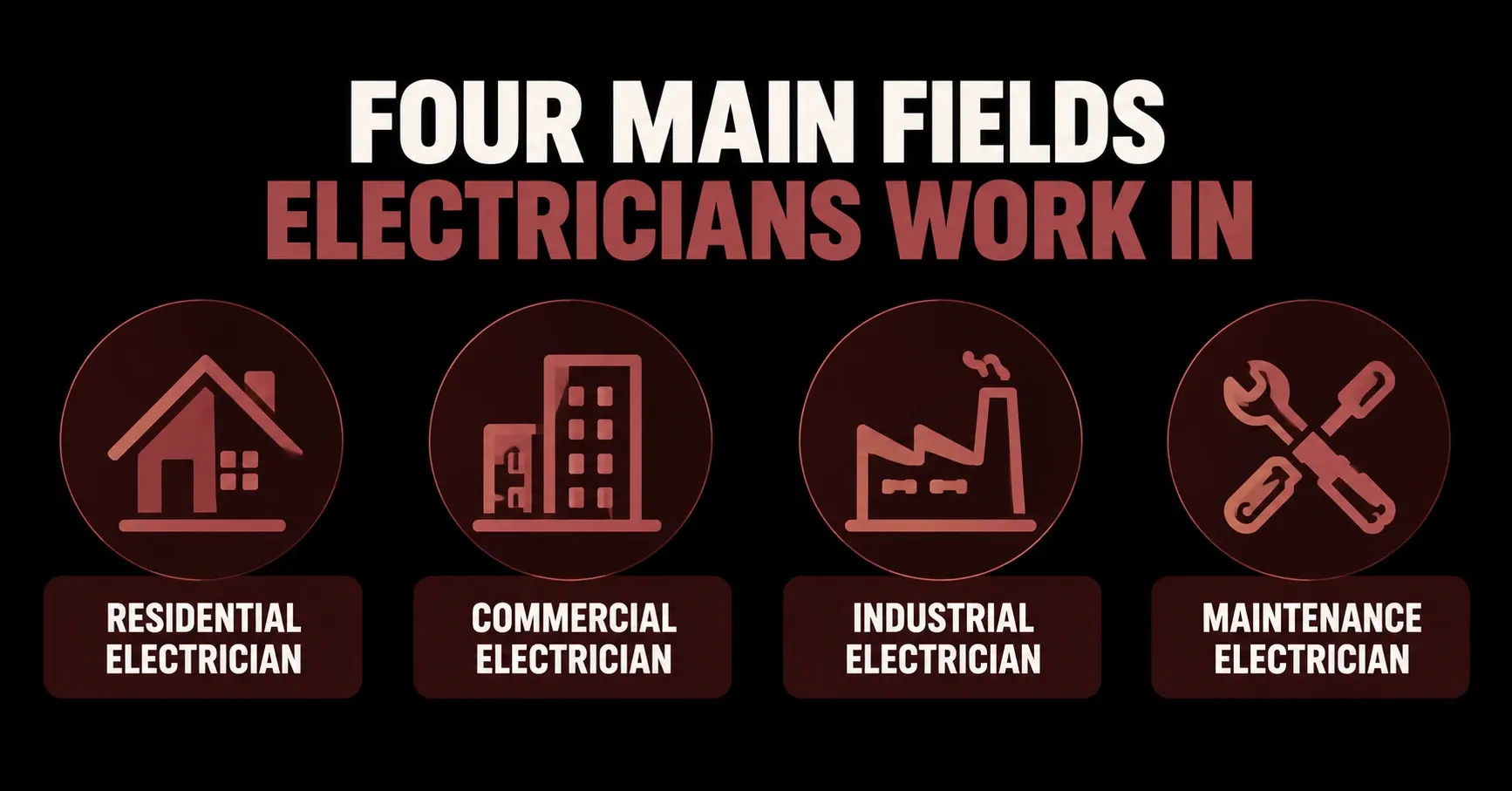
Beyond career level, electricians also specialize by work environment. Each field has its own challenges, requirements, and earning potential.
Field | Work Environment | Typical Projects | Key Requirements |
Residential | Homes, apartments, condos | Wiring, outlets, panels, fixtures, smart home systems | NEC code knowledge, customer service skills |
Commercial | Offices, restaurants, retail, schools | Lighting, security, power distribution, energy systems | Blueprint reading, project coordination |
Industrial | Factories, plants, warehouses | High-voltage machinery, PLCs, automation systems | Safety certifications, PPE training |
Maintenance | Any setting (varies) | Inspections, repairs, upgrades, preventive service | Troubleshooting skills, broad knowledge base |
Residential Electricians
Residential electricians work in homes and living spaces. They install wiring, outlets, circuit breakers, and lighting fixtures. Homeowners call them for renovations, new construction, and everyday repairs.
This field requires strong customer service skills. Residential electricians work directly with homeowners regularly. Clear communication about costs, timelines, and safety keeps customers happy.
The demand for residential electricians keeps growing steadily. Smart home technology, EV charger installations, and solar panels drive new work. Electricians who learn these emerging skills command higher rates.
Residential contractors who want to capture more customer calls should consider CloseCrew. Crew, CloseCrew's AI Employee answers homeowner calls around the clock. It qualifies the issue, books the appointment, and sends a confirmation. Premier Heating cut response times from 12 minutes to under 1 minute using Crew.
Commercial Electricians
Commercial electricians handle businesses, offices, and public buildings. Their projects involve larger electrical systems than residential work. Complex lighting, security systems, and power distribution are common tasks.
These electricians read blueprints and coordinate with other trades. They work alongside HVAC technicians, plumbers, and fire alarm installers. Commercial projects often require permits and strict code compliance.
Commercial work typically pays more than residential projects. The systems are more complex and the stakes are higher. A single error can affect an entire building full of people.
Industrial Electricians
Industrial electricians work in factories and manufacturing plants. They handle high-voltage machinery, hazardous materials, and complex automation systems. This is the most demanding and dangerous electrical field.
Safety training is critical in industrial settings. These electricians wear specialized PPE every day on the job. They must prevent arc flashes, shocks, and fire risks constantly.
Industrial electricians often work with PLCs and robotics. They troubleshoot sensors, motors, and process control systems regularly. This specialized knowledge commands some of the highest pay in the trade.
Maintenance Electricians
Maintenance electricians keep existing systems running smoothly. They work in residential, commercial, or industrial settings. Routine inspections, repairs, and upgrades fill their daily schedule.
Their role is essential for preventing costly breakdowns. A maintenance electrician catches small problems before they become big ones. This saves businesses thousands in emergency repairs and downtime.
Maintenance work provides steady, predictable income for contractors. Regular service agreements create recurring revenue month after month. This stability makes maintenance a smart addition to any electrical business.
CloseCrew helps maintenance electricians manage recurring service schedules. The platform tracks customer agreements and sends automatic reminders. Your team always knows which inspections are due and when.
Becoming a licensed electrician requires formal training and testing. Requirements vary by state, but the general path follows a clear pattern.
Step | What It Involves | Typical Timeline |
High school diploma or GED | Basic education requirement for most programs | Before starting |
Apprenticeship program | 8,000+ hours on-the-job training plus classroom instruction | 4 to 5 years |
Journeyman licensing exam | Written test on NEC code, safety, and electrical theory | After apprenticeship |
Work experience as journeyman | Independent work building advanced skills | 2 to 4 years |
Master electrician exam | Advanced test on system design, code, and business knowledge | After required experience |
Additional certifications can boost your earning potential significantly. OSHA safety certifications, solar installation credentials, and EV charger training all add value. Employers and customers pay premium rates for certified specialists.
The electrical trade offers strong earning potential at every level. Specialized roles and business ownership push incomes even higher.
Position | Annual Salary Range | What Drives Higher Pay |
Master Electrician | $70,000 to $100,000+ | Team supervision, system design, permit authority |
Industrial Electrician | $60,000 to $85,000+ | Hazardous conditions, specialized equipment |
Lineworker | $60,000 to $95,000+ | Dangerous conditions, overtime, hazard pay |
Avionics Electrician | $60,000 to $90,000+ | Aviation certifications, precision requirements |
Electrical Contractor (Owner) | $80,000 to $150,000+ | Business management, client volume, team size |
Running your own electrical contracting business opens the door to the highest earnings. But it also brings responsibilities beyond technical work. Managing operations, clients, and cash flow determines your success.
CloseCrew helps electrical business owners handle the operational side efficiently. Crew answers every customer call so you never miss a lead. The platform manages scheduling, estimates, and invoices in one place.
Air Texas landed a $20,000 after-hours job that Crew captured overnight. Air Design booked 13 extra appointments in just 30 days using the platform. These results show what happens when you stop missing calls.
Technical skills matter, but personal traits determine long-term success. The best electricians share these common characteristics.
Trait | Why It Matters | How It Shows Up on the Job |
Detail-oriented | Small mistakes cause big safety problems | Measuring twice, checking codes, following procedures exactly |
Problem solver | Every job brings unexpected challenges | Diagnosing faults, finding creative solutions, adapting quickly |
Physically fit | The work demands strength and endurance | Climbing ladders, lifting equipment, working in tight spaces |
Dependable | Teams and customers count on you | Showing up on time, finishing jobs as promised, being consistent |
Customer-focused | Homeowners and businesses are your clients | Communicating clearly, being respectful, explaining work simply |
Safety-conscious | Electrical work carries life-or-death risks | Following protocols, wearing PPE, never cutting corners on safety |
These traits help electricians build strong reputations over time. Reputation drives referrals, and referrals drive business growth. A dependable electrician with strong people skills never runs out of work.
Beyond personal traits, electricians need a strong set of technical and professional skills.
Skill | What It Covers | How to Build It |
Electrical knowledge | Circuits, voltage, resistance, current, power theory | Trade school, apprenticeship, hands-on practice |
Blueprint reading | Interpreting plans, schematics, and wiring diagrams | Classroom training, on-the-job experience |
Tool handling | Multimeters, conduit benders, wire strippers, power tools | Daily practice under supervision |
Math skills | Load calculations, material estimates, measurements | Trade school coursework, real-world application |
Code compliance | NEC standards, local regulations, permit requirements | Study guides, continuing education, code updates |
Communication | Explaining issues to clients, coordinating with teams | Customer interactions, team collaboration |
Electricians who invest in continuous learning earn more over time. New technologies like solar, EVs, and smart buildings require updated skills. Staying current with code changes keeps you compliant and competitive.