Entry-level and experienced electricians will find this online course helpful because it covers common hazards encountered during electrical installations. Mastering these principles alongside core electrical safety tips helps protect workers from job-site injuries.
Data from the Bureau of Labor Statistics, U.S. Department of Labor, shows that 10,420 electrical and electronic equipment mechanics, installers, and repairers were injured on the job between 2021 and 2022.
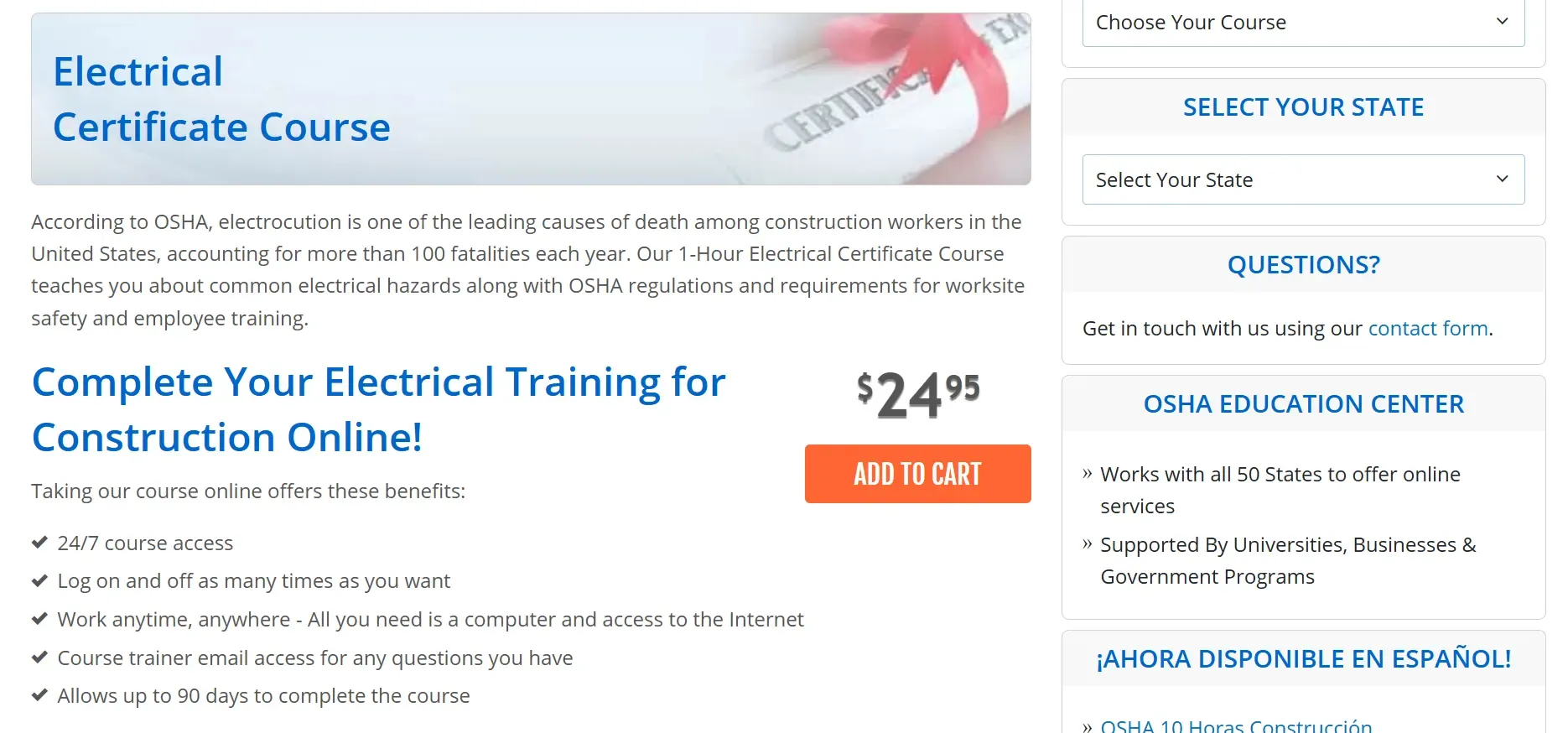
Learners can complete the course anywhere with a computer and reliable internet connection. Participants have 180 days to complete the training, after which they receive a course completion certificate.
Topics covered: Induction, grounding, electrical hazards, and field safety.
Course duration: 1 hour
Course cost: $24.95
Where to find it: OSHA Education Center
The course gives a detailed explanation of equipment used to maintain electrical systems, including personal protective equipment (PPE), circuit breakers, control systems, fuses, and first aid.
Available as both online technical training (offering 0.5 CEUs) and a course manual, this program works well for entry-level electricians straight out of high school or journeymen seeking career advancement.
Using videos, exercises, and real-life scenarios, experts teach wiring methods, raceway fill, grounding principles, and transformer protection. This is a crucial resource for safety engineers, project managers, and technicians across any multi-branch electrical business.
Electrician Apprentice & Journeyman Fast-Track Prep is designed to transition apprentice electricians into confident journeymen, this structured course focuses on practical troubleshooting, circuit analysis, and load calculations.
Combining trade math with practical field exercises, it helps technicians boost their technical proficiency, output quality, and long-term earning potential when comparing electrician salaries by state.
Crew is an AI receptionist built for home service businesses. It answers calls, understands what the customer needs, collects the right details, checks your live schedule, and books the job. If a call needs a person, it hands it to your team with the conversation history attached.
For example, a customer may call to reschedule an existing appointment. Crew can find the booking, check available times, move the appointment, and release the original slot.
Finds the right appointment: Uses the customer and job details to identify the visit.
Checks live availability: Offers appointment times that are actually open.
Updates the schedule: Moves the booking and releases the old time.
Hands off when needed: Sends complex calls to your team with the transcript attached.
What Crew Handles
Think of Crew as another member of your office team, available whenever your staff cannot answer.
Role: AI receptionist for home service businesses
Availability: 24/7, including nights, weekends, and holidays
Business name: Answers as your company using your configured greeting
Languages: English and Spanish
Trade knowledge: Uses your trade, service area, equipment, and booking rules
Scheduling: Reads live availability and books into your existing system
Lead qualification: Collects the information your team needs before the job
Escalations: Hands complex calls to your team with the conversation history
Call handling: Follows your business rules consistently across calls
Pricing: Based on call volume and the systems you need connected
Crew is configured around your business, including your hours, pricing, service area, trade, and rules for what it should handle or pass to your team.
After-Hours Call Handling
Your customers do not only call when your office is open. Nights, weekends, holidays, and busy periods can all bring calls that would otherwise reach voicemail.
Crew can answer those calls, qualify the request, check your schedule, and book available appointments. It can also escalate calls that fall outside your rules.
With Crew, your business can keep answering calls when your office team is unavailable, while keeping bookings connected to the schedule you already use.
Ready to scale your business, increase booking rates, and maximize field efficiency? Unlock our specialized trade growth resources below:
Built for the Trade: How Crew Handles Electrical Calls
Crew is tuned to how each trade actually works. It is not a single generic script serving multiple industries. For electrical contractors, Crew understands what constitutes a genuine emergency, what safety details to gather, and what information must be established before a service truck rolls out.
Electrical Triage Rules
Treated as Urgent: Complete power outages, exposed live wires, burning electrical smells, or panel sparking.
Information Established Before Booking:
Is there total power loss or a partial outage?
Are there any immediate safety hazards, smoke, or burning odors?
Is anyone in the home reliant on medical equipment?
Is the property rental or owner-occupied?
Where It Stops: Clear Boundaries and Escalations
Every answering product publishes what it can handle. Here is the other half, clearly defined upfront:
Scenario | How Crew Handles It |
Emergency at 2:00 AM | Picks up on the first ring, determines emergency rates, and books the earliest open slot on your board. |
Price Inquiries | Gives the exact diagnostic or call-out fee you configured and nothing else. It will not quote complex repairs over the phone. |
Repeat Customers | Confirms the address on file rather than asking again, attaching the new job to the existing customer profile. |
Caller Asks if It's AI | Identifies itself as an automated assistant. Crew never pretends to be human and seamlessly transfers if requested. |
Angry Callers or Warranty Disputes | Stops selling immediately and routes the call to your management team with full transcripts attached. |
Commercial / Multi-Site Work | Captures commercial details and forwards them directly to your commercial estimator. |
Unmapped Requests | Hands over cleanly to your team rather than guessing or providing incorrect information. |
API / Schedule Failures | Saves the booking as an unconfirmed request in your queue so no lead is ever silently dropped. |
Curious to see how CloseCrew automates workflow tracking, dispatching, and field communication in real time?
Courses offer valuable lessons in maintaining, repairing, and troubleshooting electrical systems, but technical skills are only part of the equation. Your field team also needs to excel at customer communication, workflow management, and operational efficiency.
To drive predictable growth and streamline your operations, consider these best practices:
1
Arm Them with Trade-Specific Technology
Field technicians face friction when relying on paper forms, calling the office for invoice approvals, or failing to capture job site details. Modern customers expect real-time visibility, online scheduling, and clear digital communication.
Ready to scale your business, increase booking rates, and maximize field efficiency? Unlock our specialized revenue growth toolkit below:
2
Teach Them Practical Communication & Sales Skills
Your field technicians represent your brand directly. Teaching them how to present options clearly, explain technical needs to homeowners, and offer appropriate add-ons turns everyday service calls into higher-ticket jobs.
Curious to see how CloseCrew automates workflow tracking, dispatching, and field communication in real time?
3
Cultivate a Customer-First Mindset
Exceeding customer expectations drives positive reviews, repeat business, and word-of-mouth referrals. Train your technicians to walk customers through their findings, explain proposed fixes transparently, and maintain clear communication from arrival to job completion.
If you want custom guidance on optimizing your team's workflows, lead generation, or field operations, speak directly with our trade growth specialists: