Google Ads for Electrical Contractors: A Complete Guide (2026)
Google Ads puts your electrical business at the top of search results when homeowners need an electrician. This guide covers campaign setup, keyword research, ad types, landing pages, budgeting, best practices, and the strategy that converts every ad click into booked revenue.
A strong online presence matters for your electrical business. SEO brings in local leads over time. But there's a faster channel most electricians underuse. Google Ads.
Google Ads puts your business atop search results. Homeowners see you first. Not tomorrow. Not in 3 months. Today.
This guide covers Google Ads for electrical contractors. How to stand out. Attract quality leads. Maximize return on ad spend. Whether you're launching your first campaign or refining your strategy, this is your blueprint.
Ever searched for a service and seen "Sponsored" at the top of results? Those are Google Ads.
Google Ads (formerly Google AdWords) is an online advertising platform. Businesses pay to display ads using a pay-per-click model. Ads appear across Google Search, YouTube, Google Maps, and partner sites.
The most common format is the search ad. Text-based. Appears at the top of Google results. Many businesses also run YouTube ads since Google owns YouTube.
Why this matters for electricians. Every contractor competes for customer attention. But the stakes are higher for service businesses. There are over 900,000 contractors in the U.S. alone. If you don't show up in top search positions, customers never see your business. They click whoever appears first.
Google Ads levels the playing field. A small electrical shop with smart ads can outrank larger competitors.
How do Google Ads work
Google Ads focuses on keywords. These are search phrases customers use. "Electrician near me." "Panel upgrade cost." "Emergency electrical repair in [City]."
When you create a campaign, you enter relevant keywords. When someone searches those terms, Google checks for active campaigns. If yours matches, your ad appears in search results.
Ad spots are limited. Many businesses compete for them. Google's algorithm decides which ads display based on several factors:
Relevance to the search query
Landing page experience and quality
Quality of the ad copy itself
Bid amount
Expected click-through rate
These factors combine into a score called Ad Rank. Businesses with higher Ad Ranks win more ad placements. A well-crafted ad with a moderate bid can outrank a poorly written expensive one. Quality matters as much as budget.
Benefits of Google Ads for electricians
Increased visibility for local businesses
Google Ads puts you at the top of results. More users see your brand name. That visibility creates a lasting impression. Even users who don't click today remember your name tomorrow.
Pay-per-click ensures cost efficiency
Traditional advertising charges regardless of results. Google Ads charges only per click. No clicks, no charge. Every dollar goes toward someone who showed interest in your services.
Target specific areas, demographics, and intent
Google Ads lets you target exact geographic areas you service. Specific ZIP codes. Cities. Neighborhoods. You can also target demographics and align ads with specific search intent.
Someone searching "emergency electrician near me" wants to hire now. Not reading DIY tips. Your ad matches that intent precisely. That's a high-quality lead.
Immediate results compared to organic SEO
SEO takes 3-6 months to generate meaningful traffic. Google Ads delivers visibility the day you launch. Immediate. Measurable. Perfect for filling slow weeks or launching new service offerings.
Enhanced performance tracking for ROI optimization
Google Ads provides detailed metrics on every campaign. Click-through rates. Conversion data. Cost per lead. This transparency lets you track what works. Make data-driven adjustments. Ensure every dollar contributes to positive ROI.
Drawbacks of Google Ads for electricians
High competition drives up costs
Depending on your local market, Google Ads can get expensive. Limited ad slots create bidding wars. Popular keywords like "electrician near me" cost $15-$50 per click in dense metro areas.
Requires ongoing monitoring and optimization
Google Ads is not set-and-forget. Campaigns need continuous oversight. Keywords and bidding strategies need adjustment as user trends and customer behavior change over time.
Mismanagement wastes ad spend
Wrong settings, targeting, or bidding burns budget with zero return. Wrong match types. Poor landing pages. Missing negative keywords. Each mistake burns money.
Seasonal fluctuations impact effectiveness
Electrical services see seasonal demand shifts. Emergency calls spike during summer storms and winter cold. Competition surges during peak periods. Ad costs increase accordingly.
Proper strategy, monitoring, and budget allocation manage these drawbacks. The ROI justifies the effort for most electrical contractors.
Types of Google Ads for electrical contractors
1
Search ads
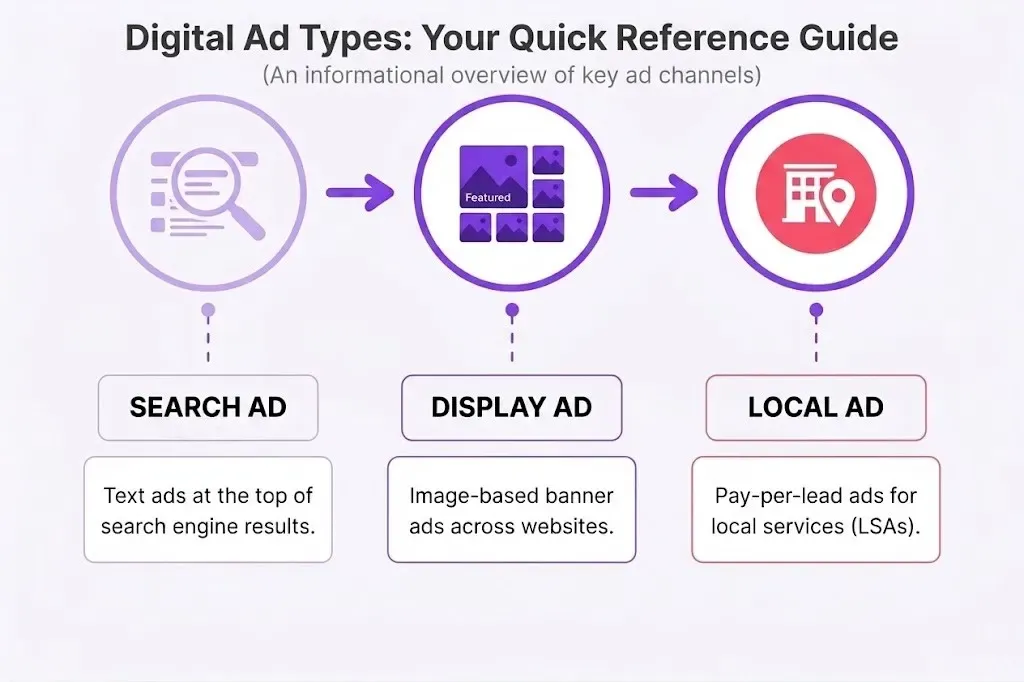
Text-based ads at the top of Google Search results. They look similar to standard listings but show a "Sponsored" label. Include your website name, headline, and description.
Search ads target keywords with high intent. They're the most direct path to leads. Someone types "licensed electrician in [City]." Your ad appears first. They click. They call.
Search ads generally cost more than other formats because they capture customers ready to buy. But the lead quality justifies the premium.
2
Display ads
Image-based ads that appear across websites you browse. Unlike search ads that target keywords, display ads target placements, audiences, and topics.
Display ads reach potential leads across Google's network of 30+ million websites and platforms. They're less direct than search ads but powerful for brand awareness. A homeowner sees your display ad on a home improvement site. They remember your name when they need an electrician next month.
3
Video ads (YouTube)
Video ads appear on YouTube and partner streaming platforms. They typically include interactive elements like CTA buttons. Users can usually skip after 5 seconds.
Those first 5 seconds are critical. Front-load your value proposition. Company name. Service. Location. Make the skip decision harder.
4
Local Services Ads (LSAs)
LSAs appear above standard search ads. They're technically separate from Google Ads but worth including. Businesses that verify their Google Business Profile can run LSA campaigns.
The best part: You pay per lead, not per click. Only charged when someone contacts you by phone or message.
LSA ranking factors:
Proximity to the searcher
Google Business Profile completeness
Review count and rating
Responsiveness to leads
Business hours
LSAs are the most cost-effective ad type for most electrical contractors. The Google Guaranteed badge builds instant trust.
For most electricians, start with LSAs and search ads. Add display and video as budget grows.
For building the website that your ads drive traffic to, see our website guide.
How to create a Google Ads campaign
Step 1: Define your campaign goals
Establish clear objectives before launching.
Lead generation: Phone calls, form submissions, bookings
Brand awareness: Impressions and local visibility
Website traffic: Clicks to specific service pages
For electrical contractors, lead generation is almost always the primary goal. Focus campaigns on generating phone calls and booked appointments.
Step 2: Conduct keyword research
Effective research ensures ads reach the right audience. Identify high-intent keywords potential customers actually type.
Use Google Keyword Planner to analyze search volume, competitiveness, and cost per click. Refine your list to target the most profitable queries.
High-intent electrical keywords:
"Electrician near me"
"Emergency electrician [City]"
"Panel upgrade cost"
"EV charger installation [City]"
"Licensed electrician [ZIP code]"
"Electrical repair [Neighborhood]"
"Breaker keeps tripping"
"Whole house rewiring cost"
Include city and neighborhood names. Local specificity reduces competition and cost per click.
Step 3: Set a budget and bid strategy
Google Ads operates on PPC. Setting a realistic budget based on your cash flow is crucial. Budget determines keyword count and monthly click volume.
Set both a daily budget and monthly cap. Industry benchmark: 2-5% of revenue for B2B, 5-10% for B2C. Allocate 25-40% of your marketing budget to Google Ads.
Starting budgets:
Small electrical business: $500-$1,500/month
Growing team (5-15 techs): $2,000-$5,000/month
Established multi-truck operation: $5,000-$10,000/month
Your budget doesn't need to be fixed. Adjust based on campaign performance. Increase on channels generating strong ROI. Decrease on underperformers.
Step 4: Optimize landing pages for conversion
Your ad gets the click. Your landing page gets the booking. A bad landing page wastes every ad dollar.
Landing page essentials:
Fast loading (under 3 seconds)
Mobile-friendly (most clicks come from phones)
Clear headline matching the ad copy
Prominent phone number (click-to-call on mobile)
Customer reviews and trust signals (certifications, licenses)
Simple form or booking widget
Clear CTA: "Call Now" or "Get a Free Quote"
Specific to the service advertised
Don't send all traffic to your homepage. Create dedicated landing pages per service. Your "panel upgrade" ad should land on a panel upgrade page. Not your general services page.
The goal isn't just getting leads. It's converting them. Keep your landing page simple, relevant, and action-oriented.
Step 5: Create compelling ads
The most critical part. Pack value into limited space.
Example: "Licensed Electrician in Austin | Same-Day Service | Free Estimates"
Ad copy approaches:
Benefit-focused: Lead with what customers care about. "Fast Response. Licensed. Insured. Book Your Electrician Today."
Solution-oriented: Address the problem directly. "Breaker Keeps Tripping? Our Licensed Electricians Fix It Today."
Proof-centered: Use results to build trust. "500+ Five-Star Reviews. Trusted by [City] Homeowners Since 2015."
Tips for every ad:
Keep headlines simple and value-driven
Emphasize benefits in descriptions
Include a compelling CTA
Add urgency without being pushy ("Available This Week")
Mention financing if applicable
Step 6: Track campaign performance
Launching is not the finish line. Monitor continuously.
Key metrics to track:
Impressions: How many users see your ad (shows bid competitiveness)
Click-through rate (CTR): Clicks vs impressions (shows ad effectiveness)
Conversion rate: Visitors who book (shows landing page effectiveness)
Cost per lead (CPL): Budget divided by leads generated
Use Google Ads analytics to review weekly. Adjust bids. Refine targeting. Test different ad creatives. A data-driven approach ensures your campaign achieves objectives.
Best practices for electrical contractor Google Ads
Analyze competitors' campaigns
Understanding competitor strategies provides valuable insights. Use Google Keyword Planner to analyze their keywords, ad copy, and bidding approaches.
Identify gaps. Target underserved neighborhoods. Offer more competitive promotions. Craft campaigns that highlight your unique strengths versus competitors.
Optimize your landing page continuously
Your landing page is crucial to ad success and return on spend. It's how you convert clicks into customers.
Ensure it's mobile-friendly, fast, and designed for engagement. Include CTAs and social proof. Update content regularly to match current campaigns and offerings.
Target negative keywords
Negative keywords prevent ads from showing on irrelevant searches. "DIY electrical wiring." "Electrician salary." "Electrician school near me." "How to wire an outlet yourself."
These searches attract the wrong audience. People looking for careers or tutorials. Not customers ready to hire.
Google lets you create negative keyword lists. Update monthly. This protects budget from wasted clicks on searches that will never convert.
Geo-target specific locations
Target only areas where you provide service. Geo-targeting narrows audiences to cities, ZIP codes, or a radius around your shop.
This ensures ads only show to potential customers within your service area. Improves lead quality. Prevents paying for clicks from homeowners 50 miles away who will never hire you.
A/B test your ads
Compare two ad variations that differ in one element. Different headline. Different CTA. Different description. Run both simultaneously. Keep the winner. Test again.
Test ad copy, placement times, bidding strategies, and target audiences. Regular testing fine-tunes campaigns and improves performance over time. Small gains on each test compound into significant results.
Match ads to landing pages
Ad says "Panel Upgrade in [City]"? Landing page must be about panel upgrades in that city. Not your homepage. Not a general services page.
Relevance improves Quality Score. Lowers cost per click. Increases conversions. Google rewards consistency between ad and destination.
The click that never gets answered
Your campaign is dialed in. Keywords targeted. Landing page optimized. Budget efficient. CTR is strong.
A homeowner searches "electrician near me" at 7 PM. Clicks your ad. Reads your landing page. Calls your number. Voicemail.
They hit the back button. Click the next ad. That electrician answers. That electrician books a $2,500 panel upgrade your ad generated.
Your ad worked perfectly. Your landing page converted. The phone rang. Nobody answered.
CloseCrew's AI Employee answers every call 24/7. He qualifies the electrical issue. Books the appointment. Sends confirmation by text. The ad click becomes a booked job. Not a missed call notification you see the next morning.
Every dollar you spend on Google Ads generates clicks. Larry converts those clicks into revenue. Without 24/7 call answering, a significant portion of your ad spend goes to voicemail. With Larry, every click has a chance to convert.
Arctic Air saw 30% more revenue in one year. Premier Heating converted 3x more leads with response under 1 minute. Air Design added 13 extra appointments in 30 days.
Your ads generate the click. Larry books the job. Every time.
Top tools for Google Ads management
Google Keyword Planner. Find relevant keywords. Analyze search volume. Estimate cost per click. Free tool. Essential for every campaign.
Google Ads Editor. Manage and edit campaigns offline. Streamlines bulk edits. Adjust bids and create ad copy across multiple campaigns efficiently.
Google Analytics. Comprehensive insights into user behavior after the click. Track CTR, conversions, bounce rates, and engagement. Refine campaigns based on actual user behavior.
SEMrush. Comprehensive SEO and PPC tool. Keyword research. Competitor ad analysis. Performance tracking. Recommendations for landing pages and ad copy during A/B testing.
CloseCrew. Tracks which ad campaigns generate actual booked jobs. Not just clicks. Not just calls. Revenue. Full funnel from ad impression to completed invoice. See which campaigns produce $15,000 panel upgrades vs $150 outlet repairs. Reallocate budget to highest-revenue channels.
CloseCrew also provides dynamic call tracking. Each campaign gets a unique phone number. You know exactly which ad generated each call. Which calls became booked jobs. Which jobs generated revenue. Full attribution without manual tracking.
For the CRM that manages the leads your ads generate, see our CRM guide. And for protecting your business as it grows, see our electrical business insurance guide.
Your ads attract them. CloseCrew books them.
Google Ads puts your electrical business in front of homeowners searching right now. The right keywords, landing pages, and budget generate clicks. But clicks only become revenue when someone answers the phone. That's the conversion most guides ignore.
CloseCrew ensures that happens. Larry answers 24/7. Every ad click that generates a call becomes a booked appointment. Not a missed opportunity sitting in voicemail until Monday morning.
Frequently asked questions
How much should electricians spend on Google Ads?
$500-$1,500/month to start for small shops. Scale based on ROI. Track cost per booked job, not just cost per click. If $1,000 in ads generates $15,000 in revenue, increase the budget.
Are Google Ads or Local Services Ads better?
LSAs for most electrical contractors. Pay per lead instead of per click. Google Guaranteed badge builds trust. Use both simultaneously for maximum visibility. LSAs capture ready-to-book customers. Search ads capture researching customers.
How long before Google Ads produce results?
Days, not months. First leads can arrive within 24-48 hours of launching. Campaign optimization takes 2-4 weeks to identify winning keywords and ad variations.
What's the biggest Google Ads mistake electricians make?
Sending all traffic to the homepage. Dedicated landing pages per service convert 2-3x better. "Panel upgrade" ads must land on a panel upgrade page. Also: not setting negative keywords. This wastes budget on irrelevant searches.
Should I run Google Ads during slow seasons?
Yes. Competition drops. Cost per click decreases. Maintenance plans and inspection offers fill the schedule. Many electricians see their best CPL during shoulder months. Competitors pause campaigns. Your ads face less competition. Budget stretches further. Slow-season leads become maintenance agreement customers who stay for years.
Can I manage Google Ads myself?
Yes for basic campaigns. Google's interface guides you through setup. For advanced optimization, consider an agency or dedicated marketing manager. The complexity grows with budget. At $500/month, self-management works. At $5,000/month, professional management typically delivers better ROI.
Related tools
Run the numbers before you update your price book or field software.
Free Electrical Templates
Invoices, estimates, and flat-rate pricing sheets for electrical contractors.
Discover 8 practical systems for managing a multi-branch electrical business, including standardized pricing, shared data, cross-branch scheduling, branch KPIs, and repeatable expansion processes.
Learn 10 electrical safety tips for protecting customers and electricians, from PPE and proper tools to training, job preparation, and safer field operations.
Never miss a Electrical service call again. Let Larry, your AI receptionist, book jobs while your crew is in the field.
We will run your numbers on the call and tell you if the maths does not work for a shop your size. That happens, and it is a cheaper conversation than finding out three months in.