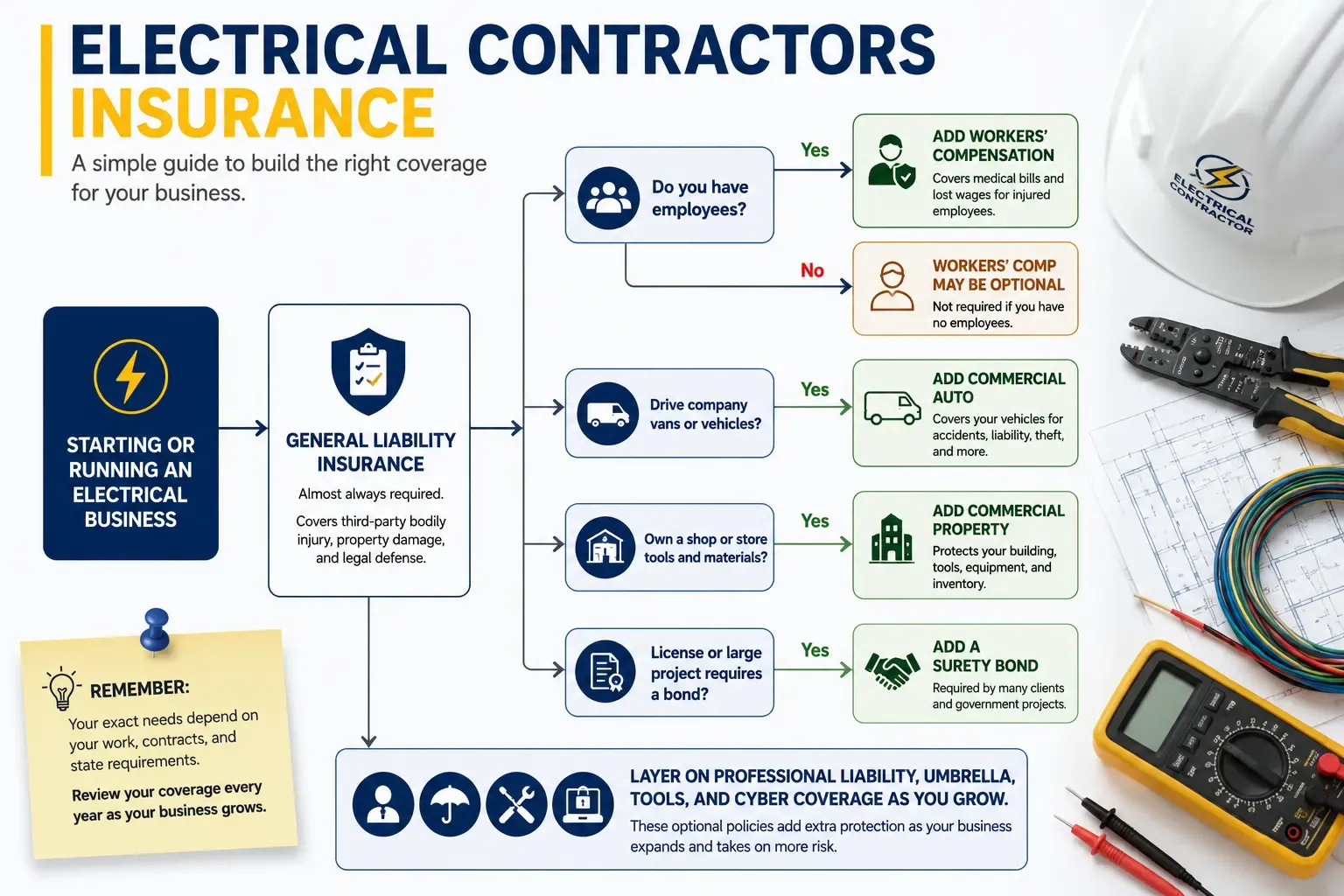
Electrical contractor insurance is an agreement between your business (the insured) and an insurer that, in exchange for a regular premium, covers the financial fallout from specific events such as accidents, injuries, property damage, and legal disputes. The policy spells out which risks are covered, what you pay to keep it active, and the limits, terms, and conditions that apply when you file a claim.
In practice, it is rarely a single policy. Most electrical businesses combine several coverages, each handling a different slice of risk, into a program that fits how they actually operate. The sections below walk through the policies that make up that program, what they cost, and how to choose them.
Electrical work stacks risk on every front. You work with live current, install panels and service equipment worth thousands, climb ladders and crawl through attics, and leave behind wiring that has to stay safe long after the job is done. A single mistake can mean an electrocution or arc-flash injury, a fire, property damage, or a lawsuit, and electrical fires in particular can surface long after the work is finished.
Insurance does three things all at once. It protects you from damage when things go wrong, meets the licensing and contractual requirements that enable you to operate, and demonstrates to clients and general contractors that you are a legitimate, professional business. Many homeowners and commercial customers will not sign until you show proof of coverage. If you are still setting things up, the U.S. Small Business Administration's overview of business insurance is a useful starting point, and our guide to how to start an electrical business covers insurance alongside licensing, pricing, and hiring.
Electrical contractors carry liability on two fronts: the on-site risk of working in customers' homes and businesses, and the post-job risk, known as completed operations, of wiring or a panel that fails or causes a fire after you leave. Good coverage has to address both. Most electrical companies build their protection from a handful of core policies, then add specialty coverage as they grow.
General Liability Insurance
This is the base. It has more weight in the electrical trade. General liability guarantees you against bodily injury and property harm to third parties caused by your work, including claims of completed operations if faulty wiring causes a fire or damage months later. It’s the policy most referenced in licensing rules, leases, and client contracts. It covers legal defense and settlements that would otherwise come out of pocket.
Workers' Compensation Insurance
Once you have employees, workers' compensation covers their medical bills and lost income if they are hurt on the job, and in return, it generally shields you from injury lawsuits. Electricians face shock, arc flash, burns, and falls, which puts them in a higher-risk classification, so a strong safety program built on standards like NFPA 70E and OSHA's electrical rules protects both your crew and your premiums. Most states make this coverage mandatory the moment you hire, with real penalties for going without, and the reason is plain: construction consistently ranks among the most dangerous sectors in the private economy for fatal injuries, according to the Bureau of Labor Statistics.
Commercial Auto Insurance
Your crews drive company vans full of tools, wire, and materials all day, and a personal auto policy almost always excludes business use. Commercial auto insurance protects your vehicles against collision, liability for injury or harm to others, theft, and vandalism. This is non-negotiable once you put your name on a van.
Commercial Property Insurance
Commercial property insurance covers your shop or office, as well as tools, materials, and inventory stored off your trucks, against fire, weather, water damage, and theft. It usually insures the building (if you own it) and the equipment and stock inside, so a break-in or fire doesn’t close your business down entirely.
Business Owner's Policy (BOP)
Small- to mid-sized electrical companies, like BOPs, combine general liability and commercial property in one generally less expensive package. Coverage, such as business interruption or equipment breakdown, is often included in a BOP. The bundle is usually cheaper than buying the policies separately. Remember, a BOP does not include commercial auto, workers’ compensation, or professional liability, so you will still need to carry those separately.
Beyond the basics, a few specialty policies cover the exposures a standard plan leaves out.
Professional Liability (Errors and Omissions)
General liability includes physical injury and property damage. Professional liability covers claims that your work, design, or advice caused a financial loss. For example, a load calculation or system design that is underperforming. It fills an important gap for electrical companies doing design-build, controls, or specification work.
Your tools travel from job to job, and standard property policies usually exclude gear that is not at a fixed location. Tools and equipment coverage, a form of inland marine insurance, protects meters, testers, power tools, and benders against theft or damage in transit or on the job site.
Umbrella Liability Insurance
An umbrella policy sits on top of your other coverage and kicks in when a claim exceeds the limits of your liability or auto policy. For a modest premium, it protects you from the rare catastrophic lawsuit, which matters most on large commercial projects, with several vans on the road, or when a fire claim runs into serious money.
Cyber Insurance
As more electrical work moves into smart-home systems, low-voltage networking, and building automation, contractors increasingly store digital records of client facilities, access points, and payments. Cyber insurance covers the cost of a data breach or a compromised system, from notification and recovery to liability. It is easy to overlook in the trades, but it becomes relevant the moment your business holds sensitive data or installs connected systems.
Surety Bonds
A surety bond is a financial confirmation, not insurance, that you will complete a job as agreed. It involves three parties: you, your client, and the bond issuer. Many jurisdictions require a bond just to hold an electrical contractor license, and government and large commercial projects almost always require one before awarding a contract.
Use this quick map to see which policies belong in your plan as you grow:
Licensing and insurance go hand in hand and vary from state to state. Once you hire electricians, you’ll typically need to show evidence of general liability coverage and workers’ compensation to apply for or renew an electrical contractor license. Many states and cities also require a surety bond for licensure, and some require commercial auto coverage.
Where states do set requirements, they can be very specific. Texas, for example, requires every licensed electrical contractor to carry commercial general liability insurance with limits of at least $300,000 per occurrence, $600,000 aggregate, and $300,000 for products and completed operations. The state rejects your certificate if any line falls short. Those product and completed operations limits are the ones that matter most in this trade, because they are what pays when a wire you installed arcs and starts a fire months after you finished the job. Many general contractors and commercial clients then require more than the state minimum, commonly $1 million per occurrence and $2 million aggregate, and local municipalities often add a surety bond, frequently $1,000 to $25,000, just to pull permits.
Because the rules vary by state and city, always confirm the exact licenses, permits, bonds, and insurance limits with your state or local licensing board before you bid work. Keep your certificates of insurance handy, too, since clients and general contractors often ask for them before a job starts. CloseCrew's free electrical templates for work orders and service agreements help you keep that paperwork consistent from day one.
There is no single price, and published figures vary significantly depending on whether they are based on lean, small-shop policies or on more comprehensive modeled coverage. The most basic electrical policies are between $49 and $194 a month, but a full program with employees, vehicles, and commercial work will be much more, thousands per year. The ranges below draw on real-world median data from TechInsurance and modeled analysis from MoneyGeek:
Policy | Typical monthly cost |
General liability | $57 to $113 (higher for commercial or industrial work) |
Business owner's policy (BOP) | $78 to $180 |
Workers' compensation | $140 to $250 |
Commercial auto | $140 to $230 |
Tools and equipment (inland marine) | around $41 |
Professional liability (E&O) | around $65 |
Commercial umbrella | around $65 |
Surety bond | around $4 |
A few things to keep in mind as you read those numbers:
General liability is the foundation, and the range is wide. Median data puts a small electrician's general liability near $57 a month, while modeled full-coverage analyses that assume $1 million per-occurrence and $2 million aggregate limits run far higher, around $379 a month for a solo policy. Commercial, industrial, and high-litigation states like California and New York drive up rates.
Workers' compensation is usually the biggest line. It is priced at roughly $1.50 to $4.00 per $100 of payroll in the electrical class, so a single electrician earning $50,000 adds about $750 to $2,000 a year, and it quickly becomes your highest cost as you add crew.
A BOP usually beats buying separately. Bundling general liability and commercial property typically costs less than two standalone policies, often around $78 to $180 a month.
By profile, a solo residential electrician with general liability and tools coverage often pays $100 to $250 a month. At the same time, a firm running crews, company vans, and commercial work can run from roughly $850 a month into the low thousands. One model analysis showed a full electrical program, general liability plus workers compensation plus commercial auto, at about $853 a month, or $10,241 a year. In a higher-cost state such as Texas, brokers say a small to midsize electrical contractor with a master electrician, a handful of journeymen, and a couple of vans costs $8,000-$20,000 per year for a complete package. For a neutral background on how business coverage is priced, the Insurance Information Institute is a reliable resource.
To lower your premium without underinsuring:
Bundle into a BOP and keep a clean claims and safety record.
Raise deductibles for property and equipment. By raising your deductible to $2,500 or $5,000, you could see your premiums drop 25 to 35 percent. But keep a low deductible for general liability. An electrical fire or shock injury could result in a six-figure claim.
Pay annually instead of monthly, which avoids installment fees of roughly 6 to 12 percent and can earn a 5 to 10 percent discount.
Invest in safety certifications like OSHA 30, which insurers reward with lower rates.
It also helps to remember that insurance is a largely fixed cost, so the more jobs you book, the less each one has to carry.
There is no fixed timeline, but most claims fall within a window of about 15 days to several weeks. A simple commercial auto claim, like a fender-bender in a work van, can resolve in roughly a week if paperwork, photos, and statements are filed promptly. A complex general liability claim, such as a customer injury or an electrical fire, can take weeks or months to investigate and settle, and workers' compensation claims follow stricter state-mandated timelines. The single biggest factor you control is documentation: dates, photos, witness statements, signed approvals, and job history. Tools that automatically log every call, text, and job, like CloseCrew, mean those records are already there when you need to file.
Renewals are typically yearly and not automatic. See how your business has performed over the year. Adding new employees, higher-risk jobs, more vehicles or equipment, or entering new markets may require increasing your general liability limits, adding vehicles to your commercial auto policy, or changing your workers’ compensation classifications. Also, check your claims history; you may qualify for discounts for a clean record. Even if you like your carrier, get some quotes from new ones because coverage options and pricing change year to year. Then request current certificates of insurance for active clients and projects.
Most policies require advance written notice, typically 30 days, to cancel, so review the terms first and call your representative to confirm the cancellation window and any required forms. See if you have a short-rate cancellation penalty or if you are due a pro-rated refund. Pay any premium owed and always get written confirmation for your files. Don't cancel if you have active jobs, open permits, or upcoming inspections, and never cancel until you have a replacement policy in place, because even a short gap can leave you exposed to a claim, a lost contract, or a licensing issue.
Insurance covers the worst day.” Good systems eliminate the small misses in between that cost you and make claims far easier when you do file. Clean records are the connective tissue: documented calls, photos, signed estimates, and consistent paperwork are exactly what an insurer wants and exactly what a busy electrical shop tends to lose track of.
That's where CloseCrew comes in. Larry, its AI agent, answers every inbound call as it comes in, day, night, or weekend, in English or Spanish. It qualifies the caller, books the job into your calendar, and follows up automatically. All calls, texts, and conversations are stored in one place, so you always have a record of who asked for what and when. Nearly 40 percent of all calls for home services are received after hours, and because most callers don’t leave a voicemail, live answering can be the difference between a booked job and a lost job.
Pair that with CloseCrew's free electrical templates for work orders, service agreements, and invoices, which give you the paper trail insurers want, and its free electrical tools for pricing and job costing. Protecting the business and keeping it booked are two halves of the same job.
Insurance is what saves you on the worst day. Booked jobs are what keep the lights on every other day, and the two work together: solid coverage protects what you have built, and the right systems make sure you keep building it. CloseCrew's AI agent, Larry, answers every call, books the job, and follows up automatically, in English or Spanish, around the clock, so a missed call never becomes a lost customer while you stay protected and out doing the work.