Plumbing Business Insurance: Types, Costs & How to Choose (2026)
Most plumbing businesses build from a few core policies: general liability, workers' compensation, commercial auto, and commercial property, often bundled into a business owner's policy (BOP).
14 min readPublished June 11, 2026Updated July 23, 2026
Plumbing is a high-risk trade. One water heater installation gone wrong, a slip on a customer's stairs, or a fender-bender in the company van can turn into a claim that wipes out a season of profit. Plumbing business insurance exists to absorb that risk so a single bad day does not end your company. Whether you are pulling your first contractor license or adding coverage as you grow, the right mix of policies protects your tools, your trucks, your employees, and your livelihood.
This guide breaks down the policies plumbing contractors actually need, what each one costs, how to choose a provider you can trust, and how to keep claims, renewals, and cancellations from tripping you up.
Plumbers work inside customers' homes, handle water and gas, and drive between jobs all day, which stacks risk on every front: property damage, bodily injury, auto accidents, stolen tools, and lawsuits. Insurance does three things at once. It covers the cost of damage when something goes wrong, meets the legal and licensing requirements that allow you to operate, and signals to customers and general contractors that you run a legitimate, protected business.
That last point is not optional in much of the country. In many states you cannot even obtain a plumbing contractor license without proof of coverage, and most commercial contracts and leases require it before you set foot on the job. If you are still mapping out your requirements, the U.S. Small Business Administration's overview of business insurance is a useful starting point, and our plumbing license requirements by state guide shows where coverage is tied directly to licensing.
The Types of Insurance Plumbing Contractors Need
Most plumbing companies build their protection from a handful of core policies, then layer on extras as they grow. Here is what each one does.
General Liability Insurance
This is the foundation. General liability insurance provides protection for third-party property damage and bodily injury caused by your work, such as a flooded floor after a repair or a customer injured by a tool left on the stairs. It’s the policy most commonly named in licensing rules, commercial leases, and client contracts, so virtually every plumbing business carries it from day one.
Workers' Compensation Insurance
Once you have employees, workers' compensation pays their medical bills and a certain amount of lost wages if they are hurt on the job, and in return it generally shields you from injury lawsuits. Most states make it mandatory the moment you hire your first technician. The stakes are real: construction remains one of the most dangerous sectors in the country, with more than 1,000 fatal work injuries in a recent year. A strong safety program, built around OSHA guidance, lowers both injuries and your premiums over time. Requirements vary, so confirm the rules with your state's workers' compensation board.
Commercial Auto Insurance
Your technicians drive from job to job all day, and a personal auto policy almost always excludes business use. Commercial auto covers your company vehicles for collision, liability for damage or injury to others, theft, and vandalism. The moment you put your name on a van, this becomes non-negotiable.
Commercial Property Insurance
If you own or lease a shop or office, or store tools and inventory anywhere off your trucks, commercial property insurance protects those assets against fire, weather, and theft. It typically covers the building (if you own it) and the equipment and stock inside.
Business Owner’s Policy (BOP)
A BOP offers both commercial property and general liability in one package, typically cheaper, making it a favorite among growing plumbing companies. Carriers tend to keep BOPs for smaller businesses, often with revenue and employee count thresholds. Many BOPs permit the inclusion of valuable extras like business interruption coverage, equipment breakdown, or employment practices liability. Remember that a BOP does not include commercial auto, workers' compensation, or professional liability, so you will still buy those separately.
Umbrella Liability Insurance
An umbrella policy sits on top of your other coverage and kicks in when a claim surpasses the limits of your general liability, auto, or employer's liability. For a relatively small premium it protects you against the rare but catastrophic lawsuit that would otherwise come out of your own pocket.
Equipment and Inland Marine Insurance
Your tools are your livelihood. Equipment coverage, often added to a liability policy or BOP, protects small tools and mobile equipment against theft or accidental damage. For high-value gear or materials in transit, inland marine insurance fills the gap, and an installation floater covers materials until they are installed and put to use.
Surety Bonds
A surety bond is not technically insurance, but many municipalities and states require one for a contractor license or permit. It involves three parties: the obligee who requires the bond, the surety company that issues it, and you, the principal. The bond guarantees your work meets standards, and if a valid claim is paid, you repay the surety. In short, it protects the customer and your reputation rather than your finances.
Insurance Requirements for Licensed Plumbing Contractors
Licensing and insurance are closely linked, and the specifics vary by state. Florida, for example, requires proof of $100,000 in liability and $25,000 in property damage coverage before issuing a certified plumbing contractor license. Illinois leads the way, requiring plumbing contractors to carry $100,000 in general liability, $300,000 in bodily injury, and $50,000 in property damage coverage.
Local jurisdictions can add their own rules on top, so always confirm the exact licenses, permits, bonds, and insurance limits where you operate before you bid a job. For the full breakdown by state, see our plumbing license requirements guide, and keep your certificates of insurance handy, since clients and general contractors often ask for them before work begins.
How Much Plumbing Insurance Costs
There is no single price, because rates depend on your location and service area, company revenue, number of employees, experience, and the coverage limits you choose. Because plumbers work in customers' homes in a high-risk trade, expect to pay more than a lower-risk business would. Industry estimates give you a useful starting range:
General liability: roughly $27 to $49 a month for a typical small-business policy with about $1 million per claim and $2 million aggregate coverage.
Business owner's policy: about $750 to $2,400 a year for similar limits, often with a deductible around $1,000.
Commercial auto: averaging around $2,700 a year per vehicle, depending on driving records and vehicle value.
Tools and equipment: roughly $220 a year for basic coverage.
Workers' compensation: priced per $100 of payroll and highly variable by state, job classification, and your claims history.
Bundling policies, such as combining liability and property in a BOP, is one of the easiest ways to lower your total cost. A clean safety and claims record helps even more over time.
It also helps to remember that insurance is a largely fixed cost, so the more jobs you book, the less each one has to carry. Answering every call is the fastest way to spread that overhead, which is why winning leads matter as much as trimming premiums. Our guide to getting more plumbing leads covers the full playbook.
How to Choose the Right Policy and Provider
A policy is only as good as the company behind it. As you compare options, weigh three things.
Financial strength. Claims are paid from the insurer's reserves, so check ratings from agencies like AM Best and favor carriers rated "A" or better. A cheap policy from a shaky insurer is no protection at all.
Familiarity with the trade. Not every insurer understands water-damage liability, tool coverage, or work performed inside customers' homes. Look for providers that specifically list plumbing or trade contractors as a target market, so your policy covers the risks you actually face.
Price and coverage together. Get at least three quotes and compare more than the premium. Look at policy limits, deductibles, and add-ons such as equipment coverage, and remember that the cheapest option is a bad deal if it leaves you underinsured.
Plumbers often compare digital-first carriers built for contractors against established insurers and online marketplaces that gather several quotes at once. A good independent broker can do the comparison shopping for you and flag gaps you might miss. Many modern carriers also issue instant certificates of insurance, which is handy when a general contractor needs proof of coverage before you can start. The providers below are a solid place to begin.
Plumbing Insurance Providers to Compare
No single carrier is right for every shop, so gather a few quotes and compare coverage, not just price. These providers are common starting points for plumbing contractors.
1
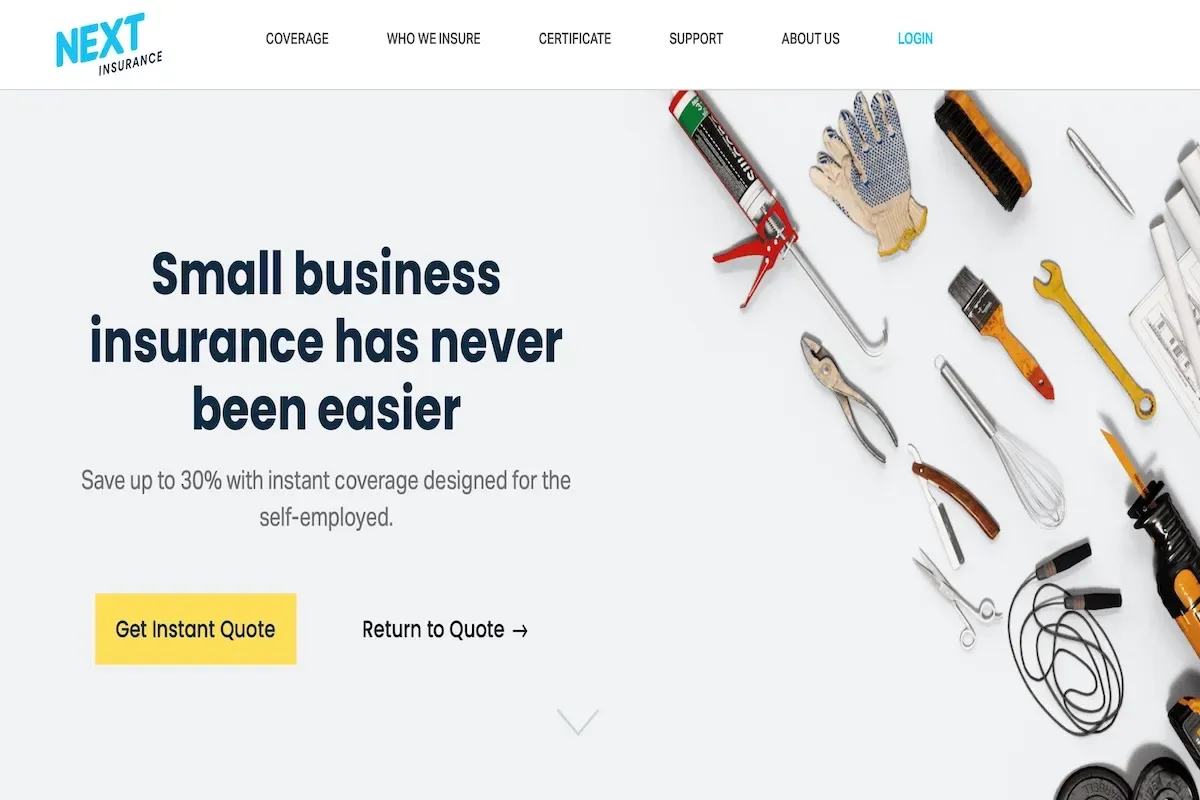
NEXT Insurance
NEXT Insurance is a fully digital, U.S.-based insurance provider built for small businesses and contractors. Plumbers can purchase and manage general liability, workers’ compensation, commercial auto, and tools coverage entirely online, with instant access to certificates of insurance on their phones.
It provides coverage for over 1,300 types of small businesses, from contractors to personal trainers. Policies are designed to be quick to set up, affordable, and tailored for self-employed workers, with purchases often taking around 10 minutes. Claims are also streamlined, with decisions typically made within about 48 hours.
Best for: contractors who want fast, app-based coverage, flexible monthly billing, and easy access to certificates.
2
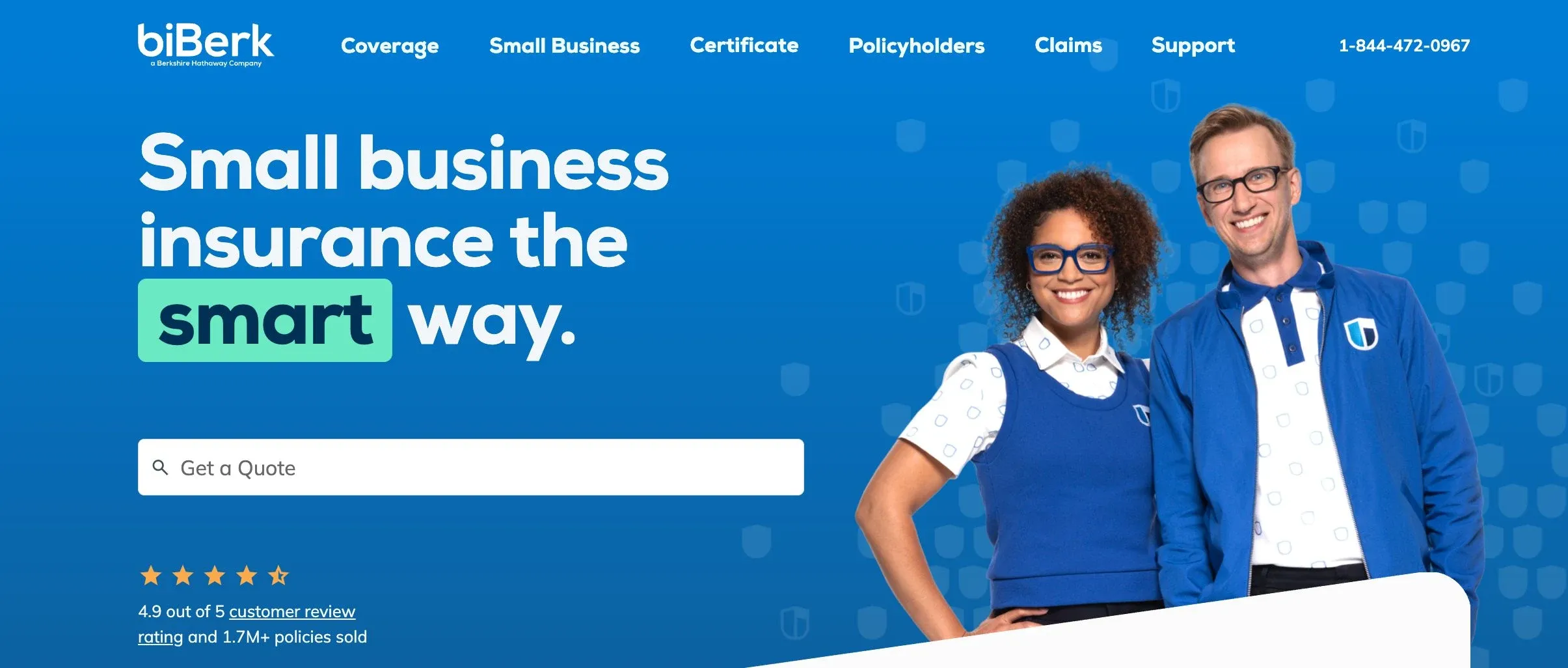
biBERK
biBERK is is a digital insurance provider backed by Berkshire Hathaway, built for small business owners and contractors. It offers fully online access to general liability, workers’ compensation, commercial auto, and other core coverages, allowing users to get instant quotes, purchase policies without a broker, and manage everything from a simple dashboard.
The company has scaled significantly, reporting over 1.7 million policies sold and steadily growing its digital presence since 2015. Its focus is on fast quotes, self-service management, and strong financial backing, with most customers finding and purchasing policies directly through online search and digital channels.
Best for: plumbers who want a financially strong, digital-first carrier and are comfortable managing policies themselves.
3
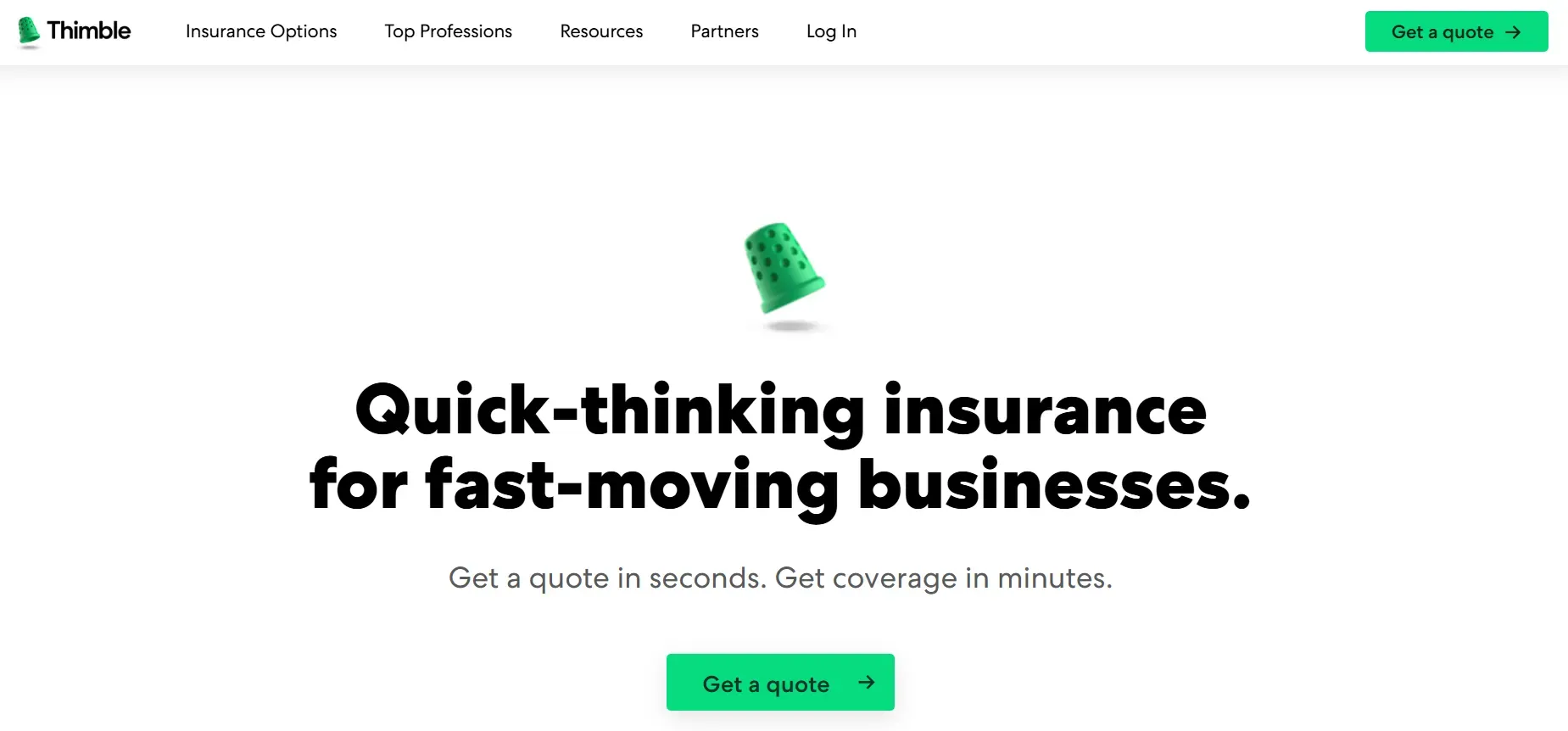
Thimble
Thimble is a digital insurance platform designed for fast-moving small businesses and contractors. It allows users to get a quote in seconds, purchase coverage in minutes, and manage policies entirely online or through its app. Coverage options include general liability, professional liability, workers’ compensation, and tools and equipment protection, with the flexibility to choose insurance by job, month, or year.
The platform is built around speed and flexibility, making it easy to adjust, pause, or scale coverage as business needs change. Contractors can customize policies, instantly add certificates, and start work quickly without lengthy approval delays, which is especially useful for short-term jobs and event-based work.
Best for: solo operators and subcontractors who want pay-as-you-go protection without a long-term commitment.
4
Hiscox
Hiscox is a long-established insurance provider focused on small businesses, professionals, and high-risk industries. It offers flexible coverage options including general liability, professional liability, cyber insurance, business interruption, and property protection, all designed for service-based businesses like plumbing, HVAC, and contracting.
Known for its customizable policies and strong customer support, Hiscox allows businesses to tailor coverage based on their specific risks and manage everything online through a simple digital platform. It is often chosen by professionals who need more specialized protection than standard entry-level insurers can provide, especially in industries where liability exposure is higher and tailored coverage matters.
Best for: small to midsize plumbing companies that want broader policy options and steady cash flow.
5
Insureon
Insureon is an digital insurance marketplace that helps small business owners compare quotes from multiple top-rated insurers in one place. Instead of acting as a single insurance carrier, it connects users with different providers so they can review coverage options, pricing, and policy types before choosing the best fit for their business.
It improves the purchasing process by allowing users to submit a single application and receive multiple quotes for policies such as general liability, professional liability, workers' compensation, and commercial property insurance. Backed by HUB International, Insureon is designed to make it faster and easier for contractors and small businesses to find and manage coverage online without dealing with multiple brokers.
Best for: contractors who want to compare several carriers quickly without calling each one.
If you operate in Canada or across the border, a brokerage such as Gendron Assurance can bundle coverage across carriers and help with regional compliance. Whichever route you choose, confirm the carrier is rated "A" or better and lists trade contractors as a target market.
Managing Your Policy: Claims, Renewals, and Cancellations
Buying coverage is only the start. Three moments tend to catch contractors off guard.
Claims rarely follow a fixed timeline. A straightforward property-damage claim, like water damage from a burst pipe, usually resolves in a few weeks, while a disputed liability or workers' compensation case can take months. The single biggest factor you control is documentation: clear invoices, photos, signed approvals, and job records speed everything up.
Renewals are typically annual and are not always automatic. Before each renewal, review your policy for gaps, update your payroll, revenue, and headcount with the carrier, and request fresh certificates of insurance for active clients and projects.
Cancellations require care. Never cancel until a replacement policy is active, since even a few days without coverage can expose you to a claim. Submit any cancellation in writing, confirm whether you owe a fee or are owed a prorated refund, and check that no current contract requires continuous proof of insurance.
How the Right Systems Protect Your Business
Insurance covers the worst day. Good systems prevent the small, expensive misses that pile up in between, and they make claims far easier when you do need to file. Clean records are the connective tissue: documented calls, photos, signed estimates, and consistent paperwork are exactly what an insurer asks for and exactly what a busy plumber tends to lose track of.
This is where CloseCrew helps. Larry, an AI agent, answers every inbound call the moment it comes in, day, night, or weekend, in English or Spanish, then qualifies the caller, books the job into your calendar, and follows up automatically. Every call, text, and conversation lives in one place, so you always have a record of who asked for what and when. Around 40% of home services calls come in after hours, and most callers will not leave a voicemail, so answering live is the difference between a booked job and a lost one.
You can pair that with CloseCrew's free plumbing templates for work orders, service agreements, estimates, and invoices, which give you the consistent paper trail insurers want and make it simple to produce a certificate or document a job. To keep that calendar full in the first place, see our guides to getting more plumbing leads andwinning every call with strong plumbing customer service. And if you are still setting up the business itself, our guide to how to start a plumbing business covers insurance alongside licensing, pricing, and your first hires.
Protect the Business, Then Keep It Booked
On your worst day, insurance is what keeps you afloat. Every other day, the lights are kept on by scheduled jobs. The two complement each other: appropriate systems ensure that you continue to build, while strong coverage safeguards what you have already created. While you are safe and working, CloseCrew's AI agent, Larry, answers every call, schedules the task, and automatically follows up in either Spanish or English. This ensures that a missed call never results in a lost customer.
Frequently asked questions
Do plumbers legally need insurance?
In most states, yes. General liability is commonly required to obtain a plumbing contractor license, and workers' compensation is mandatory once you have employees. Commercial contracts and leases usually require proof of coverage too. Requirements vary by state and city, so confirm yours before bidding work.
What insurance does a plumber need to start a business?
Most new plumbing businesses start with general liability, add commercial auto for company vehicles, and add workers' compensation as soon as they hire. A business owner's policy can bundle liability and property affordably, and a surety bond is often required for the contractor license itself.
How much does plumbing insurance cost?
It depends on your size, location, payroll, and coverage limits. As a rough guide, general liability runs about $27 to $49 a month, a BOP about $750 to $2,400 a year, commercial auto around $2,700 a year per vehicle, and tools coverage near $220 a year. Workers' compensation is priced per $100 of payroll and varies widely.
Is a surety bond the same as insurance?
No. A surety bond guarantees your work to a third party that requires it, such as a licensing board, and if a valid claim is paid you repay the surety company. Insurance protects your business directly and you do not repay covered claims. Many contractors carry both.
Does a business owner's policy cover everything?
No. Commercial property and general liability are combined in a BOP, but commercial auto, workers' compensation, and professional liability are not. To completely safeguard your cars, staff, and services, you purchase those separately.
Related tools
Run the numbers before you update your price book or field software.
Free Plumbing Templates
Invoices, estimates, and flat-rate pricing sheets for plumbing contractors.
Trade shows give plumbing professionals the chance to see new products, network with peers, and earn continuing education. This guide covers 10 upcoming shows from late 2026 through early 2027 with verified dates, locations, and strategies for turning trade show connections into business growth.
Plumbing van wraps generate thousands of daily impressions at the lowest cost per impression of any advertising method. This guide covers wrap types, design best practices, costs, maintenance, and the strategy that turns daily impressions into actual booked revenue for your plumbing business.
Never miss a Plumbing service call again. Let Larry, your AI receptionist, book jobs while your crew is in the field.
We will run your numbers on the call and tell you if the maths does not work for a shop your size. That happens, and it is a cheaper conversation than finding out three months in.