Business Tips

How Long Does It Take to Become a Plumber

Becoming a plumber can take anywhere from a few months to several years, depending on your training path and licensing requirements. This guide breaks down the typical timeline from apprentice to licensed plumber.

11 min readPublished August 20, 2026

If you're considering a career in plumbing, or you're a contractor planning your next wave of hires, one of the first questions that comes up is simple: how long does this actually take?

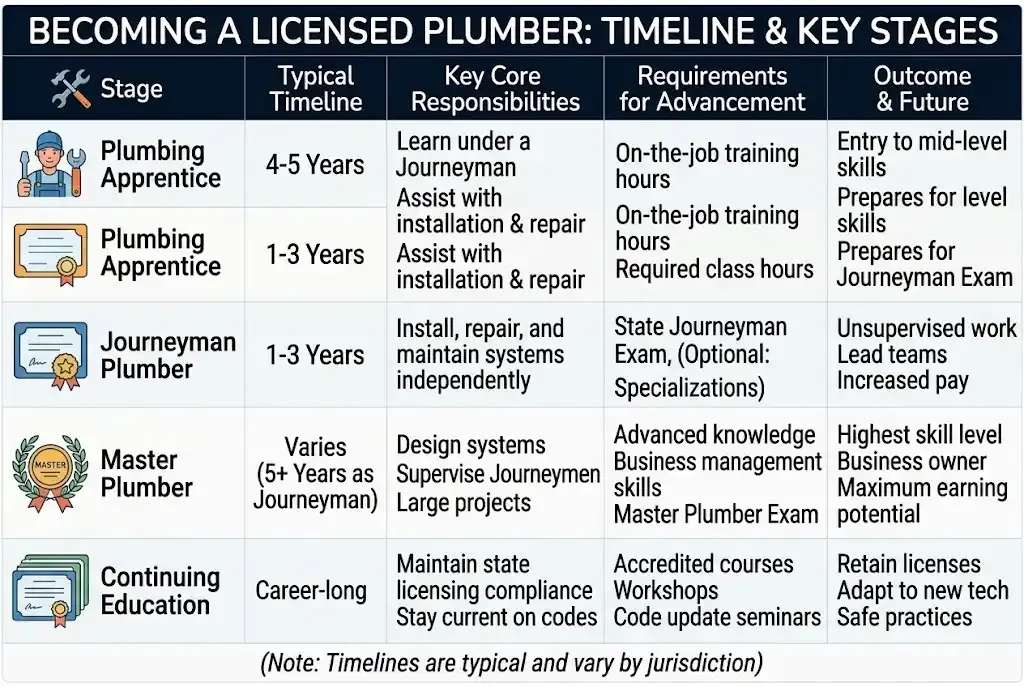
In most cases, the path from complete beginner to licensed journeyman plumber runs about 4 to 5 years. That timeline covers education, structured on-the-job training, and passing your state's licensing exam. It's a real commitment, but it also leads to one of the more stable, well-paid technical careers available without a four-year degree.

This guide breaks down:

Whether you're entering the trade yourself or managing a team of apprentices, this gives you a realistic picture of what the road actually looks like.

Part of the Business Tips section in the Plumbing Business Blog.
  • The educational requirements to get started

  • How long a plumbing apprenticeship actually takes

  • Licensing and certification steps

  • What speeds the process up or slows it down

  • Practical tips for moving through training efficiently

How Long Does It Actually Take

Most plumbers reach journeyman status in 4 to 5 years. Across the U.S., a typical apprenticeship includes:

  • Roughly 2,000 paid, hands-on hours per year

  • 144 to 200 classroom hours per year covering plumbing codes, safety, and system design

Some aspiring plumbers choose to start with trade school before or alongside an apprenticeship. These programs generally run:

  • 6 to 12 months for a certificate program

  • Up to 2 years for an associate degree program

Depending on the state and the employer, completing one of these programs beforehand can shorten the apprenticeship that follows, though the reduction varies widely and isn't guaranteed everywhere.

Quick reference: becoming a fully licensed journeyman plumber takes about 4 to 5 years nationwide on average, though the exact timeline shifts based on your state, your prior experience, and whether you complete vocational schooling before starting an apprenticeship.

Educational Requirements to Start Plumbing Training

The path typically begins with a few baseline steps before an apprenticeship is even an option.

High School Diploma or GED

Nearly every state and employer requires this as a baseline before accepting new apprentices. It's rarely a barrier for someone genuinely interested in the trade, but it's worth confirming your local requirements early rather than assuming.

Early Vocational Training Helps

Some high schools offer introductory plumbing, pipefitting, or general construction trades programs. Students who take advantage of these get a real head start, both in terms of basic skills and in terms of demonstrating genuine interest to a future employer or apprenticeship program.

Trade School or Community College

These programs typically cover:

  • Pipe systems and safety fundamentals

  • Plumbing codes and regulations

  • Blueprint reading

  • Tools and materials

  • Basic system design principles

Why it matters: completing a vocational program before applying to an apprenticeship can make acceptance meaningfully easier, since it signals real commitment to a program coordinator sorting through applicants. In some states, it can also reduce the total apprenticeship hours required, which shortens the overall timeline to licensure.

How Long Does It Take to Become a Plumber.webp

Plumbing Apprenticeships: The Core Training

An apprenticeship is where the real skill actually gets built. Apprentices earn wages while learning directly under licensed plumbers, combined with structured classroom instruction that runs alongside the fieldwork.

Where Apprenticeships Come From

Apprenticeship programs are commonly offered through:

  • Local plumbing companies hiring and training directly

  • Trade unions, which often run structured, well-documented programs

  • Technical school or community college partnerships that combine coursework with a placement pipeline

How Long Does a Plumbing Apprenticeship Actually Take

The typical duration is 4 to 5 years, with standard requirements including:

  • Roughly 8,000 total on-the-job hours

  • 144 to 200 classroom hours per year

What Apprentices Learn

Over the course of an apprenticeship, you'll build hands-on experience in:

  • Installing and repairing plumbing systems

  • Working with water, drainage, and gas lines

  • Reading blueprints and system diagrams

  • Understanding plumbing codes and regulations

  • Applying safety protocols and best practices consistently, not just when someone's watching

By the end of an apprenticeship, you should have both the technical knowledge and the practical, hands-on reps needed to sit for your journeyman exam with real confidence.

[[blog-banner:see-it-live]]Licensing and Certification: The Final Step

After finishing an apprenticeship, most states require passing a journeyman plumber exam, which typically tests:

  • Plumbing codes specific to your state or jurisdiction

  • Installation and repair knowledge across common systems

  • Safety practices and material standards

  • In some states, a practical, hands-on demonstration component

Licensing structures vary considerably by state:

  • Some states issue a single statewide license

  • Others require licensing at the city or county level, which can mean re-qualifying if you move

  • A handful of states offer tiered or specialized licenses, covering things like gas work, commercial systems, or medical gas installations separately from a general license

Becoming a Master Plumber

Once licensed as a journeyman, a plumber may qualify to pursue master plumber status after gaining an additional 1 to 5 years of experience, depending on the state. Counting from the very beginning, the typical total timeline from complete beginner to master plumber runs roughly 5 to 10 years.

Factors That Affect How Long It Takes

While 4 to 5 years is the standard range, several factors can shift your actual timeline in either direction.

1

State and Local Requirements

Some states require more classroom hours, additional certifications, or specific categories of logged work that others don't. It's genuinely worth reading your state's exact requirements early, rather than assuming they match what you've heard about a neighboring state.

2

Apprenticeship Availability

Union programs and high-demand regions sometimes have real waitlists, which can add months, occasionally longer, before a formal apprenticeship even begins. Starting the search early and applying broadly helps avoid unnecessary delays here.

3

Prior Experience or Schooling

Time spent in trade school, or even relevant construction experience, can reduce the length of the apprenticeship that follows, depending on how your state and the sponsoring program evaluate prior learning.

4

Work Pace and Consistency

Staying consistent, logging hours accurately and on time, and passing required exams on the first attempt all keep the process moving on schedule. A missed exam attempt, or a gap in logged hours, can add real time to an otherwise on-track apprenticeship.

5

Specializations

Endorsements like gas fitting, medical gas, backflow prevention, or commercial systems often require additional coursework or separate exams. These are genuinely valuable for career growth and earning potential, but they do add time on top of the base journeyman timeline.

Tips to Speed Up the Plumbing Career Path

A few practical moves that consistently shorten the path without cutting corners on actual skill:

  • Start vocational or trade schooling early. It leaves you better prepared entering an apprenticeship, and in some states, it directly reduces the required apprenticeship hours.

  • Choose a reputable apprenticeship program. Look specifically for programs with structured hour tracking, comprehensive instruction, and real exam preparation built in, not just a loose on-the-job arrangement.

  • Know your state's licensing requirements upfront. Understanding the exact rules before you start avoids timeline-killing surprises discovered halfway through.

  • Track your hours carefully, from day one. Missing or incomplete documentation is one of the most common, and most avoidable, reasons apprentices get delayed.

  • Consider additional certifications early. These make you more marketable sooner and can help with faster advancement once you're licensed.

What Plumbers Can Expect to Earn at Each Stage

Compensation naturally grows alongside experience and licensing, though exact figures vary by region and specialization.

  • Apprentices earn a training wage while gaining hours, typically a percentage of full journeyman pay that increases as they log more experience.

  • Journeyman plumbers earn a full trade wage, with the ability to work independently on most residential and commercial jobs within their license scope.

  • Master plumbers, and those who go on to own or manage their own plumbing business, generally see the highest earning ceiling, especially once they're pricing and running jobs rather than only performing them.

Specializations like gas fitting, backflow prevention, or medical gas installation tend to command a premium over general residential work, since fewer plumbers hold those endorsements and the compliance stakes are higher.

Is a Plumbing Career Actually Worth the Timeline

A 4 to 5 year path can feel long compared to some shorter certificate programs in other fields, but it's worth putting in context. Plumbing offers genuine job security, since the work can't be outsourced or automated away, steady demand that doesn't disappear during economic downturns the way some industries do, and a real path to running your own business without the debt load of a traditional four-year degree.

Compared to other skilled trades, plumbing's timeline is fairly typical. Electricians generally follow a similar 4 to 5 year apprenticeship structure, while some HVAC certifications can be completed faster, though HVAC techs often pursue additional certifications over time to match the earning potential of a licensed plumber.

Streamlining Apprentice and Team Management as You Grow

Training new plumbers takes real time, and it takes real organization, tracking hours accurately, standardizing how each apprentice learns, and making sure nothing falls through the cracks as your team grows past a size where you can personally oversee every hour logged.

But there's a piece of the growth story that's easy to overlook while you're focused on training: as your team of apprentices and licensed techs grows, so does your call volume, and a business that's investing heavily in training its people often doesn't have the office capacity to match. A missed call during a busy training week is still a lost job, regardless of how well-trained your team eventually becomes.

CloseCrew's Larry is an AI receptionist built specifically for plumbing contractors, and it's worth having in place well before your team scales, not after the phones start getting away from you. Larry answers every call 24/7, qualifies the urgency, and books the job straight into your calendar, freeing up your office staff to focus on the actual work of coordinating training, tracking apprentice hours, and keeping the business running smoothly instead of just keeping up with the phone. Every call gets recorded and transcribed too, which means new office staff, or even apprentices moving into a dispatch role, have real call examples to learn from rather than a vague verbal handoff.

  • 24/7 call answering: never send a plumbing lead to voicemail, day or night, even during a hectic training season.

  • Smart appointment booking: checks real availability and confirms bookings without back-and-forth.

  • Lead qualification: captures the issue and urgency so the right tech, apprentice or journeyman, gets matched to the right job.

  • CRM & calendar sync: jobs flow into your existing scheduling software automatically.

  • Call recordings & transcripts: a genuinely useful training resource for office staff, alongside the field training your apprentices are already getting.

  • Custom scripts per trade: built for plumbing emergencies, repairs, and routine service, fully customizable to how you run your business.

If growth planning is on your mind more broadly, from staffing to lead flow, this guide to getting more plumbing leads and a look at the best CRM platforms for plumbing businesses are worth reading alongside your hiring plans, since a growing team only pays off if the business behind it can actually keep up.

Now You Know: How Long Does It Take to Become a Plumber?

Becoming a licensed plumber is a genuine multi-year commitment, but it leads to one of the more stable, well-paid technical careers available today, without the debt load of a traditional four-year degree.

The short version: 4 to 5 years is the average timeline to reach journeyman status, education can range from a high school foundation to a full 2-year trade program, licensing requires passing your state's journeyman exam, and your exact timeline shifts based on your state, your prior experience, and how your apprenticeship is structured.

For plumbing companies, understanding this process isn't just useful trivia, it's what makes recruiting, training, and long-term workforce planning realistic instead of guesswork. And as that team grows, making sure every incoming call gets answered and booked is just as important as making sure every apprentice gets properly trained.

Want to see how CloseCrew helps growing plumbing businesses capture every call while you focus on building your team? Book a demo or see pricing to get started.

Frequently asked questions

Can you become a plumber without an apprenticeship?

In nearly every state, no. Apprenticeship hours are a legal requirement for journeyman licensure, though trade school can sometimes reduce the total hours needed depending on your state.

No, trade school is optional in most states, though it can make apprenticeship acceptance easier and occasionally shortens the required apprenticeship hours.

Costs vary widely, but many apprenticeships are paid positions, which offsets the cost significantly compared to a traditional degree. Trade school, where chosen, typically costs a fraction of a four-year college program.

Not automatically. Requirements and hour tracking vary by state, so moving mid-apprenticeship can sometimes mean re-verifying hours with the new state's licensing board.

A journeyman plumber is fully licensed to perform plumbing work independently. A master plumber has additional years of experience beyond journeyman status and, in many states, is required to pull permits, supervise other plumbers, or own a plumbing business.

Related tools

Run the numbers before you update your price book or field software.

Contractor Blog

Cross-trade guides on hiring, marketing, and operations for every home services business.

View all guides

Plumbing Licensing

State licensing requirements, exams, and renewal rules for plumbing contractors.

View states

Meet Larry

AI receptionist built for Plumbing — answers calls, books jobs, and follows up on leads 24/7.

See Larry for Plumbing

Related articles

business-tips

Top 10 Plumbing Trade Shows and Conferences for 2026-2027

Trade shows give plumbing professionals the chance to see new products, network with peers, and earn continuing education. This guide covers 10 upcoming shows from late 2026 through early 2027 with verified dates, locations, and strategies for turning trade show connections into business growth.

Read guide
business-tips

Plumbing Van Wraps: What You Need to Know (2026)

Plumbing van wraps generate thousands of daily impressions at the lowest cost per impression of any advertising method. This guide covers wrap types, design best practices, costs, maintenance, and the strategy that turns daily impressions into actual booked revenue for your plumbing business.

Read guide

Never miss a Plumbing service call again. Let Larry, your AI receptionist, book jobs while your crew is in the field.

We will run your numbers on the call and tell you if the maths does not work for a shop your size. That happens, and it is a cheaper conversation than finding out three months in.

Get a demo
How Long Does It Take to Become a Plumber | CloseCrew