Licensing

Massachusetts Electrician License: How to Become an Electrician in 2026

Massachusetts licenses every tier through the Board of State Examiners of Electricians: Systems Technician (Class D), Journeyman (Class B), Systems Contractor (Class C), and Master (Class A). The journeyman bar is 8,000 hours of work plus 600 classroom hours, roughly four to five years. A master license adds a year as a journeyman and 150 more classroom hours.

13 min readPublished June 22, 2026Updated July 14, 2026

Earning a Massachusetts electrician license is a clear but demanding process: register as an apprentice, log 8,000 hours of supervised work and 600 hours of classroom instruction, then pass the journeyman exam. Do it in one of the highest-paying states for the trade, and you have a career with real earning power and a direct route to eventually running your own shop.

This is the only Massachusetts electrician license guide you need. It walks through every license class, the exact hours and education required, the exam and its cost, the best schools and apprenticeships to get you there, license renewal, reciprocity, and what electricians actually earn in the state. Whether you are just starting out or working toward a master license and your own business, everything is here.

Part of the Licensing section in the Electrical Business Blog.
Why Become an Electrician in Massachusetts

Demand for electricians is strong and climbing. The Bureau of Labor Statistics projects 9% national employment growth from 2024 to 2034, faster than average, with about 81,000 openings a year. In Massachusetts, the pressure is even higher. CareerOneStop data points to roughly 11% growth for electricians in the state, driven by building electrification, a wave of EV charger installations, and offshore wind development.

That demand sits atop a real labor shortage across the home-service trades, which is why the best contractors are squeezing more output from the crews they already have rather than waiting on hires that may not come. For a licensed electrician, it adds up to steady work and strong leverage on pay.

What Electricians Actually Do

The daily work is more varied than most people expect, and it maps to the competency standards used by training bodies like NCCER (the National Center for Construction Education and Research):

  • Installation. Running wiring, fire alarm systems, and motor controls in homes and commercial buildings.

  • Code interpretation. Reading prints and applying the National Electrical Code and the Massachusetts Electrical Code (527 CMR).

  • Diagnostics. Troubleshooting series, parallel, and combination circuits with a multimeter.

  • Calculations. Sizing conductors and figuring voltage drop using Ohm's law.

  • Safety. Following job-site safety protocols and using the right personal protective equipment.

Massachusetts Electrician License Classes

The Board of State Examiners of Electricians regulates the trade statewide (no local variations) and issues the four credentials behind every Massachusetts electrician license. Knowing which one you are working toward shapes your entire training plan.

Class

License

What it covers

Class D

Systems Technician

Entry-level low-voltage work: fire alarm, security, and communications systems

Class B

Journeyman Electrician

General electrical work, performed under a master

Class A

Master Electrician

Required to pull permits, supervise, and own an electrical business

Class C

Systems Contractor

The business-level license for low-voltage systems work

Only a Class A master electrician can pull permits and run a full electrical contracting business, which is why the journeyman-to-master jump is the pivotal step in the trade.

License Requirements at a Glance

Every Massachusetts electrician license is built on a mix of documented work hours and Board-approved classroom education, followed by a PSI exam.

License

Work experience

Classroom education

Prerequisite

Journeyman (Class B)

8,000 hours (min. 4 years) under a licensed journeyman

600 hours + a 15-hour code-update class

Registered apprenticeship

Master

(Class A)

1 year as a licensed journeyman

150 hours

Active MA journeyman license

Systems Technician (Class D)

4,000 hours (min. 2 years)

300 hours

Registered apprenticeship

Systems Contractor (Class C)

1 year as a licensed systems technician

75 hours

Active MA systems technician license

How to Become an Electrician in Massachusetts: Step by Step

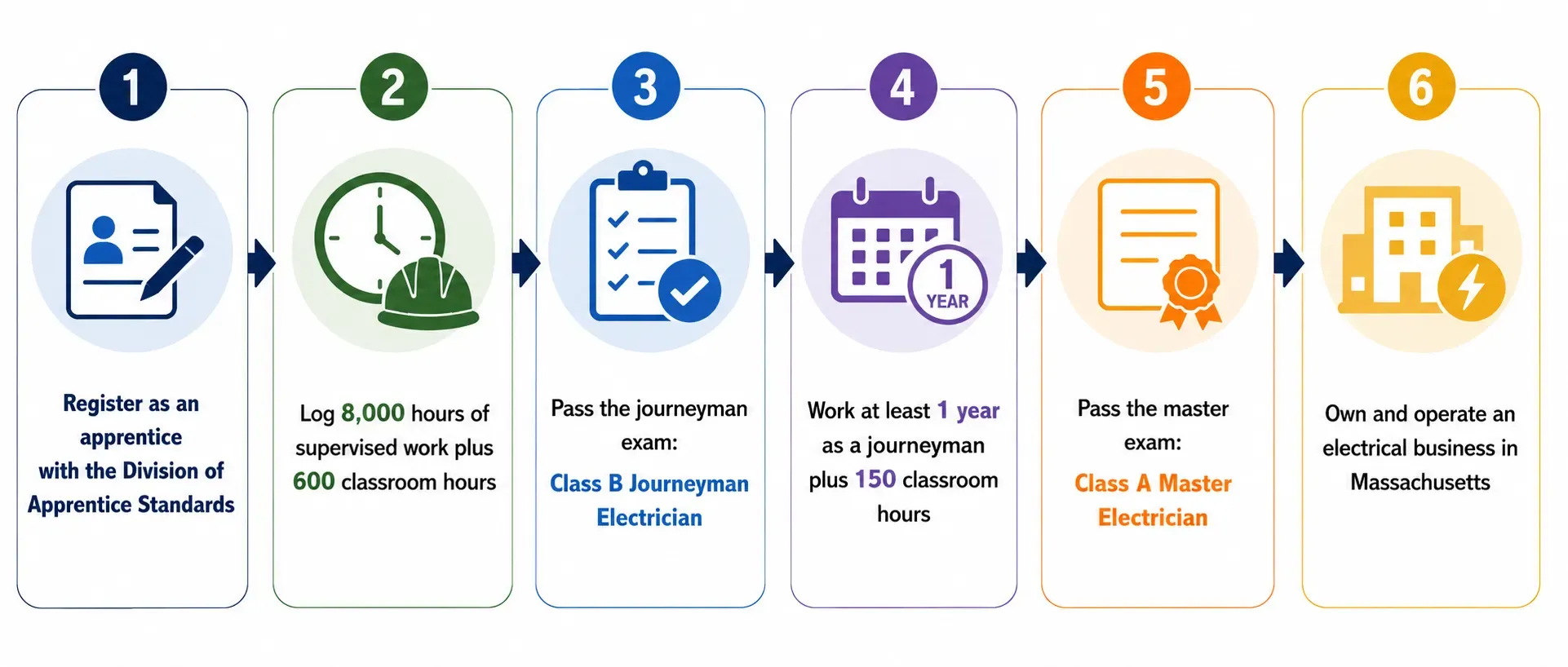
Here is the full ladder to a Massachusetts electrician license, start to finish.

Register as an apprentice with the Division of Apprentice Standards.webp
  1. Meet the basics. You must be at least 18 years old.

  2. Register as an apprentice. Sign up with the state's Division of Apprentice Standards, pay the $35 fee, submit a photo, and carry your registration card on the job. Only registered apprentices can legally do electrical work under supervision.

  3. Log your hours and schooling. Accumulate 8,000 hours of supervised work under a licensed journeyman and 600 hours of Board-approved classroom instruction, plus the required 15-hour code-update class. This typically takes four to five years.

  4. Apply through PSI and pass the journeyman exam. Submit your application online through PSI, the Board's testing vendor, then pass both parts of the exam.

  5. Work as a journeyman, then aim for master. After at least one year as a licensed journeyman and 150 more classroom hours, you can sit for the master exam, the license that lets you pull permits and own a business.

The payoff at the top of that ladder is real: a high-earning trade and the option to stop trading hours for dollars and run your own shop instead.

The Journeyman Path in Detail

The journeyman (Class B) license is the Massachusetts electrician license most people start with. It requires 8,000 hours of supervised work, a minimum of four years, plus 600 hours of Board-approved classroom instruction. That classroom piece is usually broken into Tier 1 and Tier 2 blocks (often 75-hour segments), and applicants also complete a 15-hour continuing education code update class before sitting for the exam. In practice, the whole path runs about four to five years.

The Master License and Business Ownership

The master (Class A) license is the highest individual Massachusetts electrician license. To qualify, you need at least 1 year of work as a licensed journeyman, plus another 150 hours of Board-approved classroom instruction covering advanced theory, code, and business.

The master license is more than a pay raise. Only a master electrician can pull permits, supervise journeymen and apprentices, and legally own and operate an electrical contracting business in the state. It is the credential that turns a skilled tradesperson into a business owner.

The Low-Voltage Track: Systems Technician and Contractor

If your interest is fire alarm, security, and communications systems rather than line-voltage power, Massachusetts has a parallel ladder. The Systems Technician (Class D) license requires 4,000 hours of supervised low-voltage work (minimum two years) and 300 hours of education. The Systems Contractor (Class C) license, the low-voltage equivalent of a master, requires an active systems technician license, one year of experience, and 75 hours of education, and it lets you pull permits and run a low-voltage contracting business.

The Licensing Exam: What to Expect

Every Massachusetts electrician license exam is administered by PSI, and as of June 2025 every application is submitted online through the PSI portal.

The journeyman exam has two parts, which can be taken the same day. One part covers general electrical theory and the National Electrical Code; the other covers the Massachusetts Electrical Code (527 CMR). Both are multiple-choice, and you must pass each part. Part I typically runs 80 questions in three hours, and Part II runs 30 questions in one hour. The NEC portion is effectively open-book, so success comes down to navigating the codebook quickly under time pressure.

The master exam follows the same two-part structure, with a larger NEC knowledge section (around 80 to 90 questions) and a second part of roughly 50 business-and-law questions.

If you fail a section, you can retake just that portion after paying the re-examination fee (about $135). Plan on waiting 30 days between attempts, and note that candidates generally get up to three attempts before additional training is required. Good exam-prep courses teach you to navigate the current NEC by keyword, which is the single biggest factor in passing.

What It Costs to Get Licensed

Budget for a few distinct costs on the way to a Massachusetts electrician license.

Cost

Approximate amount

Apprentice registration

$35

Classroom education

$525 per semester (public vocational) to ~$17,500 per year (private)

Journeyman application and exam

~$200 to $226

Re-examination (per failed part)

~$135

Under the Valor Act, Massachusetts waives the state application processing fee for military personnel, veterans, and their spouses (include your DD214 or Military Spouse Affidavit). Many schools also offer financial aid, which can significantly lower the education line.

Training Pathways: Trade School vs. Apprenticeship

There are two main ways to meet the education requirements for a Massachusetts electrician license, and many electricians blend them.

Trade school. Schools such as Wentworth Institute of Technology offer programs that earn college credit or a certificate, and you often complete the full 600-hour classroom requirement before you begin working full-time. This path front-loads the theory.

Apprenticeship. An apprenticeship follows the "earn while you learn" model: you log on-the-job hours during the day and take classroom instruction at night, getting paid the whole time. Programs are sponsored by unions (through Joint Apprenticeship Training Centers) or by non-union groups. The U.S. Department of Labor's registered apprenticeship program is a good place to start looking.

Top Electrician Schools in Massachusetts

Tuition changes, so confirm current pricing with each school, but these are well-known Massachusetts options across a range of budgets:

  • Assabet Community Education (Assabet After Dark), Marlborough. Journeyman Electrician 1 through 4 and master-prep courses, around $1,000 per course.

  • Wentworth Institute of Technology. A 600-hour program built around code compliance and electrical theory, with degree-integration options.

  • Porter and Chester Institute. Campuses in Brockton, Chicopee, and Worcester offer a full Industrial, Commercial, and Residential Electrician program, with an average cost of around $17,500 per year.

  • Southeastern Technical Institute. A 10-month daytime program covering Tier 1 (300 hours), with in-district tuition near $5,000.

  • Peterson School. Locations in Woburn, Westwood, and Worcester offer journeyman prep (around $3,000) and master-prep courses.

  • Gould Construction Institute. A major non-union provider in Canton, Medford, Springfield, and Woburn, with courses from roughly $1,864 to $2,476.

  • Greater Lowell Regional Technical School. State-approved training for about $525 per semester.

  • Greater New Bedford Regional Vocational Technical School. Adult electrical training for about $600 per semester.

  • Whittier Regional Vocational Technical School. Journeyman modules for about $550 per semester.

Apprenticeship Programs: Union and Non-Union

If you prefer to earn while you train, these programs are widely used across the state.

Union (Joint Apprenticeship Training Centers):

  • IBEW Local 103 (Boston) runs a five-year apprentice curriculum.

  • IBEW Local 7 (Springfield) covers Western Massachusetts.

  • IBEW Local 96 (Worcester) serves central Massachusetts.

  • IBEW Local 223 (Brockton) covers the Southeastern part of the state.

Non-union:

  • Independent Electrical Contractors of New England (IEC), with member tuition around $1,750 a year.

  • Associated Builders and Contractors (ABC), Massachusetts Chapter, which connects apprentices with non-union contractors.

  • Wayne J. Griffin Electric (Weymouth), a private employer offering in-house apprenticeship training.

License Renewal and Continuing Education

A Massachusetts electrician license is not a one-time achievement. Licenses renew on a set cycle, and the Board requires continuing education, centered on National Electrical Code updates, to keep your license active. Because the NEC is revised on a multi-year cycle and Massachusetts adopts its own amendments, staying current on code is part of the job. Confirm the exact renewal period and required continuing-education hours on the Board's licensing page before each renewal, since these can change.

Reciprocity: Moving a License In or Out

Massachusetts has a reciprocity agreement with New Hampshire for both journeyman and master licenses, provided the New Hampshire license was earned by examination. Outside of that, there is no broad reciprocity: an electrician licensed in another state generally must meet the Massachusetts electrician license requirements and pass the state exam to work here. If you are relocating, check the Board's reciprocity and out-of-state application rules before you apply.

Electrician Salaries in Massachusetts

Electricians in Massachusetts earn some of the highest wages in the country. For national context, the BLS reports that as of May 2024 the median electrician earned $62,350, the lowest 10% earned under $39,430, and the top 10% earned more than $106,030. Massachusetts sits well above that median, and union scales in the Boston metro push the ceiling higher still.

Pay rises sharply with experience and license class:

Career stage

Approximate annual pay

Entry-level (0 to 2 years)

~$38,420

Experienced journeyman or senior

~$98,610 (Boston-area union rates among the highest in the nation)

Master or supervisor

~$127,900

The jump from journeyman to master is where the math really changes, because the master license is also your ticket to owning the business and keeping the margin instead of earning an hourly rate.

What Changes When You Run the Business

That master license is more than a pay bump, it lets you open your own shop, and that is where a different set of problems begins. The contractors who win are the ones who get the most out of the team they already have, and nothing wastes a skilled crew faster than leads that ring through to voicemail while everyone is on a ladder.

Roughly 40% of home-service calls come in after hours, and a missed call is usually a missed job. CloseCrew's AI receptionist, Larry, answers every inbound call 24/7, including nights and weekends, in English and Spanish. Larry qualifies the caller, answers common questions, books the job into your calendar, and follows up on estimates afterward, with calls, texts, web chat, and email all landing in one inbox. That means a new electrical business can capture more work without hiring a front-desk person it can't yet afford.

CloseCrew reports that contractors using it see up to 3x as many booked leads and save 5 to 15 hours a week on phone calls and follow-up work, with onboarding in about 48 hours. If you are building toward that Class A license, it is worth knowing how to turn it into a real business: our guides on how to start an electrical business and electrical business insurance cover the next steps after licensing.

Start the Career, Then Build the Business

A Massachusetts electrician license rewards you for putting in the time, with pay among the best in the nation and a clear route to owning your own business. The journeyman bar is 8,000 hours of work plus 600 classroom hours, roughly four to five years, and a master license adds a year as a journeyman plus 150 more classroom hours. Demand is climbing, driven by building electrification, EV charging, and offshore wind, so the timing has rarely been better to start.

Get licensed first. Then, when you are ready to run the shop, make sure every call gets answered so your business wins the work it has earned. See how CloseCrew keeps your phone covered so no lead slips away while you are on the job.

Related tools

Run the numbers before you update your price book or field software.

Contractor Blog

Cross-trade guides on hiring, marketing, and operations for every home services business.

View all guides

Electrical Licensing

State licensing requirements, exams, and renewal rules for electrical contractors.

View states

Meet Larry

AI receptionist built for Electrical — answers calls, books jobs, and follows up on leads 24/7.

See Larry for Electrical

Related articles

Never miss a Electrical service call again. Let Larry, your AI receptionist, book jobs while your crew is in the field.

We will run your numbers on the call and tell you if the maths does not work for a shop your size. That happens, and it is a cheaper conversation than finding out three months in.

Get a demo