Business Tips

How to Respond to Negative Reviews as an Electrical Business (2026 Guide)

A bad review stings. But how you respond matters more than the review itself. Future customers read your response before they read the complaint. This guide covers the 7-step response framework, copy-paste templates, and how to prevent the problems that cause complaints in the first place.

12 min readPublished July 20, 2026

A bad review stings. There's no way around it. Your business is your livelihood. Seeing someone publicly criticize it feels personal. But here's what matters more than the review itself. Your response. 89% of consumers read business replies to reviews. Future customers read your response before they read the complaint. A professional reply can actually rebuild trust. A defensive reply confirms the complaint.

Businesses that respond to bad reviews are 45% more likely to earn customer trust. Think about it. When was the last time you saw a business with only 5-star reviews? It probably seemed too good to be true. Because it usually is.

Every electrical business gets bad reviews eventually. The key isn't avoiding them. It's knowing how to respond so you turn critics into repeat clients.

This guide covers exactly how to handle bad reviews. When to respond. When to request removal. The 7-step response framework. A copy-paste template. And how CloseCrew helps you prevent the problems that cause bad reviews in the first place.

Part of the Business Tips section in the Electrical Business Blog.
Should you respond to customer complaints

Yes. Every single time.

Can you respond to Google and Yelp reviews? Yes. Should you? Absolutely. Your response communicates something to every future customer. It shows how much your company values customer service.

96% of consumers specifically look for bad reviews when researching a business. They want to see how you handle problems. A thoughtful response shows character. No response shows indifference.

You're not just responding to one unhappy customer. You're showing everyone who reads that review how your business handles adversity. That audience includes the homeowner who needs a $3,000 panel upgrade next month.

When should you remove a bad review instead

Not all bad reviews deserve a response. Some deserve removal. Google, Yelp, Facebook, and other platforms remove reviews that violate their content policies.

Flag a review for removal when:

  • A competitor wrote it. Not an actual customer. This is a conflict of interest. Flag it for the platform to review.

  • A former employee wrote it. Disgruntled ex-employees sometimes leave fake reviews. Flag and document.

  • The content is fake or inaccurate. If the reviewer was never your customer, flag it. Don't reply with "you must have the wrong business." That looks like deflection if the review stays up.

  • The language is abusive or threatening. Personal attacks on employees or slanderous accusations warrant removal. If the language is inappropriate, the platform may remove it automatically.

Don't respond to reviews you're flagging for removal. If the platform removes it, great. If it stays up, then respond professionally.

For other grounds for review removal, Google provides detailed policies covering dangerous, illegal, and spam content.

7 steps for responding to bad reviews

Sometimes bad reviews signal a real problem. Sometimes they signal a hard-to-please customer. Either way, your response matters. Future customers see how you handle complaints. They judge your business by your response, not the complaint.

Here's the framework that works.

1

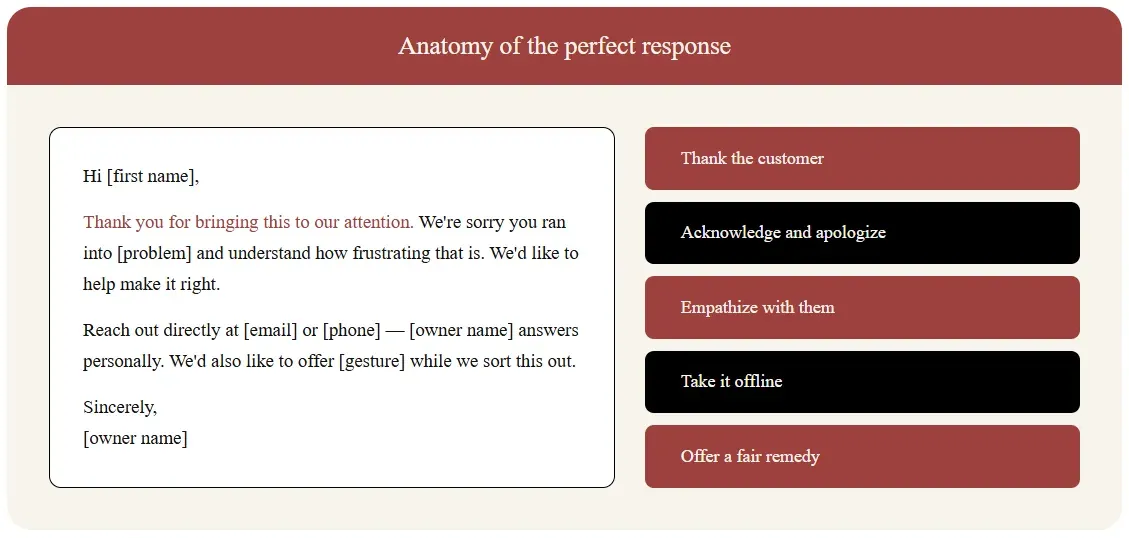
Acknowledge the issue and apologize

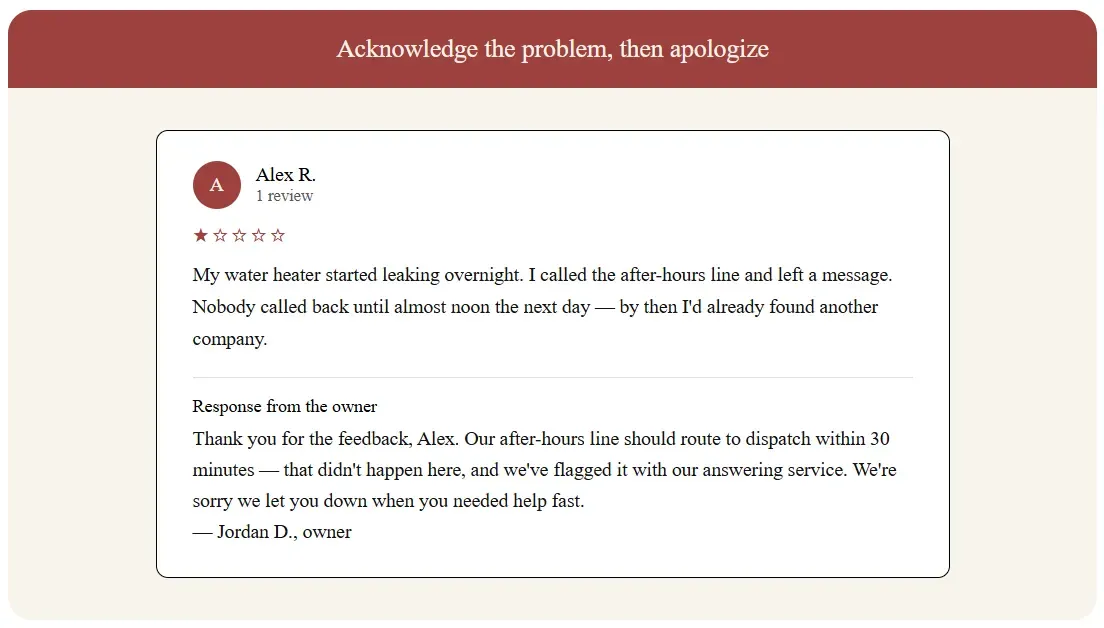
Don't beat around the bush. Restate the customer's problem so they know you understand. Then offer a genuine apology.

You don't have to accept full blame. But you should apologize for how the experience made them feel. There's a difference between "we were wrong" and "we're sorry this happened."

What a good response looks like:

"Thank you for your feedback. Our policy is to return calls within 30 minutes after hours. We have reviewed the call and will address the delay with our team. We are sorry for our failure to respond in a timely manner."

The owner thanks the customer. Explains the policy. Acknowledges the failure. Apologizes specifically. No excuses. No deflection.

acknowledge and apologize.webp
2

Empathize with the customer

Before you propose a solution, connect with their frustration. Show them you genuinely care. Not because your business depends on their review. But because you understand their experience.

"I understand how frustrating it must be to wait for a callback during an emergency." That sentence costs nothing. It changes everything.

People don't care how much you know until they know how much you care. Empathy disarms anger faster than any discount or explanation.

3

Never argue publicly

This is where most business owners fail. A negative review feels like an attack on your livelihood. The instinct is to fight back. Don't.

A defensive response makes everything worse. It confirms the customer's frustration. It signals to future customers that you can't handle criticism.

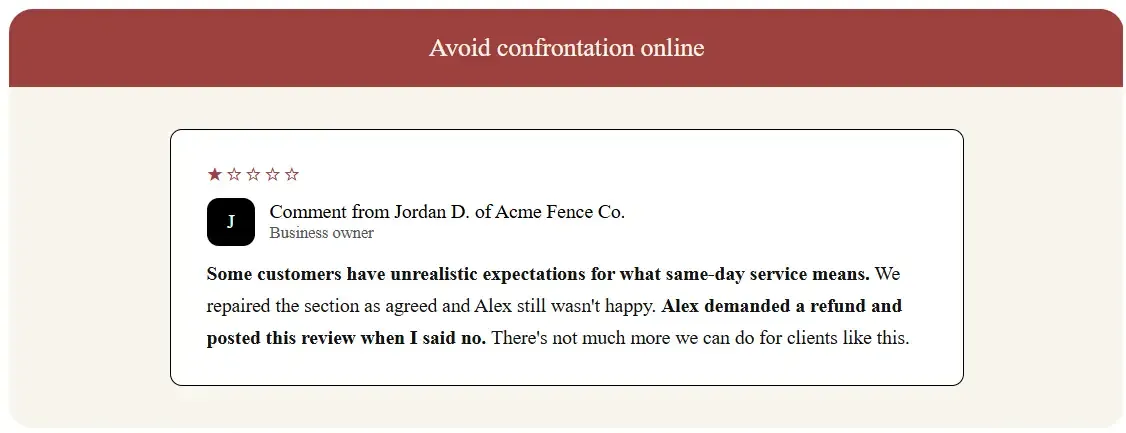
What a bad response looks like:

"Unfortunately, all businesses occasionally run into a client with unreasonable expectations."

This owner attacked the customer's personality. Then wished there was a way to "warn other companies" about this client. Future customers think: "What will they say about me?"

Never use the review platform as a place to vent. It's a stage. Every future customer is watching.

avoide confronation.webp
4

Provide direct contact info for offline support

Move the conversation out of the public eye. Don't just say "reach out to us." Give a specific phone number or email. Better yet, give your personal contact.

"Please call me directly at [your number] or email [your email]."

When the owner gives their personal info, it signals how important customer service is. It also prevents the back-and-forth from playing out publicly where competitors can use it.

5

Take steps to remedy the situation

Acknowledgment and apology aren't enough. Take action. Offer something concrete to win back their goodwill.

This could be a free follow-up inspection. A discount on their next service call. Or simply a commitment to fix the specific problem. The offer is often more about the gesture than the value.

Be careful though. Don't make it look like you're bribing for an updated review. Frame it as making things right. Not buying a better rating.

anatomy of perfect response.webp
6

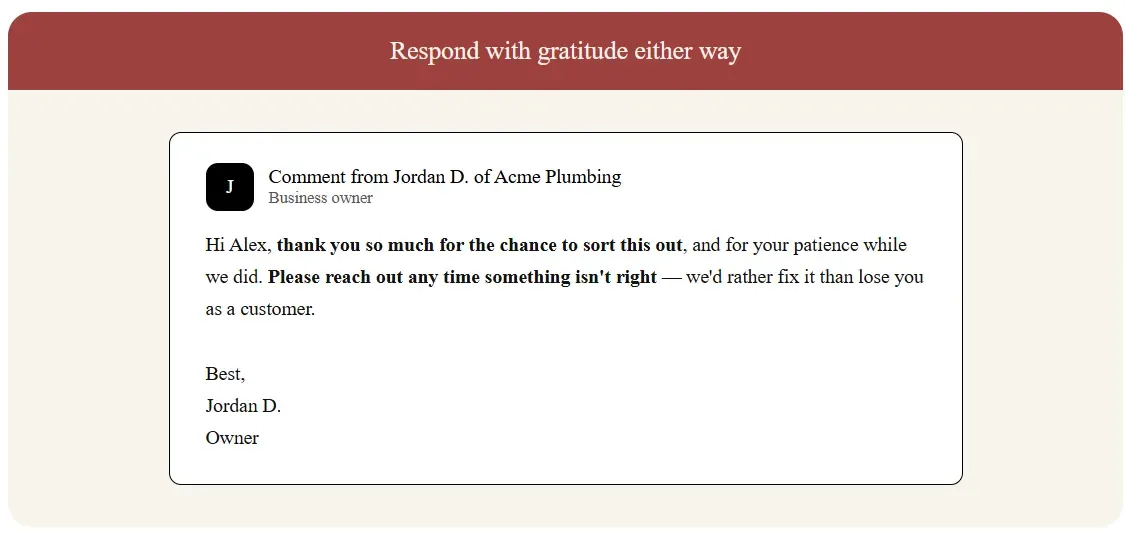
Respond with gratitude after resolution

Whether or not the customer updates their review, respond with thanks. Thank them for giving you the chance to make it right. Don't use the platform to brag about your resolution efforts. Simply express appreciation.

"Thank you for allowing us to address this. We appreciate your time and patience."

End on a positive note. Their last memory of your business should be warmth and professionalism. That final impression can retain their business for years.

respond with gratitude.webp
7

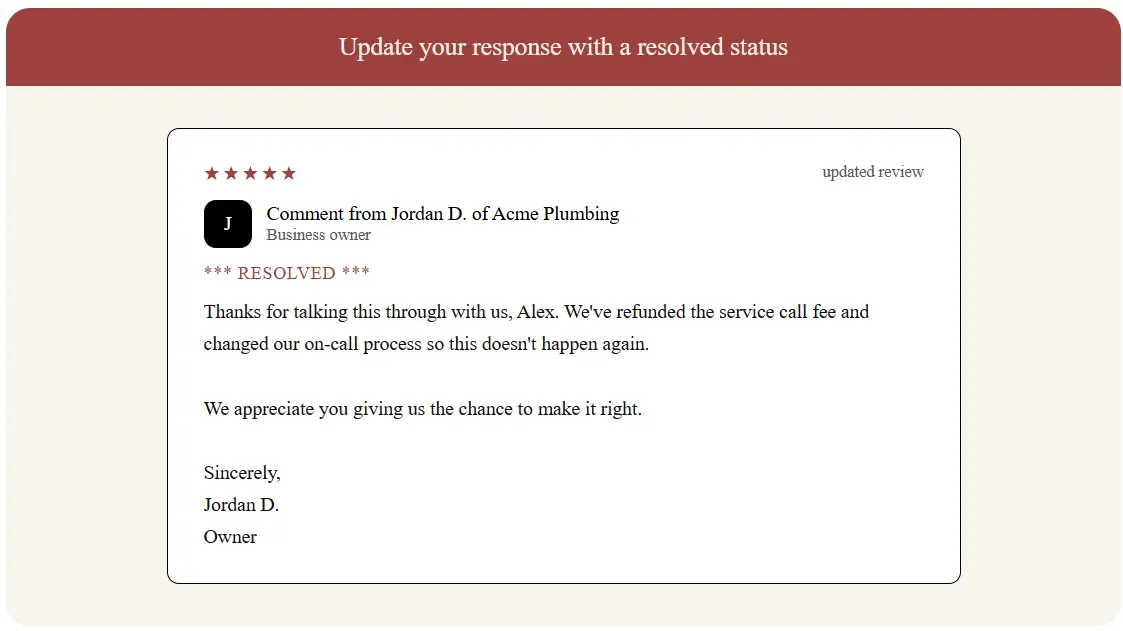
Update your response with a status

This is the step almost nobody does. It's also the most powerful.

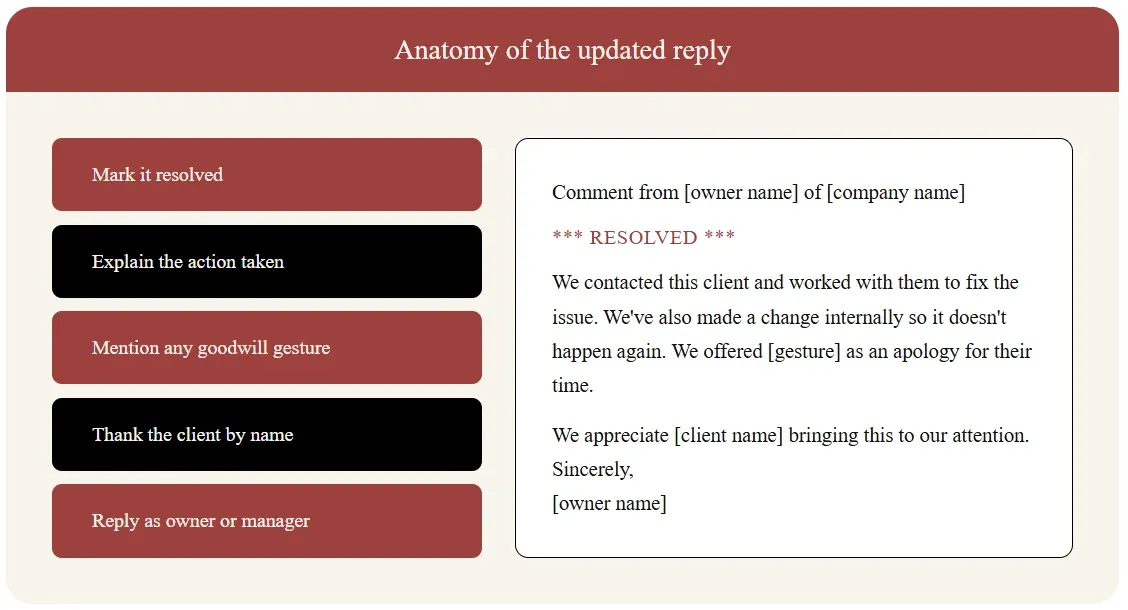
After you resolve the issue, update your public response. Add "RESOLVED" at the top. Explain briefly what action was taken. Thank the customer by name.

Future customers scanning your reviews will see the resolution status without reading the full thread. At a glance, they know: this company fixes problems.

resolved status.webp

The response template

Use this template as a starting point. Customize for each review.

Initial response to a negative review:

Hi [FIRST NAME],

Thank you for bringing this to our attention. We apologize that you experienced [PROBLEM] and understand how frustrating that must be. We truly appreciate your honest feedback and would love to help resolve your situation and fix the root cause to prevent future issues.

We are dedicated to providing excellent service and would love to find a resolution. Please reach out to our team at [EMAIL] or [PHONE]. We would also like to offer you [OFFER] as a gesture of good faith while we work towards a resolution.

Sincerely, [OWNER NAME]

Updated response after resolution:

Comment from [OWNER NAME] of [COMPANY NAME]

RESOLVED

We contacted this client and worked with them to remedy the situation. We have also taken steps internally to make sure this problem does not happen again. We offered [GESTURE] as a token of apology for their time and frustration.

We truly appreciate [CLIENT NAME] bringing this to our attention and working with us to find a solution.

Sincerely, [OWNER NAME], Owner

anatomy of updated reply.webp

How to respond to positive reviews

Don't just grease the squeaky wheels. Reward your fans too. When customers take time to leave a positive review, reciprocate. People love recognition. Recognizing them turns happy customers into advocates.

Three tips for positive review responses:

Thank them specifically. Use their name. Reference the job if possible. "Thanks, Mike! Glad we could get that EV charger installed before the weekend."

Highlight another service. If they praised your panel upgrade, mention your maintenance agreements. "Did you know we offer annual electrical inspections? Ask about our membership program." Organic marketing to the 89% who read responses.

Promote your referral program. Positive reviewers are your best referral sources. "If you know anyone who needs electrical work, we'd love to help them too." A direct ask converts advocates into lead generators.

Why most poor reviews happen in the first place

The images and templates above fix the symptom. But what causes the disease?

Look at the most common negative review themes for electricians:

  • "Nobody answered when I called."

  • "They never called me back."

  • "I waited all day and nobody showed up."

  • "The estimate was way higher than expected."

  • "I couldn't get anyone on the phone."

Notice the pattern? Most aren't about bad electrical work. They're about communication failures. Missed calls. Slow responses. No follow-up. These are operational problems, not skill problems.

Home service contractors miss 27-62% of inbound calls. 85% of callers who hit voicemail never call back. They call your competitor instead. And some of them leave a 1-star review on the way out.

The best way to handle poor reviews is to prevent them. Answer every call. Follow up on every estimate. Confirm every appointment. That eliminates the root cause of most complaints.

How CloseCrew prevents the reviews you'd have to respond to

Larry answers every call 24/7. No voicemail. No hold music. No "nobody picked up." The number one complaint in home services disappears.

Larry books jobs directly into your calendar. He sends confirmation texts to reduce no-shows. He follows up on open estimates so customers don't feel forgotten.

When your customer service is consistent, complaints drop. When complaints drop, poor reviews drop. When complaints drop, your rating climbs. When your rating climbs, more customers call.

Arctic Air saw 30% more revenue in one year. Premier Heating cut response time to under 1 minute. Air Design added 13 extra appointments in 30 days. Not by responding to reviews better. By preventing the problems that cause bad reviews in the first place.

The best response to a negative review is never needing to write one.

And when you do prevent those problems, something else happens. Your calendar fills up. Your techs stay busy. Your revenue climbs. Not because you marketed harder. But because customers trust you more. That trust shows up in your reviews. Those reviews show up in Google. And Google sends you more customers.

It's a revenue loop. Better service leads to better reviews. Better reviews lead to more calls. More calls lead to more revenue. More revenue lets you invest in even better service. The loop compounds every month.

CloseCrew automates your review collection

Prevention handles most of the problem. But you still need fresh positive reviews to outweigh the occasional negative one.

CloseCrew's reputation tools send automated review requests after every completed job. The moment a tech marks the job done, the customer gets a text. Direct link to your Google review page. One tap to leave a review.

No CSR remembers to ask. No tech feels awkward asking in person. The automation handles it consistently. After every single job.

The result is a steady stream of fresh 5-star reviews. That stream pushes bad feedback down. It lifts your Google ranking. It builds the trust that converts strangers into customers.

Most shops see review volume increase 3-5x within 90 days. Automation does the heavy lifting. That volume changes your entire online presence.

For reputation strategy across platforms, see our full reputation guide.

Picture this. Right now you have 35 Google reviews. Your competitor has 120. Customers scroll past you. Three months from now, you have 85 reviews. Six months from now, 150. Same business. Same quality. But now Google sees you as the trusted choice. Homeowners see you as the established choice. That shift didn't require a single ad dollar. Just consistent automation doing what your team forgets to do manually.

Seeing is believing. Watch how CloseCrew handles review automation alongside call answering and scheduling in one system.

Your reputation is built one response at a time

Every review is a stage. Every response is a performance. Your future customers are the audience. Show them professionalism. Show them accountability. Show them you stand behind your work.

And build the systems that prevent bad experiences from happening. Answer every call. Follow up on every estimate. Confirm every appointment. Automate review requests so positive reviews outpace the negative ones.

CloseCrew handles all of it. Larry answers 24/7. Review requests go out automatically. Your reputation grows on autopilot.

You've read the framework. You've seen the templates. You know what good responses look like. But knowing and doing are different things. The shops that win aren't the ones with the best intentions. They're the ones with systems that execute without reminders.

If you're tired of chasing reviews manually and losing leads to voicemail, our team can show you exactly how this works for your shop. No pressure. Just a conversation about what's possible.

Frequently asked questions

Should I respond to every negative review?

Yes. Every one. Each response shows you care about customer feedback. Your response helps future customers see how you handle problems. No response tells them you don't care.

Stay professional and factual. If it's clearly fake, report it to the platform. Still respond politely for other readers to see. A calm, factual response to a false review actually builds credibility.

Within 24 hours. 53% of consumers expect a quick reply to bad feedback. This shows you're attentive and willing to fix the problem. But don't respond in the heat of the moment. Cool down first.

Yes. Professional responses show accountability. Businesses that respond to customer complaints are 45% more likely to earn customer trust. A thoughtful response shows more about your character than any advertising.

Google only removes reviews that violate its policies. Spam, fake content, hate speech, and conflicts of interest qualify. Instead of focusing on removal, focus on responding professionally. And encourage happy customers to leave more positive reviews.

Getting defensive. Attacking the customer's character. Arguing publicly. One heated response can undo years of positive reputation. Take a breath. Draft your response. Read it twice. Then post.

Related tools

Run the numbers before you update your price book or field software.

Contractor Blog

Cross-trade guides on hiring, marketing, and operations for every home services business.

View all guides

Electrical Licensing

State licensing requirements, exams, and renewal rules for electrical contractors.

View states

Meet Larry

AI receptionist built for Electrical — answers calls, books jobs, and follows up on leads 24/7.

See Larry for Electrical

Related articles

Never miss a Electrical service call again. Let Larry, your AI receptionist, book jobs while your crew is in the field.