How to Follow Up on Unsold Plumbing Estimates and Recover Revenue
0-70% of plumbing estimates leave the house unsigned. Most homeowners don't say no. They just forget. One follow-up converts 20-30% of them. This guide covers the 7-step framework, timing, templates, and how AI automation recovers the revenue sitting in your CRM.
Your tech spent 45 minutes at the house. Diagnosed the problem. Built a detailed estimate. Presented three options on a tablet. The homeowner said "let me think about it."
That was two weeks ago. Nobody followed up. The estimate sits in your system. The homeowner called another plumber last Tuesday. That plumber answered. That plumber got the $4,500 repipe job.
Your tech's time was wasted. Your marketing dollars were wasted. The lead you paid to generate converted into revenue for someone else.
This happens every day in plumbing businesses. And most shops don't realize the scale of the problem.
The average plumbing business closes 30-40% of estimates on the spot. That means 60-70% of estimates leave the house unsigned. Some of those homeowners will call back. Most won't. Not because they chose a competitor. Because they simply forgot.
Life got busy. The leak slowed down. The holidays came. The quote got buried in their email. They meant to call you back. They just didn't.
Here's the math. Say your shop produces 80 estimates per month. You close 35 on-site. That leaves 45 open estimates. Industry data suggests 20-30% of those would convert with a single follow-up contact. That's 9-14 additional jobs per month. At a $1,200 average ticket, that's $10,800-$16,800 in monthly revenue sitting in your system.
Per year? $129,600-$201,600. From estimates your team already built. Leads you already paid for. Customers who already trust you enough to let you into their home.
That revenue doesn't require new marketing. It doesn't require new leads. It requires one thing. A follow-up.
Use the Profit Margin Calculator to see how those recovered jobs affect your bottom line. The margins on followed-up estimates are often higher than new leads. The customer already knows you. The diagnostic is already done. The estimate is already built. Pure incremental revenue.
Why plumbing estimates go cold
Understanding why customers don't sign immediately helps you follow up more effectively.
Price shock. A $6,000 water line replacement is a lot of money. Customers need time to process. They're not saying no. They're saying "not yet."
Spouse approval. One partner was home for the estimate. The other wasn't. They need to discuss it. If you don't follow up, the conversation never happens.
Comparison shopping. The homeowner plans to get 2-3 quotes. If your follow-up arrives while they're still comparing, you stay top of mind.
The problem seems less urgent. The leak slowed down. The drain is functioning. The water heater still works. Urgency fades. Your follow-up restores it.
They simply forgot. This is the most common reason. Not rejection. Just distraction. One text reminder converts these customers at high rates.
They couldn't reach you when ready. The homeowner decided to accept on Thursday evening. Called your office. Voicemail. Called again Friday morning. Busy. By Friday afternoon, they booked with someone who answered.
That last one is the most painful. The customer was ready to say yes. You lost them to a missed call. Use the Missed Call Cost Calculator to see what those missed callbacks cost annually. The default plumbing inputs show thousands in lost revenue.
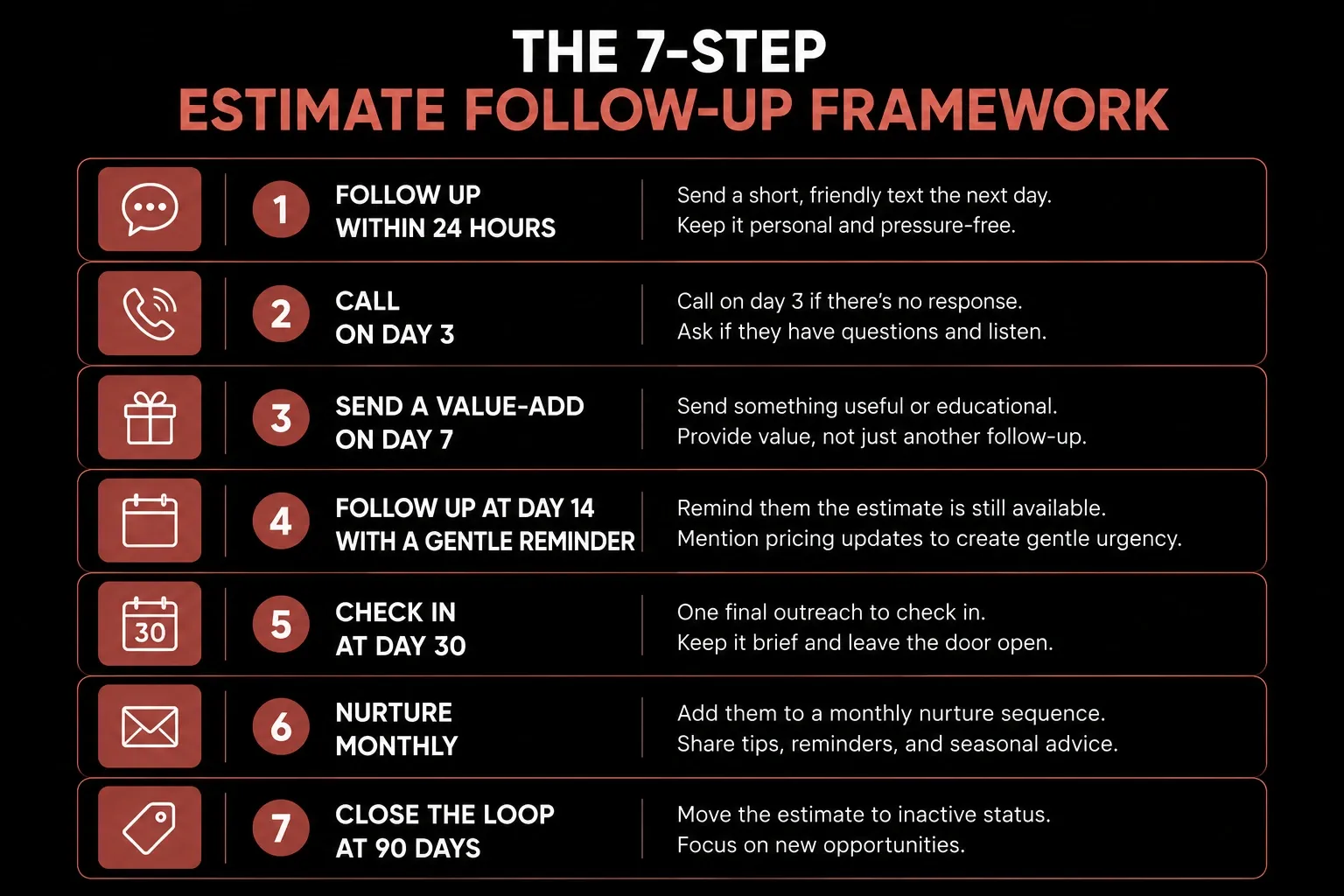
The 7-step estimate follow-up framework
Step 1: Follow up within 24 hours
The first follow-up should happen the next day. Not next week. Not "when we get around to it." Tomorrow.
Send a text message. Text gets read faster than email. Keep it short. Personal. Not salesy.
"Hi Sarah, this is Mike from [Company]. Thanks for letting us look at your water heater yesterday. Let me know if you have any questions about the options we discussed."
That's it. No pressure. No discount. Just a door left open.
Step 2: Call on day 3
If no response to the text, call on day 3. A real voice conversation converts better than text. Ask if they had questions. Ask if anything changed. Listen more than you talk.
Many customers will say "I was just about to call you." They meant to. They just hadn't yet. Your call was the nudge they needed.
Step 3: Send a value-add on day 7
If still no response, send something useful. Not another "just checking in" message. Something that adds value.
"Hi Sarah, I wanted to share a quick tip. If your water heater is making popping sounds, that's sediment buildup. A flush can extend its life by 2-3 years. Happy to help if you'd like to schedule that."
This positions you as an advisor. Not a salesperson chasing a signature.
Step 4: Follow up at day 14 with a gentle reminder
Two weeks is the sweet spot for a final active follow-up. Mention that the estimate is still available. Note that pricing is subject to change (material costs fluctuate). Create gentle urgency without pressure.
"Hi Sarah, your water heater estimate is still available. Material prices update soon. Wanted to give you a heads-up before they change."
Step 5: Check in at day 30
One more touch at the 30-day mark. This is your last active outreach. Keep it brief. Offer to answer questions. Leave the door open.
If they haven't responded by now, they likely went with another plumber. Or the problem resolved itself. Either way, you've demonstrated professionalism that builds long-term trust.
Step 6: Add to your re-engagement list
Unsold estimates older than 30 days move to your re-engagement list. These customers get quarterly outreach. Seasonal maintenance reminders. Special offers. Newsletter content.
They know your company. They trust you enough to invite you in. They may not need you now. But water heaters fail. Pipes freeze. Drains clog. When the next problem hits, your name should be the first they think of.
Step 7: Track everything in your CRM
Every follow-up gets logged. Date. Method. Response. Outcome. This data reveals patterns. Which follow-up method converts best? At which step do most customers respond? Which estimate types close fastest on follow-up?
Without tracking, you're guessing. With tracking, you're optimizing.
When to follow up: the timing that works
Day
Action
Method
Goal
Day 1
Thank you + open door
Text
Start the conversation
Day 3
Check in with questions
Phone call
Personal connection
Day 7
Value-add tip or resource
Text or email
Position as advisor
Day 14
Gentle reminder + urgency
Text
Nudge toward decision
Day 30
Final active outreach
Text
Last direct attempt
Quarterly
Re-engagement campaign
Email or text
Stay top of mind
Follow-up templates for plumbers
Template 1: Day-after text
"Hi [Name], this is [Tech] from [Company]. Thanks for your time yesterday. Let me know if you have any questions about the repair options. Happy to help."
Template 2: Day 3 call script
"Hey [Name], it's [Tech] from [Company]. Just following up on the estimate we left for your [specific job]. Did you have a chance to look it over? Any questions I can answer?"
Template 3: Day 7 value-add
"Hi [Name], quick tip on your [equipment]. [Relevant maintenance advice]. We can handle that alongside the [original job]. Let me know."
Template 4: Day 14 reminder
"Hi [Name], your estimate for [job description] is still available. Material costs update soon. Wanted to make sure you had a chance to review. Call or text anytime."
Template 5: Day 30 final check
"Hi [Name], just checking in one last time on your [job]. No pressure at all. If you'd like to move forward down the road, we're here. Thanks for considering us."
Why most plumbing shops don't follow up
The reasons are always the same. And they're all fixable.
"We're too busy." The tech moves to the next call. The office handles incoming work. Nobody owns follow-up. It falls through the cracks.
"I don't want to seem pushy." Following up isn't pushy. It's professional. Doctors follow up. Dentists follow up. Accountants follow up. Plumbers should too.
"The customer will call back if interested." Some will. Most won't. Not because they chose someone else. Because they forgot.
"We don't have a system for it." This is the real answer. Without a system, follow-up depends on memory. Memory is unreliable. Systems are consistent.
How CloseCrew automates estimate follow-up
Manual follow-up works. But it depends on humans remembering. Humans forget. Especially when 3 emergency calls come in and the afternoon schedule stacks up.
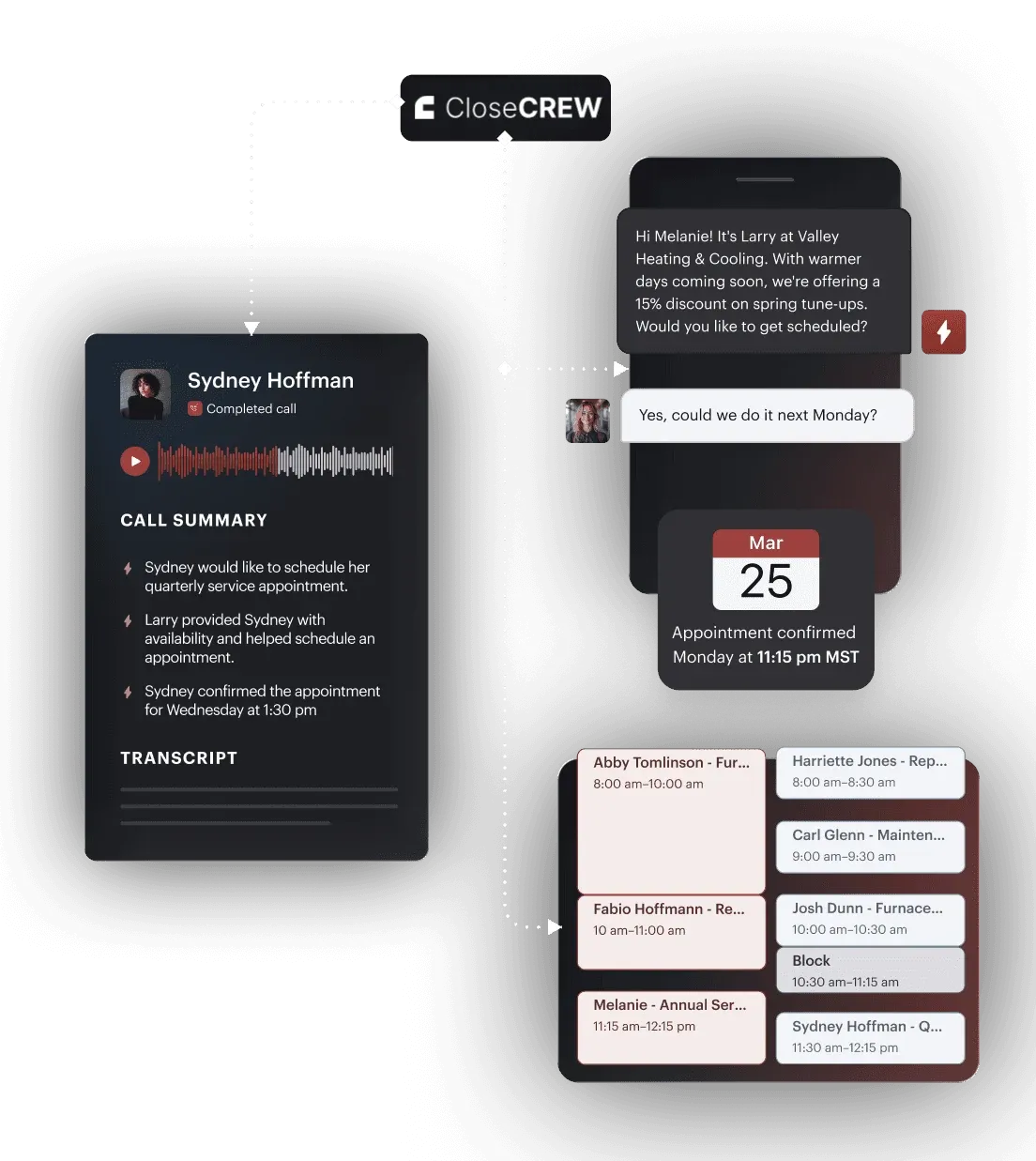
Larry, CloseCrew's AI Employee, doesn't forget. When an estimate goes unanswered, Larry triggers a follow-up automatically. Text first. Then a call if no response. He checks in at the right intervals. He answers questions. He books the job if the customer is ready.
Larry also handles the callback. When a homeowner who received your estimate calls back to accept, someone needs to answer. If that call comes at 7 PM, your office is closed. The customer gets voicemail. They call the next plumber.
Larry answers that call. He pulls up the estimate. He confirms the details. He books the installation. The job lands on your calendar before your team starts the next morning.
Air Design saw estimate conversion jump from 5-10% to near 100%. They added 13 extra appointments in 30 days. Not from new leads. From estimates their team had already built.
Premier Heating converted 3x more leads with response time under 1 minute. Arctic Air saw 30% more revenue in one year.
The estimates are already in your system. The revenue is already earned in theory. Larry turns it into reality.
Most plumbing businesses have $100,000+ in open estimates sitting in their CRM right now. Those aren't dead leads. They're customers who haven't been asked again. One follow-up converts 20-30% of them. Automation makes sure that follow-up actually happens.
Use the Markup and Margin Calculator to verify your estimates are priced for profit before following up. A recovered estimate at the wrong price still loses money.
How to measure follow-up performance
Track these metrics monthly to improve your process.
Follow-up rate. What percentage of open estimates get at least one follow-up? Target: 100%. Every single one.
Response rate by method. Do customers respond more to texts or calls? At which step? Use data to optimize your sequence.
Recovery close rate. What percentage of followed-up estimates convert? Industry average is 20-30%. Top shops hit 40%+.
Revenue recovered. Total revenue from estimates closed after follow-up. This is your ROI on the entire process.
Average days to close. How long after the initial estimate does the customer accept? This tells you when urgency peaks.
Reason for decline. When customers say no, log why. Price? Timing? Went with competitor? Decided not to fix? Each reason informs a different improvement.
A real-world follow-up scenario
Here's what this looks like in practice.
Monday: Your tech visits the Johnson home. Diagnoses a failing water heater. Presents three options. Basic repair ($450). Tank replacement ($2,800). Tankless upgrade ($5,200). Mrs. Johnson says she needs to discuss with her husband. Your tech leaves the estimate on the tablet.
Tuesday: Larry sends a text. "Hi Mrs. Johnson, thanks for your time yesterday. Let me know if you have questions about the water heater options."
Thursday: No response. Larry calls. Mr. Johnson answers. He had questions about the tankless option. Larry explains the differences. Mr. Johnson says they'll decide this weekend.
Next Monday: Larry texts. "Hi, just checking in on the water heater decision. Happy to answer anything." Mrs. Johnson replies: "We want the tankless. Can you come Thursday?"
Larry books the appointment. Assigns the tech. Sends a confirmation text. $5,200 job booked. Without a single manual follow-up from your team.
That same job without follow-up? The Johnsons would have forgotten by Thursday. The old water heater would have limped along for three more months. Then it would have failed on a Sunday. They'd call the first plumber they found on Google. Someone else gets the $5,200 job.
Follow-up didn't just recover revenue. It captured a customer for life. The Johnsons will call you for every future plumbing issue. They'll refer their neighbors. They'll sign up for your maintenance agreement.
All because Larry sent a text on Tuesday.
Stop leaving revenue in your CRM
Every open estimate represents work your team already did. A lead you already paid for. A customer who already trusts you. The only thing missing is the follow-up.
Build the system. Set the timing. Use the templates. Track the results. Or let Larry handle all of it automatically.
The revenue is already there. It's sitting in your estimates. Go get it.
Frequently asked questions
How many times should I follow up on an estimate?
Four to five active contacts over 30 days. Day 1, 3, 7, 14, and 30. After that, move to quarterly re-engagement. More than five contacts in 30 days feels aggressive.
Is text or phone better for follow-up?
Text for the first contact. It's less intrusive. Phone for the second. A real conversation converts better. Alternate between both. Track which method gets more responses.
What if the customer says they went with another plumber?
Thank them. Ask what influenced their decision. Log the reason in your CRM. This data helps you improve pricing, presentation, or speed to quote. Stay professional. They may come back for the next job.
Should I offer a discount to close an old estimate?
Rarely. Discounting trains customers to wait for a better price. Instead, add value. Throw in a free inspection. Include a maintenance agreement trial. Or note that material prices are increasing. Create urgency through value. Not price cuts.
How do I follow up without being annoying?
Add value in every contact. Don't just say "checking in." Share a tip. Answer a question they might have. Reference their specific situation. When follow-up helps the customer, it's not annoying. It's service.
For sizing jobs accurately before following up, use the free Pipe Sizing Calculator to verify specs before you re-present the estimate.
Related tools
Run the numbers before you update your price book or field software.
Free Plumbing Templates
Invoices, estimates, and flat-rate pricing sheets for plumbing contractors.
In this guide, you'll discover the best plumbing books for 2026. Compare the top titles for apprentices, contractors, and master plumbers, and learn which books cover installation, plumbing codes, troubleshooting, and business growth.
In this plumbing business guide, we covered eight practical practices for scaling a multi-branch plumbing business, from knowing when to expand and standardizing pricing to managing branch performance, maintaining brand consistency, and building systems that grow with you.
Never miss a Plumbing service call again. Let Larry, your AI receptionist, book jobs while your crew is in the field.
We will run your numbers on the call and tell you if the maths does not work for a shop your size. That happens, and it is a cheaper conversation than finding out three months in.